




Jan 11, 2007
The euCognition network
thx to Giuseppe Riva
The principal goal of the euCognition network is to leverage added-value from existing work through interaction and to use this to encourage further contributions from new participants. A key objective of the network is to foster interaction between all the many different scientific sectors involved in this multi-disciplinary area and to help create truly inter-disciplinary perspectives. The network activities will cover the four key issues of:
-
Outreach
-
Scientific Outlook
-
Education
-
On-line Resources for the Community
You can get a good idea of the goals of the network and the way it works from the euCognition website
19:55 Posted in Research tools | Permalink | Comments (0) | Tags: artificial intelligence, research tools
Jan 10, 2007
Metaversal self
Via 3Dpoint.com
BBC Newsnight’s Geek Week 2.0 examines the nature of the self in cyberspace. The 11-minute segment (click the virtual death link) provides a description of what it means to inhabit a metaversal presence.
22:31 Posted in Telepresence & virtual presence | Permalink | Comments (0) | Tags: telepresence
Finger Touching Wearable Mobile Device
Re-blogged from Textually.org (via Yanko Design)

A wearable mobile device for enhanced chatting, by Designer Sunman Kwo.
"A new wearable device that anyone can communicate with that is easier and lighter in mobile circumstances corresponding to the 3.5G, 4G communication standard. Human hand is the most basic communication method.
For easier and simpler controls, it uses the instinctive input method "finger joint". Excluding the thumb, each finger joint makes up twelve buttons, with "the knuckle button", using the cell phone's 3X4 keypad, likely being the most popular input method."
22:21 Posted in Future interfaces, Wearable & mobile | Permalink | Comments (0) | Tags: mobile phones
iPhon


22:15 Posted in Wearable & mobile | Permalink | Comments (0) | Tags: mobile phones
From proactive computing to proactive people in Ubicomp
From Pasta and Vinegar
Rogers, Y. (2006) Moving on from Weiser’s vision of of calm computing: engaging UbiComp experiences. In: P. Dourish and A. Friday (Eds.) Ubicomp 2006 Proceedings, LNCS 4206, pp. 404-421, Springer-Verlag.
In this paper, the author starts from the classical ubicomp description by Mark Weisre about a potential era of “calm computing” and explains how research in that domain did not match these expectations. The most important stance of Yvonne Rogers lays in this idea that “An alternative agenda is outlined that focuses on engaging rather than calming people” so that academics can have a new research agenda:
There is an enormous gap between the dream of comfortable, informed and effortless living and the accomplishments of UbiComp research. As pointed out by Greenfield [20] “we simply don’t do ‘smart’ very well yet” because it involves solving very hard artificial intelligence problems that in many ways are more challenging than creating an artificial human.
(…)
To this end, I propose one such alternative agenda which focuses on designing UbiComp technologies for engaging user experiences. It argues for a significant shift from proactive computing to proactive people; where UbiComp technologies are designed not to do things for people but to engage them more actively in what they currently do.
22:11 Posted in Pervasive computing | Permalink | Comments (0) | Tags: ubiquitous computing
Wirelessly controlled tactile display
Re-blogged from Infoaesthetics

a wirelessly controlled tactile display, consisting of a 4 × 4 array of vibrating motors that is mounted on a waist band or on the forearm. this tactile display can be used as a navigation aid outdoors, as experiments have proved that 8 different vibrotactile patterns can be interpreted as directional (e.g. stop, look left, run, proceed faster or proceed slower) or instructional cues (e.g. "raise arm horizontally", "raise arm vertically", "hop") with almost perfect accuracy.
[link: newscientisttech.com & ieee.org (pdf) springerlink.com|via boingboing.net]
22:05 Posted in Wearable & mobile | Permalink | Comments (0) | Tags: wereable, mobile
Researchers Use Wikipedia To Make Computers Smarter
Via KurzweilAI.net
Using Wikipedia, Technion researchers have developed a way to give computers knowledge of the world to help them "think smarter," making common sense and broad-based connections between topics just as the human mind does.
21:55 Posted in AI & robotics | Permalink | Comments (0) | Tags: artificial intelligence
Jan 09, 2007
CFP - Interacting with Immersive Worlds
An International Conference presented by the Interactive Arts and Science Program - Brock University, St. Catharines, Ontario
JUNE 5-6, 2007
Keynote Speakers:
Mihaly Csikszentmihalyi, Director of the Quality of Life Research Center at the Drucker School, Claremont Graduate University
James Paul Gee, Tashia Morgridge Professor of Reading, University of Wisconsin at Madison (sponsored by Owl Children’s Trust and the Brock Research Institute for Youth Studies)
Chris Csikszentmihalyi, Director of the Computing Culture group at the MIT Media Lab
Denis Dyack, Director/President, Silicon Knights
The primary focus of this conference is to explore the growing cultural importance of interactive media. All scholarship on digital interactive media (such as computer games, mixed realities and interactive fiction), as well as users (including adults and children), will be considered in one of four broad conference streams:
Theory of Immersive Worlds explores: i. the theory of interactivity, from perspectives such as narrative and gameplay (ludology); ii. analyses of the cultural and psychological effects of immersive worlds.
Creative Practices in Immersion examines interactive new media art, and its exploration of new idioms and challenges in immersive worlds.
Immersive Worlds in Education examines the application of immersive technologies to teaching and learning.
Immersive Worlds in Entertainment examines entertainment applications of immersive technologies.
Visit the conference website for details
23:20 Posted in Virtual worlds | Permalink | Comments (0) | Tags: virtual reality
A model of (en)action to approach embodiment
Via VRoot
A model of (en)action to approach embodiment: a cornerstone for the design of virtual environments for learning
Virtual Reality Journal, Springer London, Volume 10, Number 3-4 / December, 2006, Pages 253-269.
Author: Daniel Mellet-d’Huart
This paper presents a model of (en)action from a conceptual and theoretical point of view. This model is used to provide solid bases to overcome the complexity of designing virtual environments for learning (VEL). It provides a common grounding for trans-disciplinary collaborations where embodiment can be perceived as the cornerstone of the project. Where virtual environments are concerned, both computer scientists and educationalists have to deal with the learner/user’s body; therefore the model provides tools with which to approach both human actions and learning processes within a threefold model. It is mainly based on neuroscientific research, including enaction and the neurophysiology of action.
23:05 Posted in Enactive interfaces, Virtual worlds | Permalink | Comments (0) | Tags: enactive interfaces
5 Courts
|
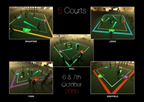
5 Courts is a revolutionary multi-player, multi-site game and arts space played across five cities: York, Leeds, Bradford and Sheffield in October 2006. Players use their own bodies to send balls of projected light across the playing space, aiming for goals representing the other cities. Entirely interactive, it's a competition to see which city has the least light balls in their square when the time runs out. Designed to be aesthetically beautiful and great fun to play and watch, games are a minute long and run throughout the night. 5 Courts was conceived, designed and programmed by digital media artists KMA (Kit Monkman & Tom Wexler). The piece was commissioned by Illuminate as part of the Light Night festival. [blogged by Martin Rieser on Mobile Audience] |
22:55 Posted in Cyberart | Permalink | Comments (0) | Tags: future interfaces
Second Life client source code now available
LindenLab has announced the availability of the Second Life client source code
Users can download the code, inspect, compile, modify, and use within the guidelines of the GNU GPL version 2
22:53 Posted in Virtual worlds | Permalink | Comments (0) | Tags: virtual worlds
The Mind Gym Psychology Prize
Mind Gym Psychology Prize is a new prize for psychological research worth £10,000 that is being given for published or unpublished reports of well-founded, practical and imaginative research that explores or suggests ways to enhance psychological capability in the general population.
The scope of the competition covers what is loosely called 'practical psychology' and includes, for example, work on social influence, stress, creativity, optimism, time management and relationships. There is, of course, a very
large overlap with positive psychology.
The prize is sponsored by The Mind Gym Ltd, a human resource development company. The prize will be judged by The Mind Gym's academic board, which is comprised of Fellows of the British Psychological Society.
In addition to the prize money, the winner and runners-up will be invited to present their findings at a special event at the Royal Society of Arts in London, and will have their research publicised in a national newspaper, almost certainly 'The Times'.
The deadline for submissions is 1 MARCH 2007
The details and rules are available here
20:39 Posted in Research institutions & funding opportunities | Permalink | Comments (0) | Tags: funding opportunities