



Jan 07, 2007
From Technological to Virtual Art
Re-blogged from Networked Performance
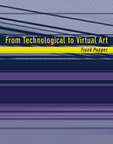
From Technological to Virtual Art by Frank Popper: In From Technological to Virtual Art, respected historian of art and technology Frank Popper traces the development of immersive, interactive new media art from its historical antecedents through today's digital, multimedia, and networked art. Popper shows that contemporary virtual art is a further refinement of the technological art of the late twentieth century and also a departure from it. What is new about this new media art, he argues, is its humanization of technology, its emphasis on interactivity, its philosophical investigation of the real and the virtual, and its multisensory nature. He argues further that what distinguishes the artists who practice virtual art from traditional artists is their combined commitment to aesthetics and technology. Their "extra-artistic" goals -- linked to their aesthetic intentions -- concern not only science and society but also basic human needs and drives.
23:34 Posted in Cyberart | Permalink | Comments (0) | Tags: cyberart
Imaging Place SL: The U.S./Mexico Border
Re-blogged from Networked Performance
Imaging Place SL: The U.S./Mexico Border by John (Craig) Freeman: Jan 5 - Feb 23, 2007: Ars Virtua: Gallery 2: Opening 7 - 9pm SLT(Pacific Time) Friday January 5, 2007. Go there
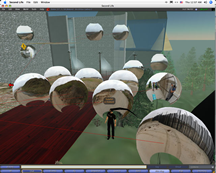
"Imaging Place," is a place-based, virtual reality art project. It takes the form of a user navigated, interactive computer program that combines panoramic photography, digital video, and three-dimensional technologies to investigate and document situations where the forces of globalization are impacting the lives of individuals in local communities. The goal of the project is to develop the technologies, the methodology and the content for truly immersive and navigable narrative, based in real places. For the past several months, Freeman has been implementing the "Imaging Place" project in Second Life.
When a denizen of Second Life first arrives at an Imaging Place SL Scene he, she or it sees on the ground a large black and white satellite photograph of the full disk of the Earth. An avatar can then walk over the Earth to a thin red line which leads to an adjacent higher level platform made of a high resolution aerial photograph of specific location from around the world. Mapped to the aerial images are networks of nodes constructed of primitive spherical geometry with panoramic photographs texture mapped to the interior.
The avatar can walk to the center of one of these nodes and use a first person perspective to view the image, giving the user the sensation of being immersed in the location. Streaming audio is localized to individual nodes providing narrative content for the scene. This content includes stories told by people who appear in the images, theory and ambient sound. When the avatar returns to the Earth platform, several rotating ENTER signs provide teleports to other "Imaging Place" scenes located at other places within the world of Second Life. In "Imaging Place SL: The U.S./Mexico Border," Freeman explores the issues, politics and personal memories of this contested space.
LIVE PERFORMANCE by Second Front: Friday, January 05, 2007 - 7 PM PST Second Front is the first dedicated performance art group in Second Life. To officially open JC Fremont's Installation at Ars Virtua, Second Front will be creating a realtime interpretive and site-specific performance based on JC Fremont's theme 'Borders' to compliment "Imaging Place SL: The U.S./Mexico Border."
23:32 Posted in Cyberart, Virtual worlds | Permalink | Comments (0) | Tags: second life
Sensorium: Embodied Experience, Technology, and Contemporary Art
Re-blogged from Networked Performance

The relationship between the body and electronic technology, extensively theorized through the 1980s and 1990s, has reached a new technosensual comfort zone in the early twenty-first century. In Sensorium, contemporary artists and writers explore the implications of the techno-human interface. Ten artists, chosen by an international team of curators, offer their own edgy investigations of embodied technology and the technologized body. These range from Matthieu Briand's experiment in "controlled schizophrenia" and Janet Cardiff and Georges Bures Miller's uneasy psychological soundscapes to Bruce Nauman's uncanny night visions and François Roche's destabilized architecture. The art in Sensorium--which accompanies an exhibition at the MIT List Visual Arts Center--captures the aesthetic attitude of this hybrid moment, when modernist segmentation of the senses is giving way to dramatic multisensory mixes or transpositions. Artwork by each artist appears with an analytical essay by a curator, all of it prefaced by an anchoring essay on "The Mediated Sensorium" by Caroline Jones.
In the second half of Sensorium, scholars, scientists, and writers contribute entries to an "Abecedarius of the New Sensorium." These short, playful pieces include Bruno Latour on "Air," Barbara Maria Stafford on "Hedonics," Michel Foucault (from a little-known 1966 radio lecture) on the "Utopian Body," Donna Haraway on "Compoundings," and Neal Stephenson on the "Viral." Sensorium is both forensic and diagnostic, viewing the culture of the technologized body from the inside, by means of contemporary artists' provocations, and from a distance, in essays that situate it historically and intellectually.
Copublished with The MIT List Visual Arts Center
23:27 Posted in Positive Technology events | Permalink | Comments (0) | Tags: cyberart
Technology Review: IBM's InfoViz software predictions
Technology Review interviewed Kristof Kloeckner, the vice president of strategy and technology for IBM's software group, to find out how software can be used to help people and businesses cope with the increasing amount of information, and how software will evolve as that information grows more complex.
Read the full interview
23:24 Posted in Information visualization | Permalink | Comments (0) | Tags: information visualization
Scientists have designed and built an immersive table tennis simulation that allows a human to compete against a computer
Via KurzweilAI.net
Scientists have designed and built an immersive table tennis simulation that allows a human to compete against a computer..
23:19 Posted in AI & robotics | Permalink | Comments (0) | Tags: artificial intelligence, robotics
Jan 06, 2007
Pushing the limits of imagination: mental practice for learning sequences
Pushing the limits of imagination: mental practice for learning sequences.
J Exp Psychol Learn Mem Cogn. 2007 Jan;33(1):254-61
Authors: Wohldmann EL, Healy AF, Bourne LE
In 2 experiments, the efficacy of motor imagery for learning to type number sequences was examined. Adults practiced typing 4-digit numbers. Then, during subsequent training, they either typed in the same or a different location, imagined typing, merely looked at each number, or performed an irrelevant task. Repetition priming (faster responses for old relative to new numbers) was observed on an immediate test and after a 3-month delay for participants who imagined typing. Improvement across the delay in typing old and new numbers was found for the imagined and actual typing conditions but not for the other conditions. The findings suggest that imagery can be used to acquire and retain representations of sequences and to improve general typing skill. ((c) 2007 APA, all rights reserved).
14:54 Posted in Mental practice & mental simulation | Permalink | Comments (0) | Tags: mental practice
Jan 02, 2007
7th International Conference on New Interfaces for Musical Expression

NIME 2007 CALL FOR PARTICIPATION: On behalf of the NIME07 Committee, we would like to invite you to be part of the 7th International Conference on New Interfaces for Musical Expression (NIME), organized by Harvestworks and New York University's (NYU) Music Technology Program in partnership with LEMUR and the NYU InteractiveTelecommunications Program (ITP).
We encourage contributions of the following kinds: * Papers (full-length, short-length, posters) * Demos * Live Performances * Installations. Complete submission guidelines are now available at http://www.nime.org/2007.
23:02 Posted in Creativity and computers | Permalink | Comments (0) | Tags: creativity and computers
Adolescent development of motor imagery
Adolescent development of motor imagery in a visually guided pointing task.
Conscious Cogn. 2006 Dec 28;
Authors: Choudhury S, Charman T, Bird V, Blakemore SJ
The development of action representation during adolescence was investigated using a visually guided pointing motor task (VGPT) to test motor imagery. Forty adolescents (24 males; mean age 13.1 years) and 33 adults (15 males; mean age 27.5 years) were instructed to both execute and imagine hand movements from a starting point to a target of varying size. Reaction time (RT) was measured for both Execution (E) and Imagery (I) conditions. There is typically a close association between time taken to execute and image actions in adults because action execution and action simulation rely on overlapping neural circuitry. Further, representations of actions are governed by the same speed-accuracy trade-off as real actions, as expressed by Fitts' Law. In the current study, performance on the VGPT in both adolescents and adults conformed to Fitts' Law in E and I conditions. However, the strength of association between E and I significantly increased with age, reflecting a refinement in action representation between adolescence and adulthood.
22:58 Posted in Mental practice & mental simulation | Permalink | Comments (0) | Tags: motor imagery, mental simulation
Temporal classification of multichannel near-infrared spectroscopy signals of motor imagery for developing a brain-computer interface
Temporal classification of multichannel near-infrared spectroscopy signals of motor imagery for developing a brain-computer interface.
Neuroimage. 2006 Dec 28;
Authors: Sitaram R, Zhang H, Guan C, Thulasidas M, Hoshi Y, Ishikawa A, Shimizu K, Birbaumer N
There has been an increase in research interest for brain-computer interface (BCI) technology as an alternate mode of communication and environmental control for the disabled, such as patients suffering from amyotrophic lateral sclerosis (ALS), brainstem stroke and spinal cord injury. Disabled patients with appropriate physical care and cognitive ability to communicate with their social environment continue to live with a reasonable quality of life over extended periods of time. Near-infrared spectroscopy is a non-invasive technique which utilizes light in the near-infrared range (700 to 1000 nm) to determine cerebral oxygenation, blood flow and metabolic status of localized regions of the brain. In this paper, we describe a study conducted to test the feasibility of using multichannel NIRS in the development of a BCI. We used a continuous wave 20-channel NIRS system over the motor cortex of 5 healthy volunteers to measure oxygenated and deoxygenated hemoglobin changes during left-hand and right-hand motor imagery. We present results of signal analysis indicating that there exist distinct patterns of hemodynamic responses which could be utilized in a pattern classifier towards developing a BCI. We applied two different pattern recognition algorithms separately, Support Vector Machines (SVM) and Hidden Markov Model (HMM), to classify the data offline. SVM classified left-hand imagery from right-hand imagery with an average accuracy of 73% for all volunteers, while HMM performed better with an average accuracy of 89%. Our results indicate potential application of NIRS in the development of BCIs. We also discuss here future extension of our system to develop a word speller application based on a cursor control paradigm incorporating online pattern classification of single-trial NIRS data.
22:57 Posted in Brain-computer interface, Mental practice & mental simulation | Permalink | Comments (0) | Tags: motor imagery