



Oct 07, 2007
Teleglass T4-N wearable monitor
Via Pink Tentacle
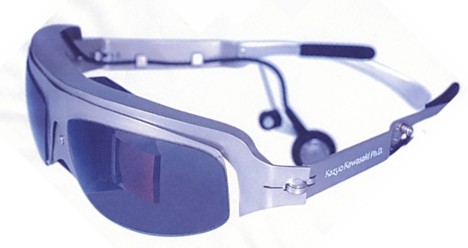
The Teleglass T4-N wearable monitor weighs 30 grams and features titanium frames by eyeglass designer Kazuo Kawasaki. The device supports any NTSC-capable video player (including iPods) and delivers images directly to the eye via a pair of tiny monitors tucked away behind the lenses. The 640 x 480 screen resolution at close proximity simulates the effect of watching a 45-inch screen from 2 meters (6 feet) away.
500 sets are available through the Scalar website, where they sell for 134,400 yen ($1,150) each.
23:40 Posted in Wearable & mobile | Permalink | Comments (0) | Tags: wearable
Decode

Decode is a multimedia exhibition showcasing the work of two artists: Jason Van Anden and Christy Matson. Experienced in traditional art-making processes - Van Anden in sculpture and Matson in weaving - both have integrated time honored methods with digital technologies. From sounds and projections to video games and robots, Van Anden and Matson’s work engages the senses and challenges perceptions in compelling and innovative ways.
Manchester Craftsmen’s Guild’s Kerr Gallery will feature Jason Van Anden’s life-sized emotive robots, Neil and Iona. The week preceding this opening, Van Anden will conduct a workshop with 10-12 students from Pittsburgh Schools at the Manchester Craftsmen’s Guild on Pittsburgh’s North side. Students participating in this workshop will be challenged to collaborate in the creation of an interactive piece that explores improvisational concepts and is inspired by the artist’s online videogame Farklempt!
Manchester Craftsmen’s Guild is a multi-discipline arts and learning center that complements traditional humanities education with studio-based art and performance programs that help catalyze academic achievement. MCG Youth serves Pittsburgh School students through year-round programs and, in conjunction with MCG Arts, promotes cultural discovery and empathy by connecting diverse accomplished artists to young people and their communities.
Neil and Iona made possible thanks to the generous support of the Finishing Fund.
23:36 Posted in Cyberart | Permalink | Comments (0) | Tags: cyberart
Mastery of the mind east and west
Mastery of the Mind East and West: Excellence in Being and Doing and Everyday Happiness.
Ann N Y Acad Sci. 2007 Sep 28;
Authors: Brown DP
Western psychological research on positive psychology and Buddhism have recently converged in their emphasis on the development of positive states, like states of excellence and veryday happiness. Yet, these traditions differ in their approaches to positive states, with respect to a state-trait and doing-being distinction. Western scientific research on peak performance emphasizes discontinuous, time-limited peak performance states wherein individuals do things extraordinarily well in sports and in the arts. The Eastern spiritual traditions emphasize continuous excellence of being, in the form of traits or character strengths. In both traditions mental imagery is a key ingredient to excellence training. With respect to everyday happiness, Western psychological research has focused on the role of meaning systems in the transformation of flow states into vital engagement in everyday life, while Buddhism stresses the role of meditation training to gain mastery over all levels of mind that leads to everyday happiness. Rorschach and tachistoscopic research on advanced meditators suggests that advance meditators have gained unusual mastery over states of mind not yet documented in the Western psychological research on positive psychology.
22:20 Posted in Meditation & brain | Permalink | Comments (0) | Tags: meditation, neuroscience
Promoting mindfulness in psychotherapists in training influences the treatment results of their patients
Promoting mindfulness in psychotherapists in training influences the treatment results of their patients: a randomized, double-blind, controlled study.
Psychother Psychosom. 2007;76(6):332-8
Authors: Grepmair L, Mitterlehner F, Loew T, Bachler E, Rother W, Nickel M
BACKGROUND: All therapists direct their attention in some manner during psychotherapy. A special form of directing attention, 'mindfulness', is recommended. This study aimed to examine whether, and to what extent, promoting mindfulness in psychotherapists in training (PiT) influences the treatment results of their patients. METHODS: The therapeutic course and treatment results of 124 inpatients, who were treated for 9 weeks by 18 PiTs, were compared. The PiTs were randomly assigned to 1 of 2 groups: (i) those practicing Zen meditation (MED; n = 9 or (ii) control group, which did not perform meditation (noMED; n = 9). The results of treatment (according to the intent-to-treat principle) were examined using the Session Questionnaire for General and Differential Individual Psychotherapy (STEP), the Questionnaire of Changes in Experience and Behavior (VEV) and the Symptom Checklist (SCL-90-R). RESULTS: Compared to the noMED group (n = 61), the patients of PiTs from the MED group (n = 63) had significantly higher evaluations (according to the intent-to-treat principle) for individual therapy on 2 STEP scales, clarification and problem-solving perspectives. Their evaluations were also significantly higher for the entire therapeutic result on the VEV. Furthermore, the MED group showed greater symptom reduction than the noMED group on the Global Severity Index and 8 SCL-90-R scales, including Somatization, Insecurity in Social Contact, Obsessiveness, Anxiety, Anger/Hostility, Phobic Anxiety, Paranoid Thinking and Psychoticism. CONCLUSIONS: This study indicates that promoting mindfulness in PiTs could positively influence the therapeutic course and treatment results in their patients.
22:16 | Permalink | Comments (0) | Tags: mindfulness
NIPS 2007 WORKSHOP: Robotics Challenges for Machine Learning
Dates: 7-8 December, 2007
Organizers:
Jan Peters (Max Planck Institute for Biological Cybernetics & USC), Marc Toussaint (Technical University of Berlin)
http://www.robot-learning.de
email: nips07@robot-learning.de
Acceptance Notification: October 26, 2007
22:12 Posted in AI & robotics | Permalink | Comments (0) | Tags: artificial intelligence, robotics
Oct 01, 2007
Serenata: Bang & Olufsen New Music Phone
Via Textually.org

a Bang & Olufsen's music phone, called Serenata.
"The phone can store up to 1,000 MP3 tracks in its 4GB, plus 25MB of memory, and can handle AAC and WMA audio tracks too. The phone's high resolution also enables it to display album artwork, B&O says."
As with any Bang & Olufsen product, style is the watchword here. Inhouse designer David Lewis said his inspiration came from the smooth pebbles he used to see on seaside walks as a child. The result is a smooth, horseshoe-shaped phone with a clickwheel at the top. This is paired with a 'sensi-touch' 2.4-inch colour screen below."
22:47 Posted in Wearable & mobile | Permalink | Comments (0) | Tags: mobile phones
2007 NSF Scientific Visualization Awards Announced

(Computer tomography scanner imagery of the sinuses of a patient)
The National Science Foundation (NSF) along with the journal Science, published by the American Association for the Advancement of Science (AAAS), today announced the winners of their fifth annual International Science and Technology Visualization Challenge.
Illustrators, photographers, computer programmers, and graphics specialists from around the world were invited to submit visualizations that would intrigue, explain and educate. More than 200 entries were received from 23 countries, representing every continent except the Arctic and Antarctica.
"Breakthroughs in science and engineering are often portrayed in movies and literature as 'ah-ha!' moments. What these artists and communicators have given us are similar experiences, showing us how bats fly or how nicotine becomes physically addictive," said Jeff Nesbit, director of NSF's Office of Legislative and Public Affairs. "We look at their visualizations, and we understand."
Winning entries can be viewed on the NSF Web site, the Science website (www.sciencemag.org ), and in the print issue of Science. First place and honorable mention winners are listed below. A number of semifinalist awards were made as well. Note: only two researchers are listed in this release; in some instances several others contributed to the winning visualization. No first place or honorable mention awards were made this year in the Illustrations category.
22:35 Posted in Information visualization | Permalink | Comments (0) | Tags: information visualization
Oribotics

Part of the Melbourne International Arts FestivalOribotics [network] is a unique art and technology installation in the Atrium at Federation Square, drawing on cutting edge research in biology, computing, and scientific origami. Discover living biomimetic works attached to the glass panes of the Atrium’s Fracture Galleries.
Seek out Oribotics [network] and you will find robots rooted to the architecture, surviving on solar power, with their faceted folded mechanical blossoms attracting data, moving in response to the physical audience and stimuli from online users at www.oribotics.net. In Oribotics [network] each robot is individually connected to the vastness of the internet, and to local mobile phone, Bluetooth and wifi networks, enabling interaction via mobile devices and the web.
Bring your laptop, PDA, or mobile phone, start up your bluetooth and wifi connections and ‘network’ with the Oribots. Or point your browser to www.oribotics.net and explore the virtual world of the oribots digestion. Oribotics [network]Matthew Gardiner’s research into the hybrid art / science field that fuses the ancient art of origami with robotic technology. Witness the results of four years development of intricately folded designs integrated with robotic mechanisms. continues multimedia artist
This is the most complex generation of oribots to date. With support from Arts Victoria Innovation fund, we are powering ahead into new realms.
At the moment we are working with compact computers (about the size of a greeting card), Micro Linear Actuators, designing flowers from water bombs, and using some of the strongest sticky tape in the world… If all that sounds a little odd, then you’d better read the blog. - Matthew Gardiner
Oribotics.net is designed and coded by Matthew Gardiner & My Trinh Gardiner at http://www.airstrip.com.au.
22:26 Posted in AI & robotics, Cyberart | Permalink | Comments (0) | Tags: robotics, cyberart
Survival in HIV-1-positve adults practicing psychological or spiritual activities
Survival in HIV-1-positve adults practicing psychological or spiritual activities for one year.
Altern Ther Health Med. 2007 Sep-Oct;13(5):18-20, 22-4
Authors: Fitzpatrick AL, Standish LJ, Berger J, Kim JG, Calabrese C, Polissar N
OBJECTIVE: To investigate associations between survival and use of psychological and spiritual activities practiced over 1 year in HIV-positive (HIV+) patients. METHOD: Nine hundred one HIV+ adults living in the United States using at least 1 form of complementary and alternative medicine (CAM) completed a questionnaire 3 times between 1995 and 1998. Information on specific mind-body therapies included psychotherapy (group therapy, support groups, individual therapy) and spiritual therapies (self-defined "spiritual" activities, prayer, meditation, affirmations, psychic healing, visualizations). Subsequent death was ascertained from the National Death Index (NDI). Cox proportional-hazards regression assessed risk of death through 1999. RESULTS: Use of any psychological therapy reported in both the 6-month and 12-month follow-up questionnaires (1 year continuous use) was associated with a reduced risk of death (hazard ratio [HR]: 0.5, 95% CI: 0.3-0.9) adjusted for income, clinical acquired immune deficiency syndrome, CD4 count, smoking, alcohol use, and use of antiretroviral therapy or highly active antiretroviral therapy (HAART). The relationship between spiritual activities and survival was modified by use of HAART, which may reflect severity of illness. Individuals not currently using HAART and who participated in spiritual activities over the previous year were found to be at a reduced risk of death (HR: 0.4, 95% CI: 0.2-0.9) compared to those not practicing spirituality. CONCLUSIONS: Participation in spiritual and psychological therapies may be related to beneficial clinical outcomes in HIV+ individuals, including improved survival. Due to the self-selection of therapies in this observational cohort, it is not possible to distinguish use of the therapies from other characteristics or activities of the people participating in them.
22:19 Posted in Meditation & brain | Permalink | Comments (0) | Tags: meditation, neuroscience
Relationships between mindfulness practice and wellbeing
Relationships between mindfulness practice and levels of mindfulness, medical and psychological symptoms and well-being in a mindfulness-based stress reduction program.
J Behav Med. 2007 Sep 25;
Authors: Carmody J, Baer RA
Relationships were investigated between home practice of mindfulness meditation exercises and levels of mindfulness, medical and psychological symptoms, perceived stress, and psychological well-being in a sample of 174 adults in a clinical Mindfulness-Based Stress Reduction (MBSR) program. This is an 8- session group program for individuals dealing with stress-related problems, illness, anxiety, and chronic pain. Participants completed measures of mindfulness, perceived stress, symptoms, and well-being at pre- and post-MBSR, and monitored their home practice time throughout the intervention. Results showed increases in mindfulness and well-being, and decreases in stress and symptoms, from pre- to post-MBSR. Time spent engaging in home practice of formal meditation exercises (body scan, yoga, sitting meditation) was significantly related to extent of improvement in most facets of mindfulness and several measures of symptoms and well-being. Increases in mindfulness were found to mediate the relationships between formal mindfulness practice and improvements in psychological functioning, suggesting that the practice of mindfulness meditation leads to increases in mindfulness, which in turn leads to symptom reduction and improved well-being.
22:18 Posted in Meditation & brain | Permalink | Comments (0) | Tags: meditation, neuroscience
Artificial brain falls for optical illusions
Via New Scientist
A computer program that emulates the human brain falls for the same optical illusions humans do.
It suggests the illusions are a by-product of the way babies learn to filter their complex surroundings. Researchers say this means future robots must be susceptible to the same tricks as humans are in order to see as well as us.
For some time, scientists have believed one class of optical illusions result from the way the brain tries to disentangle the colour of an object and the way it is lit. An object may appear brighter or darker, either because of the shade of its colour, or because it is in bright light or shadows.
The brain learns how to tackle this through trial and error when we are babies, the theory goes. Mostly it gets it right, but occasionally a scene contradicts our previous experiences. The brain gets it wrong and we perceive an object lighter or darker than it really is – creating an illusion
Read full article
22:15 Posted in AI & robotics | Permalink | Comments (0) | Tags: artificial intelligence