




Oct 14, 2007
Neuropod
17:55 Posted in Research tools | Permalink | Comments (0) | Tags: neuroscience
Oct 13, 2007
No more SMS from Jesus
Via Experientia
In this thought-provoking article entitled "No more SMS from Jesus: ubicomp, religion and techno-spiritual practices", Genevieve Bell, a researcher in anthropology and director of user experience at Intel, discusses the use of information technologies in religious practices:
Abstract. Over the last decade, new information and communication technologies have lived a secret life. For individuals and institutions around the world, this constellation of mobile phones, personal computers, the internet, software, games, and other computing objects have supported a complex set of religious and spiritual needs. In this paper, I offer a survey of emerging and emergent techno-spiritual practices, and the anxieties surrounding their uptake. I am interested in particular in the ways in which religious uses of technology represent not only a critique of dominant visions of technology’s futures, but also suggest a very different path(s) for ubiquitous computing's technology envisioning and development
The article was presented at the conference Ubicomp 2006. Full text is available here
15:50 Posted in Technology & spirituality | Permalink | Comments (0) | Tags: technology, spirituality
Death by PowerPoint
Via Leeander.com
Want to make a successful powerpoint presentation? Keep these few simple rules in mind (credits to Alexei Kapterev)
15:35 Posted in Information visualization | Permalink | Comments (0) | Tags: information visualization
Oct 12, 2007
The Hands-on Computer

Perceptive Pixel’s Interactive Media Wall (aka the Multi-Touch wall) got the 2007 Breakthrough Award, the annual prize assigned by the journal Popular Mechanics to "cutting-edge projects and ideas leading to a better world". The Minority Report interface supports diverse functions, such as navigate, locate, and manipulate information, all handled through multi-touch gesturing.
22:10 Posted in Future interfaces | Permalink | Comments (0) | Tags: future interfaces
Cue-exposure therapy to decrease alcohol craving in virtual environment
Cue-exposure therapy to decrease alcohol craving in virtual environment.
Cyberpsychol Behav. 2007 Oct;10(5):617-23
Authors: Lee JH, Kwon H, Choi J, Yang BH
During abstinence from alcohol, craving is elicited by the cues and contexts previously associated with alcohol, which contribute to relapse. To prevent the craving and relapse experienced by alcoholics, cue-exposure therapy (CET) has been used to extinguish the association between alcohol and alcohol-related cues and contexts. This study applied CET, using a virtual reality (VR) system, to eight members of an Alcoholics Anonymous group for eight sessions. Cues and contexts most likely to elicit an urge to drink were selected through a preliminary survey in order to compose VR-CET scenarios: a glass, a bottle, food, and a bar were judged to be the most tempting for people in alcohol dependence and abstinence. Using these cues and contexts, a Japanese-style pub and a western bar were created. Each session was administered for 30 minutes by a psychiatrist and included an introduction, immersion, VR navigation, interviews about feelings, and self-report questionnaires about cravings. The eight sessions consisted of initial and closing sessions and person-, object-, and situation-focused sessions. As a result, a reduction in cue-elicited craving after VR-CET was reported. A mean score of 15.75 (SD = 10.91) on the Alcohol Urge Questionnaire in the first session decreased to 11.50 (SD = 5.76) in the final session. This study suggests that using virtual reality can enhance the effectiveness of CET.
21:52 Posted in Cybertherapy | Permalink | Comments (0) | Tags: virtual reality, cybertherapy
Psychosocial stress evoked by a virtual audience
Psychosocial stress evoked by a virtual audience: relation to neuroendocrine activity.
Cyberpsychol Behav. 2007 Oct;10(5):655-62
Authors: Kelly O, Matheson K, Martinez A, Merali Z, Anisman H
A modified version of the Trier Social Stress Test (TSST) was employed to determine whether exposure to a virtual audience using virtual reality (VR) technology would prompt an increase of neuroendocrine activity comparable to that prompted by a real audience. Following an anticipatory period, participants completed a speech or a speech-plus-math challenge in front of either a virtual audience, a panel of judges they were led to believe was behind a one-way mirror, or an audience comprised of confederates. An additional group that had prepared a speech was simply directed to observe the virtual audience but did not deliver the speech. Finally, a control group completed questionnaires for the duration of the experiment. Cortisol samples were obtained upon arrival to the laboratory, just before the challenge, and 15 and 30 minutes after the task. Participants also completed a measure assessing stressor appraisals of the task before and after the challenge. Anticipation of the task was associated with a modest increase of cortisol levels, and a further rise of cortisol was evident in response to the challenge. The neuroendocrine changes evoked by the virtual audience were comparable to those elicited by the imagined audience (behind the one-way mirror) but less than changes evoked by the panel of confederates. Stressor appraisals were higher post-challenge compared to those reported prior to the task; however, appraisals were similar across each group. These data suggest that VR technology may be amenable to evaluating the impact of psychosocial stressors such as the TSST.
21:51 Posted in Virtual worlds | Permalink | Comments (0) | Tags: virtual reality
Stop smoking programs go mobile
Via Textually.org [via Reuters]
Colorado's STEPP and Denver-based ad agency Cactus developed a message system on cell phones with an Internet quit program.
Initially aimed at high school students in Colorado, the state hopes to soon share its fledgling FixNixer program as a technique for all age groups and geographies.
QuitNet.com, one of the most established Web sites for quitting, is also considering more tailored messages to users of its site and a foray into mobile, while quit support groups are popping up on social networks MySpace and Facebook.
18:08 Posted in Persuasive technology | Permalink | Comments (0) | Tags: persuasive technology
Brain-computer interface for Second Life
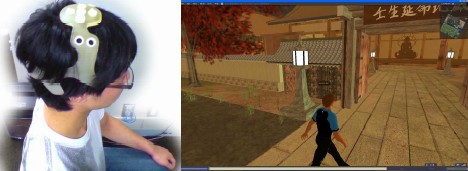
18:04 Posted in Brain-computer interface, Virtual worlds | Permalink | Comments (0) | Tags: brain-computer interface, virtual worlds
Oct 10, 2007
Google makes virtual world real
Via KurzweilAI.net (CNET News.Com)

Virtual-worlds platform developer Multiverse Network is set to announce a partnership tuesday that will allow anyone to create a new online interactive 3D environment with just about any model from Google's online repository of 3D models, its 3D Warehouse, as well as terrain from Google Earth.
Another project is SceneCaster, a new technology unveiled at last week's Demo conference that allows anyone to make 3D "scenes" incorporating models from the 3D Warehouse that can then be attached to blogs or Facebook pages or even to Flickr.
23:24 Posted in Virtual worlds | Permalink | Comments (0) | Tags: virtual reality
Brain radiator
Via New Scientist Invention Blog

Researchers at Yamaguchi University in Japan have applied for a patent describing a heat pipe installed over the brain that would allow it to be cooled and prevent epileptic fits in susceptible people.
read full brain radiator patent
22:57 Posted in Neurotechnology & neuroinformatics | Permalink | Comments (0) | Tags: neuroinformatics
Oct 09, 2007
Concentrative meditation enhances preattentive processing
Concentrative meditation enhances preattentive processing: a mismatch negativity study.
Neuroreport. 2007 Oct 29;18(16):1709-1712
Authors: Srinivasan N, Baijal S
23:21 Posted in Meditation & brain | Permalink | Comments (0) | Tags: meditation, neuroscience
Preservation of motor programs in paraplegics
Preservation of motor programs in paraplegics as demonstrated by attempted and imagined foot movements.
Neuroimage. 2007 Aug 23;
Authors: Hotz-Boendermaker S, Funk M, Summers P, Brugger P, Hepp-Reymond MC, Curt A, Kollias SS
Execution and imagination of movement activate distinct neural circuits, partially overlapping in premotor and parietal areas, basal ganglia and cerebellum. Can long-term deafferented/deefferented patients still differentiate attempted from imagined movements? The attempted execution and motor imagery network of foot movements have been investigated in nine chronic complete spinal cord-injured (SCI) patients using fMRI. Thorough behavioral assessment showed that these patients were able to differentiate between attempted execution and motor imagery. Supporting the outcome of the behavioral assessment, fMRI disclosed specific patterns of activation for movement attempt and for motor imagery. Compared with motor execution data of healthy controls, movement attempt in SCI patients revealed reduced primary motor cortex activation at the group level, although activation was found in all single subjects with a high variability. Further comparisons with healthy subjects revealed that during attempt and motor imagery, SCI patients show enhanced activation and recruitment of additional regions in the parietal lobe and cerebellum that are important in sensorimotor integration. These findings reflect central plastic changes due to altered input and output and suggest that SCI patients may require additional cognitive resources to perform these tasks that may be one and the same phenomenon, or two versions of the same phenomenon, with quantitative differences between the two. Nevertheless, the retained integrity of movement attempt and motor imagery networks in SCI patients demonstrates that chronic paraplegics can still dispose of the full motor programs for foot movements and that therefore, attempted and imagined movements should be integrated in rehabilitative strategies.
23:20 Posted in Mental practice & mental simulation | Permalink | Comments (0) | Tags: mental practice
Serious Games approaches to challenging racism in the workplace
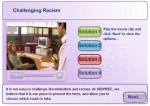
The Institute of Digital Learning at the University of Wales, Newport (UK) has been successfully applying serious games positive technologies as a mechanism of empowering workers with virtual experience and knowledge transfer that allows them to deal with situations relating to Equality & Diversity as they arise in a workplace settings.
For further information and to access the serious games and wider etraining as free resources please visit http://equal.newport.ac.uk
Matt Chilcott and Nick Savage
Institute of Digital Learning, University of Wales, Newport
10:47 Posted in Serious games | Permalink | Comments (0) | Tags: serious gaming
Oct 08, 2007
Mind-reading computers respond to users' moods
Researchers at Tufts University are developing a system that allows to monitor user experiences while working. The system is based on functional near-infrared spectroscopy (fNIRS) technology that uses light to monitor brain blood flow as a proxy for workload stress a user may experience when performing an increasingly difficult task to respond to users' thoughts of frustration or boredom.
New evaluation techniques that monitor user experiences while working with computers are increasingly necessary," said Robert Jacob, computer science professor and researcher. "One moment a user may be bored, and the next moment, the same user may be overwhelmed. Measuring mental workload, frustration and distraction is typically limited to qualitatively observing computer users or to administering surveys after completion of a task, potentially missing valuable insight into the users' changing experiences."
00:22 Posted in Emotional computing | Permalink | Comments (0) | Tags: stress
Nintendo Wii used in stroke rehabilitation
Via Medgadget
Doctors at Sister Kenny Rehabilitation Institute at Abbott Northwestern Hospital are using the new Nintendo video game console to help stroke victims recover.
We saw 77-year-old Jerry Pope getting a workout playing a virtual tennis game. He suffered a debilitating stroke in June. Pope said that the Wii has enabled him to regain his balance, and the use of his arms."Not only am I moving the hand, my feet are moving, I am jumping around, it is as if I am really playing the game. It is motivational, makes you feel like you are progressing, even if you are not and that helps you," he said.
Before his stroke, Pope was a semi-pro tennis player. He initially tried the traditional exercises recommended by physical therapists, but found them repetitive and boring.
He says the Wii is fun and it is helping him make progress. His therapists agree.
Right now just a few hospitals around the nation are trying this, but the Army has also jumped on board. Injured soldiers in Landstuhl, Germany are also regaining their strength by playing virtual games on the Wii.
00:13 Posted in Cybertherapy | Permalink | Comments (0) | Tags: cybertherapy
MIT develops new algorithm to help create prosthetic devices
Neural prosthetic devices represent an engineer's approach to treating paralysis and amputation. Here, electronics are used to monitor the neural signals that reflect an individual's intentions for the prosthesis or computer they are trying to use. Algorithms form the link between neural signals that are recorded, and the user's intentions that are decoded to drive the prosthetic device.Over the past decade, efforts at prototyping these devices have divided along various boundaries related to brain regions, recording modalities, and applications. The MIT technique provides a common framework that underlies all these various efforts.
The research uses a method called graphical models that has been widely applied to problems in computer science like speech-to-text or automated video analysis. The graphical models used by the MIT team are diagrams composed of circles and arrows that represent how neural activity results from a person's intentions for the prosthetic device they are using.
The diagrams represent the mathematical relationship between the person's intentions and the neural manifestation of that intention, whether the intention is measured by an electoencephalography (EEG), intracranial electrode arrays or optical imaging. These signals could come from a number of brain regions, including cortical or subcortical structures.
Until now, researchers working on brain prosthetics have used different algorithms depending on what method they were using to measure brain activity. The new model is applicable no matter what measurement technique is used, according to Srinivasan. "We don't need to reinvent a new paradigm for each modality or brain region," he said.
00:09 Posted in Neurotechnology & neuroinformatics | Permalink | Comments (0) | Tags: neuroinformatics