




Jan 09, 2007
CFP - Interacting with Immersive Worlds
An International Conference presented by the Interactive Arts and Science Program - Brock University, St. Catharines, Ontario
JUNE 5-6, 2007
Keynote Speakers:
Mihaly Csikszentmihalyi, Director of the Quality of Life Research Center at the Drucker School, Claremont Graduate University
James Paul Gee, Tashia Morgridge Professor of Reading, University of Wisconsin at Madison (sponsored by Owl Children’s Trust and the Brock Research Institute for Youth Studies)
Chris Csikszentmihalyi, Director of the Computing Culture group at the MIT Media Lab
Denis Dyack, Director/President, Silicon Knights
The primary focus of this conference is to explore the growing cultural importance of interactive media. All scholarship on digital interactive media (such as computer games, mixed realities and interactive fiction), as well as users (including adults and children), will be considered in one of four broad conference streams:
Theory of Immersive Worlds explores: i. the theory of interactivity, from perspectives such as narrative and gameplay (ludology); ii. analyses of the cultural and psychological effects of immersive worlds.
Creative Practices in Immersion examines interactive new media art, and its exploration of new idioms and challenges in immersive worlds.
Immersive Worlds in Education examines the application of immersive technologies to teaching and learning.
Immersive Worlds in Entertainment examines entertainment applications of immersive technologies.
Visit the conference website for details
23:20 Posted in Virtual worlds | Permalink | Comments (0) | Tags: virtual reality
A model of (en)action to approach embodiment
Via VRoot
A model of (en)action to approach embodiment: a cornerstone for the design of virtual environments for learning
Virtual Reality Journal, Springer London, Volume 10, Number 3-4 / December, 2006, Pages 253-269.
Author: Daniel Mellet-d’Huart
This paper presents a model of (en)action from a conceptual and theoretical point of view. This model is used to provide solid bases to overcome the complexity of designing virtual environments for learning (VEL). It provides a common grounding for trans-disciplinary collaborations where embodiment can be perceived as the cornerstone of the project. Where virtual environments are concerned, both computer scientists and educationalists have to deal with the learner/user’s body; therefore the model provides tools with which to approach both human actions and learning processes within a threefold model. It is mainly based on neuroscientific research, including enaction and the neurophysiology of action.
23:05 Posted in Enactive interfaces, Virtual worlds | Permalink | Comments (0) | Tags: enactive interfaces
5 Courts
|
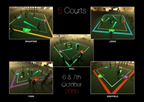
5 Courts is a revolutionary multi-player, multi-site game and arts space played across five cities: York, Leeds, Bradford and Sheffield in October 2006. Players use their own bodies to send balls of projected light across the playing space, aiming for goals representing the other cities. Entirely interactive, it's a competition to see which city has the least light balls in their square when the time runs out. Designed to be aesthetically beautiful and great fun to play and watch, games are a minute long and run throughout the night. 5 Courts was conceived, designed and programmed by digital media artists KMA (Kit Monkman & Tom Wexler). The piece was commissioned by Illuminate as part of the Light Night festival. [blogged by Martin Rieser on Mobile Audience] |
22:55 Posted in Cyberart | Permalink | Comments (0) | Tags: future interfaces
Second Life client source code now available
LindenLab has announced the availability of the Second Life client source code
Users can download the code, inspect, compile, modify, and use within the guidelines of the GNU GPL version 2
22:53 Posted in Virtual worlds | Permalink | Comments (0) | Tags: virtual worlds
The Mind Gym Psychology Prize
Mind Gym Psychology Prize is a new prize for psychological research worth £10,000 that is being given for published or unpublished reports of well-founded, practical and imaginative research that explores or suggests ways to enhance psychological capability in the general population.
The scope of the competition covers what is loosely called 'practical psychology' and includes, for example, work on social influence, stress, creativity, optimism, time management and relationships. There is, of course, a very
large overlap with positive psychology.
The prize is sponsored by The Mind Gym Ltd, a human resource development company. The prize will be judged by The Mind Gym's academic board, which is comprised of Fellows of the British Psychological Society.
In addition to the prize money, the winner and runners-up will be invited to present their findings at a special event at the Royal Society of Arts in London, and will have their research publicised in a national newspaper, almost certainly 'The Times'.
The deadline for submissions is 1 MARCH 2007
The details and rules are available here
20:39 Posted in Research institutions & funding opportunities | Permalink | Comments (0) | Tags: funding opportunities