




Jan 07, 2007
From Technological to Virtual Art
Re-blogged from Networked Performance
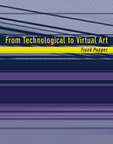
From Technological to Virtual Art by Frank Popper: In From Technological to Virtual Art, respected historian of art and technology Frank Popper traces the development of immersive, interactive new media art from its historical antecedents through today's digital, multimedia, and networked art. Popper shows that contemporary virtual art is a further refinement of the technological art of the late twentieth century and also a departure from it. What is new about this new media art, he argues, is its humanization of technology, its emphasis on interactivity, its philosophical investigation of the real and the virtual, and its multisensory nature. He argues further that what distinguishes the artists who practice virtual art from traditional artists is their combined commitment to aesthetics and technology. Their "extra-artistic" goals -- linked to their aesthetic intentions -- concern not only science and society but also basic human needs and drives.
23:34 Posted in Cyberart | Permalink | Comments (0) | Tags: cyberart
Imaging Place SL: The U.S./Mexico Border
Re-blogged from Networked Performance
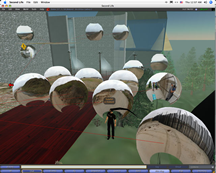
Imaging Place SL: The U.S./Mexico Border by John (Craig) Freeman: Jan 5 - Feb 23, 2007: Ars Virtua: Gallery 2: Opening 7 - 9pm SLT(Pacific Time) Friday January 5, 2007. Go there
"Imaging Place," is a place-based, virtual reality art project. It takes the form of a user navigated, interactive computer program that combines panoramic photography, digital video, and three-dimensional technologies to investigate and document situations where the forces of globalization are impacting the lives of individuals in local communities. The goal of the project is to develop the technologies, the methodology and the content for truly immersive and navigable narrative, based in real places. For the past several months, Freeman has been implementing the "Imaging Place" project in Second Life.
When a denizen of Second Life first arrives at an Imaging Place SL Scene he, she or it sees on the ground a large black and white satellite photograph of the full disk of the Earth. An avatar can then walk over the Earth to a thin red line which leads to an adjacent higher level platform made of a high resolution aerial photograph of specific location from around the world. Mapped to the aerial images are networks of nodes constructed of primitive spherical geometry with panoramic photographs texture mapped to the interior.
The avatar can walk to the center of one of these nodes and use a first person perspective to view the image, giving the user the sensation of being immersed in the location. Streaming audio is localized to individual nodes providing narrative content for the scene. This content includes stories told by people who appear in the images, theory and ambient sound. When the avatar returns to the Earth platform, several rotating ENTER signs provide teleports to other "Imaging Place" scenes located at other places within the world of Second Life. In "Imaging Place SL: The U.S./Mexico Border," Freeman explores the issues, politics and personal memories of this contested space.
LIVE PERFORMANCE by Second Front: Friday, January 05, 2007 - 7 PM PST Second Front is the first dedicated performance art group in Second Life. To officially open JC Fremont's Installation at Ars Virtua, Second Front will be creating a realtime interpretive and site-specific performance based on JC Fremont's theme 'Borders' to compliment "Imaging Place SL: The U.S./Mexico Border."
23:32 Posted in Cyberart, Virtual worlds | Permalink | Comments (0) | Tags: second life
Sensorium: Embodied Experience, Technology, and Contemporary Art
Re-blogged from Networked Performance

The relationship between the body and electronic technology, extensively theorized through the 1980s and 1990s, has reached a new technosensual comfort zone in the early twenty-first century. In Sensorium, contemporary artists and writers explore the implications of the techno-human interface. Ten artists, chosen by an international team of curators, offer their own edgy investigations of embodied technology and the technologized body. These range from Matthieu Briand's experiment in "controlled schizophrenia" and Janet Cardiff and Georges Bures Miller's uneasy psychological soundscapes to Bruce Nauman's uncanny night visions and François Roche's destabilized architecture. The art in Sensorium--which accompanies an exhibition at the MIT List Visual Arts Center--captures the aesthetic attitude of this hybrid moment, when modernist segmentation of the senses is giving way to dramatic multisensory mixes or transpositions. Artwork by each artist appears with an analytical essay by a curator, all of it prefaced by an anchoring essay on "The Mediated Sensorium" by Caroline Jones.
In the second half of Sensorium, scholars, scientists, and writers contribute entries to an "Abecedarius of the New Sensorium." These short, playful pieces include Bruno Latour on "Air," Barbara Maria Stafford on "Hedonics," Michel Foucault (from a little-known 1966 radio lecture) on the "Utopian Body," Donna Haraway on "Compoundings," and Neal Stephenson on the "Viral." Sensorium is both forensic and diagnostic, viewing the culture of the technologized body from the inside, by means of contemporary artists' provocations, and from a distance, in essays that situate it historically and intellectually.
Copublished with The MIT List Visual Arts Center
23:27 Posted in Positive Technology events | Permalink | Comments (0) | Tags: cyberart
Technology Review: IBM's InfoViz software predictions
Technology Review interviewed Kristof Kloeckner, the vice president of strategy and technology for IBM's software group, to find out how software can be used to help people and businesses cope with the increasing amount of information, and how software will evolve as that information grows more complex.
Read the full interview
23:24 Posted in Information visualization | Permalink | Comments (0) | Tags: information visualization
Scientists have designed and built an immersive table tennis simulation that allows a human to compete against a computer
Via KurzweilAI.net
Scientists have designed and built an immersive table tennis simulation that allows a human to compete against a computer..
23:19 Posted in AI & robotics | Permalink | Comments (0) | Tags: artificial intelligence, robotics