




Jun 06, 2006
Blushing Light
Re-blogged from Mocoloco

The Blushing Light designed by Nadine Jarvis and Jayne Potter blushes in response to the emotional pitch of a mobile phone. Through conversation, the lamp is activated by the Electromagnetic field (EMF) emitted from a mobile phone and continues blushing for 5 minutes after the call has ended; prolonging the memory of the otherwise transient conversation.
19:01 Posted in Emotional computing | Permalink | Comments (0) | Tags: emotional computing
3D Topicscape

3D Topicscape is a info visualization application that allows organizing different types of computer files (i.e. documents, images, websites etc) in a 3D landscape. The mindmaps-like approach helps users to discover hidden details and relationships between data.
from the website:
3D Topicscape is a computer software that works with you to organize and find information held in your computer. And it's a strong and flexible way for you to plan your approach on a new project even before you have collected any files or information, using an approach similar to concept or mind maps, but in 3D.
18:40 Posted in Virtual worlds | Permalink | Comments (0) | Tags: virtual reality
Jun 05, 2006
HUMANOIDS 2006
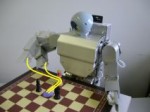
HUMANOIDS 2006 - Humanoid Companions
2006 IEEE-RAS International Conference on Humanoid Robots December 4-6, 2006, University of Genova, Genova, Italy.
From the conference website
The 2006 IEEE-RAS International Conference on Humanoid Robots will be held on December 4 to 6, 2006 in Genova, Italy. The conference series started in Boston in the year 2000, traveled through Tokyo (2001), Karlsruhe/Munich (2003), Santa Monica (2004), and Tsukuba (2005) and will dock in Genoa in 2006.
The conference theme, Humanoid Companions, addresses specifically aspects of human-humanoid mutual understanding and co-development.
Papers as well as suggestions for tutorials and workshops from academic and industrial communities and government agencies are solicited in all areas of humanoid robots. Topics of interest include, but are not limited to:
* Design and control of full-body humanoids
* Anthropomorphism in robotics (theories, materials, structure, behaviors)
* Interaction between life-science and robotics
* Human - humanoid interaction, collaboration and cohabitation
* Advanced components for humanoids (materials, actuators, portable energy storage, etc)
* New materials for safe interaction and physical growth
* Tools, components and platforms for collaborative research
* Perceptual and motor learning
* Humanoid platforms for robot applications (civil, industrial, clinical)
* Cognition, learning and development in humanoid systems
* Software and hardware architectures for humanoid implementation
Important Dates
* June 1st, 2006 - Proposals for Tutorials/Workshops
* June 15th , 2006 - Submission of full-length papers
* Sept. 1st , 2006 - Notification of Paper Acceptance
* October 15th, 2006 - Submission of final camera-ready papers
* November 1st 2006 - Deadline for advance registration
Paper Submission
Submitted papers MUST BE in Portable Document Format (PDF). NO OTHER FORMATS WILL BE ACCEPTED. Papers must be written in English. Six (6) camera-ready pages, including figures and references, are allowed for each paper. Up to two (2) additional pages are allowed for a charge of 80 euros for each additional page.
Papers over 8 pages will NOT be reviewed/accepted.
Detailed instructions for paper submissions and format can be found at here
Exhibitions
There will be an exhibition site at the conference and promoters are encouraged to display state-of-the art products and services in all areas of robotics and automation. Reservations for space and further information may be obtained from the Exhibits Chair and on the conference web site.
Video Submissions
Video submissions should present documentary-like report on a piece of valuable work, relevant to the humanoids community as a whole.
Video submissions should be in .avi or mpeg-4 format and should not exceed 5Mb.
INQUIRIES:
Please contact the General Co-Chairs and the Program Co-Chairs at humanoids06@listes.epfl.ch
ORGANIZATION:
General Co-Chairs:
Giulio Sandini, (U. Genoa, Italy)
Aude Billard, (EPFL, Switzerland)
Program Co-Chairs:
Jun-Ho Oh (KAIST, Korea)
Giorgio Metta (University of Genoa, Italy) Stefan Schaal (University of Southern California) Atsuo Takanishi (Waseda University)
Tutorials/Workshops Co-Chairs:
Rudiger Dillman (University of Karlsruhe) Alois Knoll (TUM, Germany)
Exhibition Co-Chairs:
Cecilia Laschi (Scuola Superiore S. Anna - Pisa, Italy) Matteo Brunnettini (U. Genoa, Italy)
Honorary Chairs:
George Bekey ((U. Genoa, Italy)USC, USA) Hirochika Inoue (JSPS, Japan) Friedrich Pfeiffer, (TU Munich, Germany)
Local Arrangements Co-Chairs:
Giorgio Cannata, (U. Genoa, Italy)
Rezia Molfino, (U. Genoa and SIRI, Italy)
10:00 Posted in AI & robotics | Permalink | Comments (0) | Tags: robotics, artificial intelligence
3rd Annual Colloquium on Online Simulations, Role-Playing, and Virtual Worlds

3rd Annual Colloquium on Online Simulations, Role-Playing, and Virtual Worlds
October 30 - November 3, 2006, Appalachian State University, Boone, North Carolina USA
From the conference website
About the League of WorldsThe League of Worlds (LoW) annual colloquium brings together people engaged in the creation of virtual worlds and real- time simulations for educational and training purposes. Our mission is (1) to stimulate and disseminate research and analysis regarding the theoretical, technical, and curricular developments in; and (2) to contribute towards the development of coherent frameworks for the advancement, application and assessment of educational and social uses of role-playing, simulations, and virtual worlds.
Our primary areas of interest include:a. theoretical analysis
b. the development of practical applications
c. the documentation of framework projects and case studies
The League of Worlds colloquium is not an ordinary conference. This year's theme is: "Exploring Issues in and Asking Questions about Virtual Environments." Participants are expected to challenge one another to take a fresh look at the questions that arise when people meet in virtual territories to play, to learn, and to share. Participation is purposely limited and there will be no concurrent sessions.
Instead, participants will participate in an ongoing dialogue about virtual environments, integrating their own perspectives and expertise into the conversation. The outcome of the colloquium will be a published text comprised of a scholarly narrative of the dialogue around the themes and research discussed throughout the colloquium. All LoW participants will be cited as contributors to this published work.PROPOSAL CATEGORIES
The League of Worlds colloquium is designed to support sharing and meaningful reflection. Participants should allow one another the opportunity to share experiences, to demonstrate technologies, and to think critically. To facilitate these activities, the colloquium review committee is interested in submissions on the following topics:
metaphors)
CFP available at: http://www.leagueofworlds.com/news.php
09:55 Posted in Call for papers | Permalink | Comments (0) | Tags: virtual reality