




Jun 18, 2006
Seizure Detection Algorithm
Via Medgadget

A New Zealand based medical device company is seeking FDA approval for their seizure detection algorithm. According to the company's press release:
The data supporting the seizure detection algorithm has been presented at multiple international medical conferences over the past 18 months. The data presented indicated that the BrainZ seizure detection algorithm had higher sensitivity, higher positive predictive value, higher correlation, and a lower level of false positive detection than two other recognized seizure detection algorithms. The latest presentation was made to the Pediatric Academic Societies' meeting in San Francisco in May 2006.
Company's technology in a nutshell:

The BRM2 Brain Monitor provides bilateral aEEG (amplitude-integrated EEG) displays to allow easy recognition of background EEG patterns, and EEG Waveform displays to show the raw EEG signal from each hemisphere.
Amplitude-integrated EEG (aEEG) provides a compressed display of the level (amplitude) of EEG activity.
It is useful for continuous monitoring of background EEG activity and for discriminating between normal and abnormal EEG traces.
Abnormal aEEG traces can be used to identify patients who require further neurological workup and investigations. Normal traces may be used to reassure families of the likelihood of good long term neurological outcome for their infant.
Studies show marked changes in the level and frequency of EEG activity after ischemic injury. These changes can be predictive of the extent of neurological deficit. The pathophysiologic EEG changes associated with brain injury evolve through latent and delayed phases, over several days. Prolonged monitoring over the first week after birth can be valuable, as normalization of aEEG recording is associated with an improved outcome compared to a persistently abnormal recording. The longer the period of monitoring the more accurately the severity of brain injury can be assessed.
Seizure activity has often been monitored by clinical assessment alone, however a large proportion of seizure activity is either difficult to assess by examination or has no clinical manifestation. Bedside monitoring with aEEG traces can be used to identify seizure-like events in real time, with review of the raw EEG trace recommended for event validation. EEG monitoring can be used to guide the affect of anticonvulsant therapy.
aEEg can also be used to help identify those patients who are most likely to benefit from new hypothermia therapies. These therapies may improve outcomes in infants exposed to hypoxic ischaemic encephalopathies.
18:30 Posted in Research tools | Permalink | Comments (0) | Tags: research tools
Artificial hippocampus to help Alzheimer's patients
Via Medgadget
According to journalist Jennifer Matthews (News14Carolina), neuroscientist Theodore Berger has developed the "first artificial hippocampus", which should help people suffering from Alzheimer's disease to form new memories.

"There's no reason why we can't think in terms of artificial brain parts in the same way we can think in terms of artificial eyes and artificial ears," said Theodore Berger, who does research at the University of Southern California.
Berger believes this new technology will help not only Alzheimer's disease patients, but also individuals suffering from other CNS diseases such as epilepsy, Parkinson's disease or stroke. Also, with this new technolgy, the brain would gain help in information processing. A computer chip will reroute the information, bypassing damaged area(s) of the hippocampus
18:26 Posted in Brain training & cognitive enhancement | Permalink | Comments (0) | Tags: neuroinformatics
Exceptional counting ability induced by temporarily switching off brain region
Via KurzweilAI.net
Applying transcranial magnetic stimulation (TMS) to the left anterior temporal lobe allow for temporary exceptional counting and calculating abilities similar to those of autistic savants, according to Allan Snyder of Australian National University. ...
18:14 Posted in Neurotechnology & neuroinformatics | Permalink | Comments (0)
Rheo Knee
Via KurzweilAI.net
MIT's Media Lab researchers have developed a prosthetic "Rheo Knee" that uses AI to replicate the workings of a biological human joint and "bio-hybrids," surgical implants that allow an amputee to control an artificial leg by thinking..
18:12 Posted in AI & robotics | Permalink | Comments (0) | Tags: artificial intelligence
bio-sensor server

bodydaemon is a bio-responsive web server created by media artist Carlo Castellanos, which uses biofeedback sensors to change in realtime its configuration, according to the participant's psychophysiological states
From the project's website:
BodyDaemon is a bio-responsive Internet server. Readings taken from a participant's physical states, as measured by custom biofeedback sensors, are used to power and configure a fully-functional Internet server. For example, more or fewer socket connections are made available based on heart rate, changes in galvanic skin response (GSR) can abruptly close sockets, and muscle movements (EMG) can send data to the client. Other feature's such as logging can be turned on or off depending on a combination of factors. BodyDaemon also includes a client application that makes requests to the BodyDaemon server. The client requests and server responses are sent over a "persistent" or open socket. The client can thus use the data to continuously visualize, sonify or otherwise render the live bio-data. This project is part of larger investigations focusing on the development of protocols for the transfer of live physiological and biological information across the Internet.
BodyDaemon represents the early stages of investigations into the viability of systems that alter their states based off of a person's changing physiological states and intentions - with the ultimate goal of accommodating the development of emergent states of mutual influence between human and machine in a networked ecosystem.

17:10 Posted in Biofeedback & neurofeedback | Permalink | Comments (0) | Tags: social presence
Special issue of Cognition on Neurogenomics


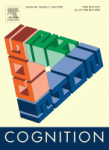
14:49 | Permalink | Comments (0) | Tags: neurogenomics
Jun 13, 2006
Robot with the human touch feels just like us
From: Times (UK)
A touch sensor developed to match the sensitivity of the human finger is set to herald the age of the robotic doctor.
Until now robots have been severely handicapped by their inability to feel objects with anything like the accuracy of their human creators. The very best are unable to beat the dexterity of the average six-year-old at tying a shoelace or building a house of cards.
But all that could change with the development by nanotechnologists of a device that can “feel” the shape of a coin down to the detail of the letters stamped on it. The ability to feel with at least the same degree of sensitivity as a human finger is crucial to the development of robots that can take on complicated tasks such as open heart surgery.
Read the full article
00:45 Posted in AI & robotics | Permalink | Comments (0) | Tags: robotics