




Aug 02, 2006
3D blog
Thanks to Giuseppe Riva (reporting from Siggraph 2006)
12:50 Posted in Future interfaces, Telepresence & virtual presence, Virtual worlds | Permalink | Comments (0)
The Huggable
Via Siggraph2006 Emerging Technology website

The Huggable is a robotic pet developed by MIT researchers for therapy applications in children's hospitals and nursing homes, where pets are not always available. The robotic teddy has full-body sensate skin and smooth, quiet voice coil actuators that is able to relate to people through touch. Further features include "temperature, electric field, and force sensors which it uses to sense the interactions that people have with it. This information is then processed for its affective content, such as, for example, whether the Huggable is being petted, tickled, or patted; the bear then responds appropriately".
The Huggable has been unveiled at the Siggraph2006 conference in Boston. From the conference website:
Enhanced Life
Over the past few years, the Robotic Life Group at the MIT Media Lab has been developing "sensitive skin" and novel actuator technologies in addition to our artificial-intelligence research. The Huggable combines these technologies in a portable robotic platform that is specifically designed to leave the lab and move to healthcare applications.
Goals
The ultimate goal of this project is to evaluate the Huggable's usefulness as a therapy for those who have limited or no access to companion-animal therapy. In collaboration with nurses, doctors, and staff, the technology will soon be applied in pilot studies at hospitals and nursing homes. By combining Huggable's data-collection capabilities with its sensing and behavior, it may be possible to determine early onset of a person's behavior change or detect the onset of depression. The Huggable may also improve day-to-day life for those who may spend many hours in a nursing home alone staring out a window, and, like companion-animal therapy, it could increase their interaction with other people in the facility.
Innovations
The core technical innovation is the "sensitive skin" technology, which consists of temperature, electric-field, and force sensors all over the surface of the robot. Unlike other robotic applications where the sense of touch is concerned with manipulation or obstacle avoidance, the sense of touch in the Huggable is used to determine the affective content of the tactile interaction. The Huggable's algorithms can distinguish petting, tickling, scratching, slapping, and poking, among other types of tactile interactions. By combining the sense of touch with other sensors, the Huggable detects where a person is in relation to itself and responds with relational touch behaviors such as nuzzling.
Most robotic companions use geared DC motors, which are noisy and easily damaged. The Huggable uses custom voice-coil actuators, which provide soft, quiet, and smooth motion. Most importantly, if the Huggable encounters a person when it tries to move, there is no risk of injury to the person.
Another core technical innovation is the Huggable' combination of 802.11g networking with a robotic companion. This allows the Huggable to be much more than a fun, interactive robot. It can send live video and data about the person's interactions to the nursing staff. In this mode, the Huggable functions as a team member working with the nursing home or hospital staff and the patient or resident to promote the Huggable owner's overall health.
Vision
As poorly staffed nursing homes and hospitals become larger and more overcrowded, new methods must be invented to improve the daily lives of patients or residents. The Huggable is one of these technological innovations. Its ability to gather information and share it with the nursing staff can detect problems and report emergencies. The information can also be stored for later analysis by, for example, researchers who are studying pet therapy.
12:05 Posted in AI & robotics, Emotional computing, Serious games | Permalink | Comments (0) | Tags: cybertherapy, robotics, artificial intelligence
Photos transformed into 3D model
With Photosynth you can:
- Walk or fly through a scene to see photos from any angle.
- Seamlessly zoom in or out of a photograph whether it’s megapixels or gigapixels in size.
- See where pictures were taken in relation to one another.
- Find similar photos to the one you’re currently viewing.
- Explore a custom tour.
- Send a collection to a friend.

11:55 Posted in Virtual worlds | Permalink | Comments (0)
Home-based sensors could detect early signs of dementia
Via Medgadget
According to a study conducted by Oregon Health & Science University researchers, continuous, unobtrusive monitoring of in-home activity may be a reliable way of assessing changes in motor behaviors that may occur along with changes in memory. The study was presented last week at the 10th International Conference on Alzheimer's Disease and Related Disorders in Madrid.
From the university's press release:
"To see a trend over time, you need multiple measures - good days and bad days - and it often takes years to see that trend in a clinic setting," said Tamara Hayes, Ph.D., assistant professor of biomedical engineering at OHSU's OGI School of Science & Engineering, and the study's lead author. She noted that most clinic visits by elders are spaced over months or even years, and their memory and motor skills performances are evaluated in a small number of tests completed in a limited amount of time.
"In contrast, we're looking continuously at elders' activity in their own homes," Hayes said. "Since we're measuring a person's activity many times over a short period, we can understand their normal variability and identify trends. If there's a change over a period, you can see it quickly. "
Mild cognitive impairment is a known risk factor for dementia, a neurological disorder most commonly caused by Alzheimer's disease. Changes in clinical measures of activity, such as walking and finger-tapping speeds, have been shown to occur at about the same time as memory changes leading to dementia. By detecting subtle activity changes over time in the natural setting of an elder's home, researchers hope to more effectively identify when elders are starting to have trouble.
11:40 Posted in Cybertherapy, Persuasive technology, Pervasive computing | Permalink | Comments (0)
Animation can be outlet for victimized children, a tool for research
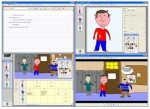
Animation is a proven vehicle for biting comedy, a la "The Simpsons" and "South Park." But some of the same qualities that make it work for comedy make it valuable, too, as an outlet for victimized children and for a new research method that tests the empathy of teachers who may deal with them, says Sharon Tettegah, a professor of curriculum and instruction at the University of Illinois at Urbana-Champaign.
Tettegah believes so strongly in the value of animation – specifically “animated narrative vignette simulations” – that she sought out a computer science professor at Illinois, Brian Bailey, to help develop her concept for a child-friendly program for producing them.
The program that resulted, called Clover, gives children, as well as adults, a tool for making and sharing their own vignettes about their personal and sometimes painful stories.
According to Tettegah, the program is the only one she is aware of that allows the user to write the narrative, script the dialogue, storyboard the graphics and add voice and animation, all within one application. Those four major aspects of producing a vignette gave rise to the name “Clover,” the plant considered to bring good luck in its four-leaf form.
A paper about Clover, written by Bailey, Tettegah and graduate student Terry Bradley, has been published in the July issue of the journal Interacting With Computers.
In other research, Tettegah has used animations as a tool for gauging the empathy of teachers and others who might deal with children and their stories of victimization. One study with college education majors, or teachers-in-training, showed only one in 10 expressing a high degree of empathy for the victim, she said.
A paper about that study has been accepted by the journal Contemporary Educational Psychology (CEP), with publication slated for later this year. The co-author of the study is Carolyn Anderson, a professor of educational psychology at Illinois.
11:30 Posted in Cybertherapy, Serious games | Permalink | Comments (0) | Tags: serious gaming
EJEL special issue on Communities of Practice and e-learning
In the issue of the Electronic Journal of E-Learning to be published in the summer of 2006, there will be a section focusing on Communities of Practice. This special section will examine, from a theoretical and practical perspective, how the concepts of Communities of Practice and e-learning can be combined.
Possible topics include:
- Communities of Practice for e-learning professionals;
- Establishing Communities of Practice to support e-learners
- Communities of Practice and informal e-learners;
- Technologies supporting Communities of Practice and e-learning
The Electronic Journal of e-Learning provides perspectives on topics relevant to the study, implementation and management of e-Learning initiatives.
The journal contributes to the development of both theory and practice in the field of e-Learning. The journal accepts academically robust papers, topical articles and case studies that contribute to the area of research in e-Learning.
10:33 Posted in Creativity and computers | Permalink | Comments (0) | Tags: collaborative computing
Urban Tapestries

Urban Tapestries aims to enable people to become authors of the environment around them – Mass Observation for the 21st Century. Like the founders of Mass Observation in the 1930s, we are interested creating opportunities for an "anthropology of ourselves" – adopting and adapting new and emerging technologies for creating and sharing everyday knowledge and experience; building up organic, collective memories that trace and embellish different kinds of relationships across places, time and communities.
It is part of an ongoing research programme of experiments with local groups and communities called Social Tapestries.
10:23 Posted in Information visualization, Telepresence & virtual presence, Wearable & mobile | Permalink | Comments (0) | Tags: locative media
ECGBL 2007: The European Conference on Games Based Learning
University of Paisley, Scotland, UK 25-26 October 2007
Over the last ten years, the way in which education and training is delivered has changed considerably with the advent of new technologies. One such new technology that holds considerable promise for helping to engage learners is Games-Based Learning (GBL).
The Conference offers an opportunity for scholars and practitioners interested in the issues related to GBL to share their thinking and research findings. The conference examines the question “Can Games-Based Learning Enhance Learning?” and seeks high-quality papers that address this question. Papers can cover various issues and aspects of GBL in education and training: technology and implementation issues associated with the development of GBL; use of mobile and MMOGs for learning; pedagogical issues associated with GBL; social and ethical issues in GBL; GBL best cases and practices, and other related aspects. We are particularly interested in empirical research that addresses whether GBL enhances learning. This Conference provides a forum for discussion, collaboration and intellectual exchange for all those interested in any of these fields of research or practice.
Important dates:
Abstract submission deadline: 17 May 2007
Notification of abstract acceptance: 24 May 2007
Full paper due for review: 5 July 2007
Notification of paper acceptance: 16 August 2007
Final paper due (with any changes): 6 September 2007
A full call for papers, online submission and registration forms and all other details are available on the conference website.
10:15 Posted in Creativity and computers, Positive Technology events, Virtual worlds | Permalink | Comments (0) | Tags: serious gaming