




Aug 03, 2006
Virtual bots teach each other
From New Scientist Tech
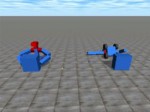
"Robots that teach one another new words through interaction with their surroundings have been demonstrated by UK researchers. The robots, created by Angelo Cangelosi and colleagues at Plymouth University, UK, currently exist only as computer simulations. But the researchers say their novel method of communication could someday help real-life robots cooperate when faced with a new challenge. They could also help linguists understand how human languages develop, they say..."
Continue to read the full article on New Scientist
Watch the video
21:11 Posted in AI & robotics, Virtual worlds | Permalink | Comments (0) | Tags: artificial intelligence
empathic painting
Via New Scientist
A team of computer scientists (Maria Shugrina and Margrit Betke from Boston University, US, and John Collomosse from Bath University, UK) have created a video display system (the "Empatic Painting") that tracks the expressions of onlookers and metamorphoses to match their emotions:
"For example, if the viewer looks angry it will apply a red hue and blurring. If, on the other hand, they have a cheerful expression, it will introduce increase the brightness and colour of the image." (New Scientist )

See a video of the empathic painting (3.4MG .avi, required codec).
20:50 Posted in Cyberart, Emotional computing | Permalink | Comments (0) | Tags: emotional computing
Forehead Retina System
Va Technovelgy
Researchers at at the University of Tokyo, in joint collaboration with EyePlusPlus, Inc., have developed a system that uses tactile sensations in the forehead as a "substitute retina" to enable visually impaired people to "see" the outlines of objects.
The Forhead Retina System (FRS) uses a special headband to selectively stimulate different mechanoreceptors in forehead skin to allow visually impaired people to perceive a picture of what lies in front of them.

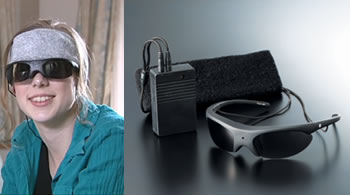
The system has been presented at the Emerging Technology session of Siggraph 2006. From the conference website:
Although electrical stimulation has a long scientific history, it has not been used for practical purposes because stable stimulation was difficult to achieve, and mechanical stimulation provided much better spatial resolution. This project shows that stable control of electrical stimulation is possible by using very short pulses, and anodic stimulation can provide spatial resolution equal to mechanical stimulation. This result was presented at SIGGRAPH 2003 as SmartTouch, a visual-to-tactile conversion system for skin on the finger using electrical stimulation. Because the Forehead Retina System shows that stable stimulation on the "forehead skin" is also quite possible, it leads to a new application of electrical stimulation.
Goals
According to a 2003 World Health Organization report, up to 45 million people are totally blind, while 135 million live with low vision. However, there is no standard visual substitution system that can be conveniently used in daily life. The goal of this project is to provide a cheap, lightweight, yet fully functional system that provides rich, dynamic 2D information to the blind.
Innovations
The big difference between finger skin and forehead skin is the thickness. While finger skin has a thick horny layer of more than 0.7 mm, the forehead skin is much thinner (less than 0.02mm). Therefore, if the electrode directly contacts the skin, concentrated electrical potential causes unnecessary nerve stimulation and severe pain. The Forehead Retina System uses an ionic gel sheet with the same thickness and electrical impedance as the horny layer of finger skin. When the gel sheet is placed between the electrode and the forehead, stable sensation is assured.
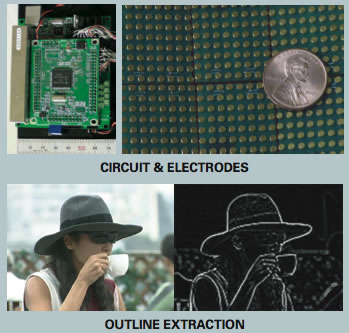
Compared to current portable electronic devices, most of the proposed "portable" welfare devices are not portable in reality. They are bulky and heavy, and they have a limited operation time. By using electrical stimulation, the Forehead Retina System partially solves these problems. Nevertheless, driving 512 electrodes with more than 300 volts is quite a difficult task, and it normally requires a large circuit space. The system uses a high-voltage switching integrated circuit, which is normally used to drive micro-machines such as digital micro-mirror devices. With fast switching, current pulses are allocated to appropriate electrodes. This approach enables a very large volune of stimulation and system portability at the same time.
Vision
This project demonstrates only the static capabilities of the display. Other topics pertaining to the display include tactile recognition using head motion (active touch), gray-scale expression using frequency fluctuation, and change in sensation after long-time use due to sweat. These will be the subjects of future studies.
The current system uses only basic image processing to convert the visual image to tactile sensation. Further image processing, including motion analysis, pattern and color recognition, and depth perception is likely to become necessary in the near future.
It is important to note that although many useful algorithms have been proposed in the field of computer vision, they can not always be used unconditionally. The processing must be performed in real time, and the system must be small and efficient for portability. Therefore, rather than incorporating elegant but expensive algorithms, the combination of bare minimum image processing and training is practical. The system is now being tested with the visually impaired to determine the optimum balance that good human interfaces have always achieved.
18:14 Posted in Brain training & cognitive enhancement | Permalink | Comments (0)
Sixth International Conference on Epigenetic Robotics
Via Human Technology
Sixth International Conference on Epigenetic Robotics: Modeling Cognitive Development in Robotic Systems
Dates: 20-22 September 2006
Location: Hopital de la Salpêtrière, Paris, France

From the conference website:
In the past 5 years, the Epigenetic Robotics annual workshop has established itself as a unique place where original research combining developmental sciences, neuroscience, biology, and cognitive robotics and artificial intelligence is being presented.
Epigenetic systems, either natural or artificial, share a prolonged developmental process through which varied and complex cognitive and perceptual structures emerge as a result of the interaction of an embodied system with a physical and social environment.
Epigenetic robotics includes the two-fold goal of understanding biological systems by the interdisciplinary integration between social and engineering sciences and, simultaneously, that of enabling robots and artificial systems to develop skills for any particular environment instead of programming them for solving particular goals for the environment in which they happen to reside.
Psychological theory and empirical evidence is being used to inform epigenetic robotic models, and these models should be used as theoretical tools to make experimental predictions in developmental psychology.
17:55 Posted in AI & robotics, Positive Technology events | Permalink | Comments (0)