




Aug 04, 2006
The state of the art in Assisted Cognition
The article entitled "Assistive technology for cognitive rehabilitation: State of the art", by LoPresti et al. provides a comprehensive review of Assisted Cognition, a research field that aims to develop and assess technological tools for individuals with either acquired impairments or developmental disorders.
The full-text of this article is available here
Authors: Edmund Frank LoPresti; Alex Mihailidis; Ned Kirsch
Neuropsychological Rehabilitation, Volume 14, Numbers 1-2/March-May 2004, pp. 5-39(35)
Abstract: For close to 20 years, clinicians and researchers have been developing and assessing technological interventions for individuals with either acquired impairments or developmental disorders. This paper offers a comprehensive review of literature in that field, which we refer to collectively as assistive technology for cognition (ATC). ATC interventions address a range of functional activities requiring cognitive skills as diverse as complex attention, executive reasoning, prospective memory, self-monitoring for either the enhancement or inhibition of specific behaviours and sequential processing. ATC interventions have also been developed to address the needs of individuals with information processing impairments that may affect visual, auditory and language ability, or the understanding of social cues. The literature reviewed indicates that ATC interventions can increase the efficiency of traditional rehabilitation practices by enhancing a person's ability to engage in therapeutic tasks independently and by broadening the range of contexts in which those tasks can be exercised. More importantly, for many types of impairments, ATC interventions represent entirely new methods of treatment that can reinforce a person's residual intrinsic abilities, provide alternative means by which activities can be completed or provide extrinsic supports so that functional activities can be performed that might otherwise not be possible. Although the major focus of research in this field will continue to be the development of new ATC interventions, over the coming years it will also be critical for researchers, clinicians, and developers to examine the multi-system factors that affect usability over time, generalisability across home and community settings, and the impact of sustained, patterned technological interventions on recovery of function.
19:05 Posted in Brain training & cognitive enhancement | Permalink | Comments (0) | Tags: assisted cognition
Call for papers: Pervasive Computing in Healthcare
From the IEEE Pervasive Computing Journal website
Author guidelines: www.computer.org/pervasive/author.htm
Submission address: http://cs-ieee.manuscriptcentral.com
WIP Deadline: See below
Publication date: January 2007
IEEE Pervasive Computing invites articles about the use of pervasive computing technology in healthcare applications. We welcome papers that focus on novel applications of embedded sensor and actuators as well as user interfaces for use by caregivers and/or patients. We also encourage surveys of available technologies, and reporting on user experiences. Example topics include:
- Sensors and mobile devices for continuous patient monitoring
- Actuators and prompters for rehabilitation and behavior modification
- Mobile and wearable technologies for next generation drug trials
- Intelligent prosthetics
- Medical data-mining from health records
- Privacy architectures for medical records
- Applications for first responders including paramedics and emergency rooms
- Hospital work-flow management
- Intelligent implantable devices for applications in hearing, pain management, etc.
- Devices to monitor dietary intake and/or caloric expenditure
- Technologies for collaborative and/or competitive exercise support groups
- Issues in healthcare technology standards, interoperability, security, usability, cost, etc
Submissions should be 4,000 to 6,000 words long and should follow the magazine's guidelines on style and presentation. All submissions will be peer-reviewed in accordance with normal practice for scientific publications. Submissions should be received by 5 September 2006 to receive full consideration.
In addition to full-length submissions, we also invite work-in-progress submissions of 250 words or less (submit to mmraz@computer.org) These will not be peer-reviewed but will be reviewed by the Department Editor, Anthony Joseph, and, if accepted, edited by the staff into a feature for the issue. The deadline for work-in-progress submissions is 1 November 2006.
Walter Menning, Mayo Clinic
18:00 Posted in Call for papers, Pervasive computing | Permalink | Comments (0) | Tags: pervasive computing
Using Simulation and Virtual Reality Technology to Assess Continuing Nurse Competency
Education and Practice Collaboration: Using Simulation and Virtual Reality Technology to Assess Continuing Nurse Competency in the Long-Term Acute Care Setting.
J Nurses Staff Dev. 2006 July/August;22(4):163-169
Authors: Landry M, Oberleitner MG, Landry H, Borazjani JG
Assessment of continuing competence of staff is a challenge for many healthcare organizations. There is no clear consensus as to what constitutes continuing competence or how to measure that competence. Methods for assessing continued competence of nurses are varied. A novel method, simulation and virtual reality technology, was used to assess the competency of nurses employed in long-term acute care hospitals in Louisiana. This article will describe the project which was the result of a collaborative effort between a large healthcare organization and a school of nursing.
17:35 Posted in Virtual worlds | Permalink | Comments (0) | Tags: virtual reality
Tablescape Plus: Upstanding Tiny Displays on Tabletop Displays
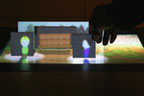
Placing physical objects on a tabletop display is common for intuitive tangible input. The overall goal of our project is to increase the possibility of the interactive physical objects. By utilizing the tabletop objects as projection screens as well as input equipment, we can change the appearance and role of each object easily. To achieve this goal, we propose a novel tablescape display system, "Tabletop Plus." Tabletop Plus can project separate images on the tabletop horizontal screen and on vertically placed objects simlutaneously. No special electronic devices are installed on these objects. Instead, we attached a paper marker underneath these objests for vision-based recogniton. Projected images change according to the angle, position and ID of each placed object. In addition, the displayed images are not occluded by users' hands since all equipment is installed inside the table.
Example application :: Tabletop Theater (pictured above): When you put a tiny display on a tabletop miniature park, an animated character appears and moves according to the position and direction of it. In addition, the user can change the actions of the characters by their positional relationships.
17:21 Posted in Future interfaces | Permalink | Comments (0) | Tags: future interfaces
Artificial feedback for remotely supervised training of motor skills
Artificial feedback for remotely supervised training of motor skills.
J Telemed Telecare. 2006;12 Suppl 1:50-2
Authors: van Dijk H, Hermens HJ
Electromyographic (EMG) biofeedback can be used to train motor functions at a distance, which makes therapy at home a possibility. To enable patients to train properly without the presence of a therapist, artificial feedback is considered essential. We studied the combined effect of age and timing of artificial feedback on training muscle relaxation in 32 healthy subjects (younger: 20-35 years; older: 55-70 years). All subjects improved their performance significantly (F = 6.1, P<0.001). The effect of different timing of feedback (feedback provided during or after performance) was similar in young and older adults. However, this conclusion should be interpreted with caution owing to the small sample size. It can be argued that the artificial feedback used was too complicated for older adults to interpret. When designing remotely supervised treatment programmes, one should consider carefully the way that artificial feedback is being applied as it may enable (elderly) subjects to train without the presence of a therapist.
17:14 Posted in Biofeedback & neurofeedback | Permalink | Comments (0) | Tags: biofeedback, telemedicine
Whole-brain connectivity diagrams
Via BrainTechSci
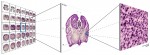
In a previous post I covered BrainMaps, the interactive zoomable high-resolution diagram for whole-brain connectivity. Now the project provides a powerful new feature, the interactive visualization of brain connectivity in 3D.
From the download page:
Welcome to nodes3D, a 3D graph visualization program written by Issac Trotts in consultation with Shawn Mikula, in the labs of Edward G. Jones. On startup, nodes3d will download a graph of gross neuroanatomical connectivity from the MySQL database at brainmaps.org. Future versions will probably support loading of graphs from files or other databases
12:50 Posted in Information visualization, Research tools | Permalink | Comments (0) | Tags: neurotechnology
TransVision06

The TransVision 2006 annual conference of the World Transhumanist Association, Helsinki 17-19 August 2006, organized by the WTA and the Finnish Transhumanist Association, will be open to remote visitors in the virtual reality world of Second Life.
TransVision06, August 17-19: University of Helsinki, Finland, Europe
This year the theme of the conference will be Emerging Technologies of Human Enhancement. We'll be looking at recent and ongoing technological developments and discussing associated ethical and philosophical questions.
We will hold a mixed reality event between the Helsinki conference hall and Second Life:
The Second Life event will take place in the uvvy island in SL. To attend, use the Second Life map in the client, look for region uvvy and teleport.
The real time video stream from Helsinki will be displayed in SL.
Some presentations will also be displayed in SL in Power Point -like format.
Some PCs running the SL client will be available in the conference hall in Helsinki for SL users (at least 3 plus myself (gp)).
Some SL users will be simultaneously present in both worlds who can relay questions from the remote SL audience to speakers.
The SL event will be projected on a screen in Helsinki.
There will be a single text chat space for Second Life users and IRC chat users. So those whose computers are too slow or for some other reason don't want to use Second Life can use a combination of IRC and the video feed to interact with the conference participants in both Helsinki and Second Life.
See also:
http://community.livejournal.com/transvision06/
http://community.livejournal.com/transvision06/1346.html
12:35 Posted in Brain training & cognitive enhancement, Positive Technology events | Permalink | Comments (0) | Tags: Transhumanism