




Aug 01, 2006
Drinking Games
Via Medgadget
Miles Cox, professor of the psychology of addictive behaviors at the University of Wales, is experimenting a computer-based approach to get alcoholics to ignore the potent cues that trigger their craving. The study has been covered by MIT Technology Review:
Just as these responses can be conditioned, they can also be de-conditioned, reasons Cox. His computer program helps abusers deal with the sight of alcohol, since it's often the first cue they experience in daily life. The program presents a series of pictures, beginning with an alcohol bottle inside a thick, colored frame. As fast as they can, users must identify the color of the frame. As users get faster, the test gets harder: the frame around the bottles becomes thinner. Finally, an alcohol bottle appears next to a soda bottle, both inside colored frames. Users must identify the color of the circle around the soda. The tasks teach users to "ignore the alcohol bottle" in increasingly difficult situations, says Cox.Such tests have long been used to study attention phenomena in alcohol abusers, but they have never been used for therapy, says Cox. His group adapted the test for this new purpose by adding elements of traditional therapy. Before the tests, users set goals on how quickly they want to react; a counselor makes sure the goals are achievable. After each session, users see how well they did. The positive feedback boosts users' motivation and mood, Cox says.
Find more on the ESRC study page
17:20 Posted in Cybertherapy, Serious games | Permalink | Comments (0) | Tags: serious gaming, cybertherapy
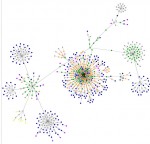
PTJ sitegraph
16:08 Posted in Information visualization | Permalink | Comments (0) | Tags: complex networks
Computer's schizophrenia diagnosis inspired by the brain
Via New Scientist
University of California at San Francisco researchers may have created a computerized diagnostic tool utilizing MRI based technology for determining whether someone has schizophrenia. From New Scientist:"Raymond Deicken at the University of California at San Francisco and colleagues have been studying the amino acid Nacetylaspartate (NAA). They found that levels of NAA in the thalamus region of the brain are lower in people with schizophrenia than in those without.To find out whether software could diagnose the condition from NAA levels, the team used a technique based on magnetic resonance imaging to measure NAA levels at a number of points within the thalamus of 18 people, half of whom had been diagnosed with schizophrenia. Antony Browne of the University of Surrey, UK, then analysed these measurements using an artificial neural network, a program that processes information by learning to recognise patterns in large amounts of data in a similar way to neurons in the brain.
Browne trained his network on the measurements of 17 of the volunteers to teach it which of the data sets corresponded to schizophrenia and which did not. He then asked the program to diagnose the status of the remaining volunteer, based on their NAA measurements. He ran the experiment 18 times, each time withholding a different person's measurements. The program diagnosed the patients with 100 per cent accuracy."
11:50 Posted in AI & robotics, Cybertherapy | Permalink | Comments (0)
Freq2
From Networked Performance (via Pixelsumo]
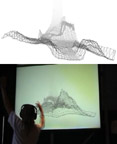
Freq2, by Squidsoup, uses your whole body to control the precise nature of a sound - a form of musical instrument. The mechanism used is to trace the outline of a person's shadow, using a webcam, and transform this line into an audible sound. Any sound can be described as a waveform - essentially a line - and so these lines can be derived from one's shadow. What you see is literally what you hear, as the drawn wave is immediately audible as a realtime dynamic drone.
Freq2 adds to this experience by adding a temporal component to the mix; a sonic composition in which to frame the instrument. The visuals, an abstract 3-dimensional landscape, extrudes in realtime into the distance, leaving a trail of the interactions that have occurred. This `memory' of what has gone before is reflected in the sounds, with long loops echoing passed interactions. The sounds, all generated in realtime from the live waveform, have also been built into more of a compositional soundscape, with the waveform being played at a range of pitches and with a rhythmic component.
Watch video
11:39 Posted in Cyberart | Permalink | Comments (0) | Tags: cyberart
Oribotics
via textually.org
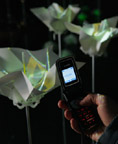
Oribotics - by Matthew Gardiner - is the fusion of origami and technology, specifically 'bot' technology, such as robots, or intelligent computer agents known as bots. The system was designed to create an intimate connection between the audience and the bots; a cross between gardening, messaging a friend, and commanding a robot. It was developed during an Australian Network for Artists and Technology (ANAT) artists lab; achieved with Processing as an authoring tool, and connected a mobile phone via a USB cable.
"Ori-botics is a joining of two complex fields of study. Ori comes from the Japanese verb Oru literally meaning 'to fold'. Origami the Japanese word for paper folding, comes from the same root. Oribotics is origami that is controlled by robot technology; paper that will fold and unfold on command. An Oribot by definition is a folding bot. By this definition, anything that uses robotics/botics and folding together is an oribot. This includes some industrial applications already in existance, such as Miura's folds taken to space, and also includes my two latest works. Orimattic, and Oribotics."
11:38 Posted in AI & robotics, Cyberart | Permalink | Comments (0) | Tags: cyberart