




Apr 18, 2006
2007 Bower Award and Prize for Achievement in Science

The Franklin Institute is soliciting nominations for the 2007 Bower Award and Prize for Achievement in Science, which will be on the theme of Human-Centered Computing
From the website:
The Franklin Institute invites you to nominate candidates for the Benjamin Franklin Medals, the 2007 Bower Award and Prize for Achievement in Science and the 2007 Bower Award for Business Leadership.
The Benjamin Franklin Medals are awarded annually in seven disciplines of science: chemistry, computer and cognitive science, earth and environmental science, electrical engineering, life science, mechanical engineering, and physics.
The Bower Awards are presented in a predetermined field of interest chosen each year. The theme of the 2007 Bower Award for Achievement in Science is Human-Centered Computing. The theme of the 2007 Bower Award for Business Leadership is Computer and Cognitive Science.
Please feel free to share this Call for Nominations with others who might wish to submit a nomination. Questions about the appropriateness of a particular nomination are welcome and should be directed to Dr. Philip W. Hammer, Vice President, The Franklin Institute, at the number and/or address listed in the nomination sections. 2007 nominations must be received in the Awards office by May 31, 2006.
22:52 Posted in Research institutions & funding opportunities | Permalink | Comments (0) | Tags: Positive Technology
Human Technology Special Issue: Culture, Creativity and Technology
Via Usability News
Deadline: 8 May 2006
Advances in interactive computing technology have blurred the line between art, social studies and science. The age of digital reproduction is making radical changes in how art is created, distributed and perceived. Recent work from the humanities and arts has constructively critiqued traditional Interaction Design theory and practice. Studies of experience with technology can provide new insights into the potential of interactivity in contemporary arts and performance, as well as new tools for creativity.
This special issue will provide a forum for radically interdisciplinary analysis of digital technology. It will focus on the role of technology in enhancing culture and creativity. It will seek critical and reflective approaches to the design and analysis of interactive technology. Contributions will be welcomed from the Arts and Humanities as well as the Sciences. Contributions can take the form of academic papers but also less traditional creative presentation formats such as multimedia, digital artwork and sound.
Arts and HCI
Re-mediation
Technology and Experience
Enabling Creativity
Performance Arts
Entertainment and Leisure Identity Politics
Collaborative approaches
Approaches of Interest:
Interaction design, computer science, engineering, architecture, cultural
studies, media studies, literary studies, critical theory, aesthetics,
performance arts, digital art, psychology, socio-technical studies.
21:45 Posted in Call for papers | Permalink | Comments (0) | Tags: Positive Technology
Virtual Reality treatment in post traumatic stress disorder
 In the study, veternas used a head-mounted display and experienced a virtual Vietnam War clip (J. Clin. Psychiatry, in press). To more closely simulate actual combat, each of the veterans stood or sat on a platform above a vibrating speaker during the therapy session. According to Dr. Rothbaum, patients showed consistent improvements.
Read the full report on Clinical Psychiatry News
21:30 Posted in Cybertherapy | Permalink | Comments (0) | Tags: Positive Technology
Cogain project: Communication by Gaze Interaction
The EU-funded five-year project COGAIN (Communication by Gaze Interaction) will attempt to make eye-tracking technologies more affordable for people with disabilities and extend the potential use of the devices to enable users to live more independently.
From the project website:
COGAIN is a network of excellence on Communication by Gaze Interaction, supported by the European Commission's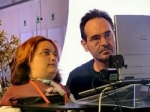 IST 6th framework program. COGAIN integrates cutting-edge expertise on interface technologies for the benefit of users with disabilities. The network aims to gather Europe's leading expertise in eye tracking integration with computers in a research project on assistive technologies for citizens with motor impairments. Through the integration of research activities, the network will develop new technologies and systems, improve existing gaze-based interaction techniques, and facilitate the implementation of systems for everyday communication.
Read the full report
20:30 Posted in Research tools | Permalink | Comments (0) | Tags: Positive Technology
The Guardian: Now the bionic man is real
Via VRoot
From the article: The 1970s gave us the six-million-dollar man. Thirty years and quite a bit of inflation later we have the six-billion-dollar human: not a physical cyborg as such, instead an umbrella term for the latest developments in the growing field of technology for human enhancement.
Helping the blind to see again, being able to carry enormous loads without the prospect of backache and a prosthetic robotic hand that works (almost) like a real one were some of the ideas presented at a recent meeting of engineers, physicists, biologists and computer scientists organised by the American Association of Anatomists...
Read full article
20:29 Posted in AI & robotics | Permalink | Comments (0) | Tags: Positive Technology
VRoot: Polhemus announces new tracker
Polhemus, the industry leader in 6 Degree of Freedom (6DOF) motion capture, tracking and digitizing technologies is proud to announce MINUTEMAN™, the new low cost (under $1,500) 3-Degree-of-Freedom (3DOF) tracking product. MINUTEMAN represents a quantum leap in new technology and state of the art Digital Signal Processor (DSP) electronics which results in a major price reduction for tracking technology. MINUTEMAN is drift free, has the speed of 75 Hz per sensor and offers ease of use via an intuitive Graphical User Interface (GUI). The electronics unit (E-Pod), which is powered by the USB interface and contains the electromagnetic source, is only slightly larger than a pack of playing cards. Full InertiaCube2 emulation software is also provided for plug-and-play hardware replacement without having to worry about rewriting code. The combination of all these attributes clearly positions MINUTEMAN as a new class of electromagnetic tracking, offering significant improvements over competitive technologies.
20:20 Posted in Virtual worlds | Permalink | Comments (0) | Tags: Positive Technology
$25K Prize for Neurobiology
Via Brain Waves

$25,000 Eppendorf & Science Prize for Neurobiology is now accepting entries. Deadline: June 15, 2006.
From the website:
The Eppendorf & Science Prize for Neurobiology acknowledges the increasing importance of this research in advancing our understanding of how the brain and nervous system function a quest that seems destined for dramatic expansion in the coming decades. This international prize, established in 2002, is intended to encourage and support the work of promising young neurobiologists who have received their PhD or MD within the past 10 years. The prize is awarded annually to one young scientist for the most outstanding neurobiological research conducted by him/her during the past three years, as described in a 1,000-word entrance essay.
20:05 Posted in Research institutions & funding opportunities | Permalink | Comments (0) | Tags: Positive Technology
Brain waves: Neurotechnology Revenues Reach $110 Billion
Via Brain Waves
According to the Neurotechnology Industry 2006 Report, neurotechnology revenues reach $110 Billion.
Produced by Neuroinsight, the report provides a unified market-based framework to help investors, companies and governments quantify opportunities, determine risks and understand the dynamics of this market.
20:01 Posted in Neurotechnology & neuroinformatics | Permalink | Comments (0) | Tags: Positive Technology
United States Patent: Nervous system manipulation by electromagnetic field from monitors
I found this US technology patent, which claims a method for manipulating the nervous system of a subject via broadcast television signals, DVD, and computer terminal (if the link does not work, go to this page and type the number 6,506,148 in the "Query" bar):
| Inventors: | Loos; Hendricus G. (3019 Cresta Way, Laguna Beach, CA 92651) |
| Appl. No.: | 872528 |
| Filed: | June 1, 2001 |
11:35 Posted in Persuasive technology | Permalink | Comments (0) | Tags: Positive Technology
WMMNA: Children 'bond with robots'
Researchers from Sony Intelligence Dynamics Laboratories and a nursery school in San Diego are conducting an experiment that focuses on how children can develop emotions toward robots. Results of this research could be used to develop smarter and friendlier humanoid robots, with a huge commercial potential.

11:17 Posted in AI & robotics | Permalink | Comments (0) | Tags: Positive Technology
High Speed, Light-based Brain Activity Detector
From Neuromarketing
Neuroscientists Gabriele Gratton and Monica Fabiani at the University of Illinois Beckman Institute’s Cognitive Neuroimaging Laboratory are using very intense near-infrared illumination to measure neuronal activity in the cortex:
The EROS is a new non-invasive brain imaging method that we are developing at the CNL. Our research has determined that this technique possesses a unique combination of spatial and temporal resolution. This makes it possible to use EROS to measure the activity in localized cortical areas. For this reason, EROS can be used to analyze the relative timing of activity in different areas, to study the order of recruitment of different cortical areas, and to examine the connections between areas. These are all questions that are difficult to study with other brain imaging methods.
According to these researchers, the EROS system can measure very short intervals of activity, down to the millisecond level. Its biggest shortcoming is the inability to detect activity more than a few centimeters deep, but it is a relative unexpensive technique (as compared to fMRI and PET) that is not invasive to the test subject.
More information about EROS can be found in this paper entitled: "Fast and Localized Event-Related Optical Signals (EROS) in the Human Occipital Cortex: Comparisons with the Visual Evoked Potential and fMRI" (Neuroimage 6, 168–180 (1997)
11:05 Posted in Research tools | Permalink | Comments (0) | Tags: Positive Technology
Moving while being seated
Via Emerging Technology Trends
Researchers from Max Plank Institute (Germany) and Chalmers University of Technology (Sweden) have developed a new virtual reality prototype, which gives users the illusion of movement while being seated. According to developers, this approach could lead to commercial low-cost VR simulators in the near future.
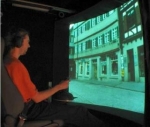 The simulator "exploits a vection illusion of the brain, which makes us believe we are moving when actually we are stationary. The same can be experienced, for instance, when you are stopped at a traffic light in your car and the car next to you edges forward. Your brain interprets this peripheral visual information as though you are moving backwards".
More information about the scientific background of this approach can be found in the paper entitled "Influence of Auditory Cues on the Visually Induced Self-Motion Illusion (Circular Vection) in Virtual Reality" (PDF format, 9 pages, 1.22 MB).
The VR system is the main outcome of the EU-funded project POEMS "Perceptually Oriented Ego — Motion Simulation".
10:41 Posted in Virtual worlds | Permalink | Comments (0) | Tags: Positive Technology