




Jan 09, 2005
Presence Research in Europe: Economic and Social
Presence Research in Europe: Economic and Social
Prospects
PREP 05
March 17 - 18, 2005
Hanover, Germany
Virtual and Augmented Reality applications diffuse into more and
more realms of business, research, and every day life. To make
people feel "present" in mediated environments is the goal of
many new technologies. But do we exploit the capacities of those
"Presence" technologies to full extent? What do the R & D
departments know that has not been adopted in applied
contexts? What do businesses and governments expect from
future VR and AR research? PREP 05 is the forum to discuss
these questions at a European level.

PREP 05 brings together leading researchers, industry
representatives and policy makers who are working on
development, applications and knowledge dissemination in the
domain of Presence. The concept of Presence is one of the
major research topics in the VR and AR communities, and the
European Commission is very actively supporting international
projects on Presence. PREP 05 is the 6th biannual gathering of
those projects, which are organized under the "Future Emerging
Technologies" Section of the Directorate General "Information
Society".
PREP 05 addresses the visions of how to use "Presence"
technologies for commercial success and the public good.
Reflecting the broad range of domains in which Presence is of
major relevance, PREP 05 will feature expert presentations on
VR-based business communication, tele-medicine, e-learning,
and entertainment. Moreover, invited speakers will introduce
European political visions on the economic and social prospects
of Presence research.
Experts from media technology corporations, e-government
projects, applied research centers, academic institutions, and
organizations who actually use VR / AR systems are invited to
join PREP 05, to share their ideas on the future of the field, and
to learn about the visions of leading experts in the field. PREP 05
will take place immediately after CeBIT, the world's leading IT
exhibition, and provides an excellent environment for networking
and exchange of ideas.
We cordially invite you to join us for PREP 2005 and contribute
your expertise and visions to the fields of VR, AR, and
"Presence" technologies.
For further information, please visit www.prep2005.info
<http://www.prep2005.info/> .
Conference Chair
Professor Peter Vorderer, Ph. D.
Annenberg School for Communication
University of Southern California
Los Angeles, USA
21:44 Posted in Positive Technology events | Permalink | Comments (0)
Jan 06, 2005
CRC-Clinical Cyberpsychology New Investigator Award
For a presentation of outstanding research quality
at the CyberTherapy 2005 conference
The aim of this prize is to reward the presentation of strong methodological
studies at the Cybertherapy conference. The recipient has to be a researcher
who is new to the field of cyberpsychology. It is open to both oral or poster
presentations and to researchers from all countries and disciplines.
For more information about the CyberTherapy conference and deadlines for
posters and oral presentations, see
http://www.interactivemediainstitute.com/conference2005.org/index.htm .
The award is delivered by Stéphane Bouchard, chairholder of the Canada
Research Chair in Clinical Cyberpsychology. It includes a certificate and a
check of 1 000 $ US.
Rules of attributions:
The first criterion to assess the submissions is the scientific merit of the
study. Rigorous designs, reliable measurements, adequate sample sizes,
appropriate statistical analyses and strong control conditions are all
significant assets. The scientific quality of the content of the presentation
will also contribute (i.e., clear and replicable descriptions of the
methodology), but not the graphic quality of the presentation (e.g., nice
images or videos).
The recipient must be the first author of the presentation, have the oral /
poster accepted for the conference, submit the presentation in time for the
award, pay the registration dues and personally attend to the conference. His
or her intellectual contribution must be significant (e.g., not the main
results of a funded study planned and conducted by a senior researcher in the
field but presented at the conference by a student). In case of doubt, please
explain the situation in writing when submitting your presentation to the
award.
A new investigator in the field is defined by meeting one the criteria below.
The applicant must stated in writing which criteria are met when sending the
submission:
- currently a university student;
- currently a post-doc researcher;
- currently an autonomous researcher but not having published as first
author more than five peer-reviewed papers on VR or cyberpsychology since the
end of the Ph.D. or the post-doc;
- currently an autonomous researcher but not having received more than
two major research grants on VR or cyberpsychology.
The content of the presentation must be submitted no later than two weeks
ahead of the conference to stephane.bouchard@uqo.ca
conducted during the days prior to the conference, based only on this
document. The recipient will be informed publicly during the conference.
All reviews will be made by Stéphane Bouchard, excepted for presentations
involving collaborators to the Chair (e.g., students, co-investigators). The
best submissions will be selected and ranked-ordered by Stéphane Bouchard
according to their scientific merit. Submission from collaborators to the
Chair will be reviewed by an independent reviewer (this year, Brenda
Wiederhold), compared to those rank-ordered and placed accordingly in the
ranks. To maximise impartiality, the decision of the independent reviewer will
be final.
If you have any question about this award, please contact Stéphane Bouchard by
e-mail or by phone (819-595-3900-ext. 2360).
The creation of this award is made possible by a Canada Research Chair (CRC)
grant (www.chairs.gc.ca
Bouchard for the CRC in Clinical Cyberpsychology. It is not awarded by the CRC
program or by the Cybertherapy organisation committee.
12:00 | Permalink | Comments (0)
Eyetop Multimedia: Mobile Virtual Reality at hand!
From Eyetop web-site
The EYETOP DVD personal video entertainment system gives you the freedom to watch your favorite DVD’s while you are commuting, waiting for a plane, or just relaxing in your easy chair. The high quality private image is like having your own personal home theatre…on the go. Imagine watching a favorite video while at the same time being able to move about….a walkabout video system!
Relaxing at home, commuting, flying, or even in a car*: you can now watch your favorite movie anytime! Just wear and watch! Eyetop DVD is the first video player that you can use as a simply as your favorite portable audio player: lightweight, fully portable and easily storable. Just choose your favorite movie, put your eyetop glasses on anywhere, and enjoy!
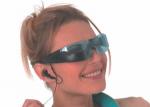
The system is preconnected and assembled in a ready to use format, just add batteries and presto….your own private video entertainment system.
Eyetop DVD, is first of all a DVD player as small as a CD player. Compact and powerful, it can read almost any disc format, DVD+ & - R & RW, MP3 and CDs and even Kodak photo cds. . With 4 hours of use, you can watch 2 movies without recharging the battery!
The EYETOP video glasses and DVD player may also be used separately. The EYETOP video glasses will accept any standard video input from a camcorder, video game, VCR or whatever. Just think how much more exciting video gaming can become wearing EYETOP video glasses. You can also plug the DVD player directly to the video composite input of your TV set (yellow plug) and turn it into a miniature table top multiformat DVD player.
The video image in the EYETOP video glasses is quickly optimized by easy vertical and horizontal adjustments. And there is a focus control for crystal clear sharp imagery. The individual electronic control unit allows additional adjustments to color, saturation, contrast and hue, just like your big screen TV.
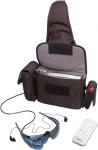
Eyetop DVD also has a miniaturized active matrice LCD screen and earbuds embedded in an eyewear that fits all!
Fully adjustable thanks to its 2 ergonomic settings (vertical and horizontal screen adjustment) and its 4 image settings. Discover a high definition colored screen with a size equivalent to the one of a laptop in front of you!
Enjoy your movie on this integrated screen (eyetop patented technology) and earbuds while keeping an eye on things around you.You do not need to store it when standing or walking from point to point. You can have a personal home theatre experience anywhere.
11:55 Posted in Wearable & mobile | Permalink | Comments (0) | Tags: Positive Technology, wearable
Jan 05, 2005
Computer generated brain surgery to help trainees
FROM THE PRESENCE-L LISTSERV:
[From E-Health Insider (<http://www.e-health-insider.com/news/item.cfm?ID=988>)...
Researchers at the University of Nottingham have developed a
virtual reality brain surgery simulator for trainee surgeons that
combines haptics with three-dimensional graphics to give what
they claim is the most realistic model in the world.
A 'map' of the brain surface is produced by the software, which
also renders the tweezers or other surgical implement and shows
any incisions made into the virtual brain. The simulator is
controlled by a device held by the user, which uses a robotic
mechanism to give the same pressure and resistance as it would
if it were touching a real brain.
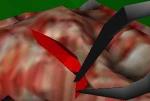
Map of brain on virtual surgery simulator
Dr Michael Vloeberghs, senior lecturer in paediatric neurosurgery
at the University's School of Human Development, who led the
development team, said that the new system would benefit
trainees: "Traditionally a large amount of the training that
surgeons get is by observing and performing operations under
supervision. However, pressures on resources, staff shortages
and new EU directives on working hours mean that this teaching
time is getting less and less.
"This simulator will allow surgeons to become familiar with
instruments and practice brain surgery techniques with
absolutely no risk to the patient whatsoever."
The pilot software was developed with the Queen's Medical
Centre, in Nottingham, which contains a Simulation Centre in
which dummies are often used for surgical training.
Dr Vloeberghs says that the haptic system is an improvement on
the existing system: "Dummies can only go so far – you're still
limited by the physical precense, and you can't do major surgery
on dummies... you can simulate electrically and phonetically what
is happening, but nothing more than that."
Adib Becker, Professor of Mechanical Engineering at the
university, said that the technology could be developed for the
future, and that brain surgery online could even be possible: "If
you project maybe four or five years from now, it may be possible
for a surgeon to operate on a patient totally remotely.
"So the surgeons would be located somewhere else in the world
and can communicate through the internet, and can actually feel
the operation as they are seeing it on the screen."
The team hopes that the piloted software, which was funded by a
grant of £300,000 from the Engineering and Physical Sciences
Research Council (EPSRC), will help train surgeons to a higher
level before their first operation on live patients, thereby
increasing safety.
15:05 Posted in Cybertherapy | Permalink | Comments (0) | Tags: Positive Technology, virtual reality, cybertherapy
Jan 04, 2005
Experience Colors!
Art | Color becomes all in Arcadia installation
By Edward J. Sozanski
Inquirer Columnist
Olafur Eliasson's installation at Arcadia University, Your colour
memory, might be the most intense and disorienting sensory
experience you'll ever have.
Being inside this oval space suffused with the most vivid color
imaginable, shifting at random through every hue of the spectrum
and then some, is like standing inside a sunrise.
The installation that transforms the Arcadia gallery into a color-
immersion chamber is complex technically, but easily described.
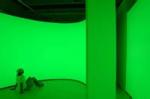
Inside the rectangular, high-ceilinged room, Eliasson has
constructed an oval, open-topped chamber with a small chamber
at one side that's curtained off.
One enters at the side, at a point where the encircling wall
separates like the first coil of a spiral. The inside surface of the
oval is made of translucent plastic stretched as taut as a
drumhead.
Inside the wall, whose outside surface is opaque, Eliasson has
installed a series of computer-controlled lights and filters. These
lights generate random sequences of primary and secondary
colors that change unpredictably.
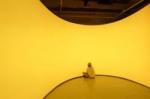
To say that the light in this chromatic bombardment is intense
understates the effect, which admittedly varies for each visitor.
We all see and react to colors differently, but I doubt anyone with
normal color vision would deny that Eliasson's installation
transforms color into a physical presence.
19:10 Posted in Cyberart | Permalink | Comments (0)
Transpersonal Psychology
From Wikipedia, the free encyclopedia.
A major motivating factor behind the initiative to establish this school of psychology was the already published work of Abraham Maslow regarding human peak experiences. Maslow was also one of the initiators behind the publication of the first issue of the Journal of Transpersonal Psychology in 1969, the leading academic journal in the field. This was soon to be followed by the founding of the Association for Transpersonal Psychology in 1972. Today Transpersonal Psychology also includes approaches to health, social sciences and practical arts. According to the Association for Transpersonal psychology the Transpersonal perspective includes such research interests as: Psychology and psychotherapy, Meditation, spiritual paths and practices, Change and personal transformation, Consciousness research, Addiction and recovery, Psychedelic and altered states of consciousness research, Death, dying and near death experience (NDE), Self-realization and higher values, The mind-body connection, Mythology and Shamanism and Exceptional Human Experience (EHE).
However, most psychologists do not hold strictly to traditional schools of psychology; most psychologists take an eclectic approach. Furthermore, the phenomena listed are considered by standard subdisciplines of psychology, religious conversion falling within the ambit of social psychology, altered states of consciousness within physiological psychology, and spiritual life within the psychology of religion. Transpersonal psychologists, however, disagree with the approach to such phenomena taken by traditional psychology, and claim that they have typically been dismissed either as signs of various kinds of mental illnesses or regression to infantile stages of psychosomatic development. One must not confuse transpersonal psychology with parapsychology- a mistake frequently made due to the unenviable academic reputation of both branches, and the eerie atmosphere surrounding the subjects investigated.
Although there are many disagreements with regard to transpersonal psychology, one could succinctly lay out a few basic traits of the field:
* transpersonal psychology is rooted in religious psychological doctrines expounded in: Zen Buddhism, Kabbalah, Gnosticism, Sufism, Vedanta, Taoism and Neoplatonism
* by common consent, the following branches are considered to be transpersonal psychological schools: Jungian Depth Psychology or, more recently rephrased by James Hillman, a follower of Carl Jung as Archetypal Psychology; Psychosynthesis founded by Roberto Assagioli and schools of Abraham Maslow and Robert Tart.
* Some transpersonal psychologists claim other authors, for example William James, as supporting their approach. This is controversial; it is unlikely that James ever used the expression "transpersonal" to describe his approach to psychology.
* Doctrines or ideas of many colorful personalities who were or are "spiritual teachers" in the Western world are often assimilated in the transpersonal psychology mainstream scene: Gurdjieff, Alice Bailey or Ken Wilber. This development is, generally, seen as detrimental to the aspiration of transpersonal psychologists to gain firm and respectable academic status.
All transpersonal psychologies, whichever their differences, share one basic contention: they claim that human beings possess the supraegoic centre of consciousness that is irreducible to all known states of empirical, or, better, "ordinary" consciousness (sleep, waking state, ...). This root of consciousness (and human existence, for some schools) is frequently called "Self" (or "Higher Self"), in order to distinguish it from "self" or "ego", which is equated to the seat of ordinary everyday waking consciousness. However, they differ in the crucial traits they ascribe to the Self:
* the supraegoic root of consciousness (the Self) survives bodily death in some transpersonal schools; for others, it dies with the body
* for ones, the Self is dormant and latent; for others, it is ever watchful and precedes empirical human consciousness
* some think that Self is mutable and potentially expandable; others aver that it is perfect and completely outside of time-space, and that only "ego" is subject to temporal change
Currently, transpersonal psychology (especially Archetypal Psychology of Carl Jung and his followers) is integrated, at least to some extent, to numerous psychology departments in US and European Universities; also, transpersonal therapies are included in many therapeutic practices.
14:40 Posted in Meditation & brain | Permalink | Comments (0) | Tags: Positive Technology, meditation
Upcoming VR-conferences
The 3rd Annual Virtual Reality, Associated Technologies and Rehabilitation Conference, University of Haifa, Israel, March 7-9, 2005, http://hw.haifa.ac.il/occupa/LIRT/
IEEE VR2005, Bonn, Germany, March 12-16, 2005, http://www.vr2005.org/view.php?nid=0
The 7th Annual Laval Virtual Reality International Conference and Exhibition, Laval, France, April 20-24, 2005, http://www.laval-virtual.org/en/index.php
CyberTherapy2005: A Decade of VR, Ramada Plaza, Basel, Switzerland, June 6-10, 2005, http://www.interactivemediainstitute.com/conference2005/
The 11th International Conference on Human-Computer Interaction, Las Vegas, Nevada, USA, July 22-27, 2005, http://www.hcii2003.gr/general/hcii2005.asp
The 4th International Workshop on Virtual Rehabilitation, Catalina Island, Los Angeles, California, September 19-21, 2005, http://www.iwvr.org/2005
14:29 Posted in Positive Technology events | Permalink | Comments (0)
MMVR13: Medicine Meets Virtual Reality
Medicine Meets Virtual Reality 2005
Long Beach, California, January 26 - 29, 2005
MMVR is the premier forum for computer scientists and physicians who develop, refine, and promote advanced, data-centered tools for clinical care and medical education. MMVR stimulates interdisciplinary networking and collaboration for improved research, validation, and commercialization.

Primary MMVR foci are medical and surgical simulation and information-guided diagnosis and therapy, along with supporting technologies: imaging, modeling, haptics, visualization, robotics, and informatics. Lectures, posters, workshops, and panels educate creators and advocates of emerging technologies.
MMVR encourages a vigorous discussion of current progress – from engineering groundwork, through assessment and validation studies, to experience with clinical and academic utilization and commercialization.
MMVR engineers, clinicians, and educators are a vanguard community of thinkers envisioning and making real the future of healthcare and medical education.
10:32 Posted in Positive Technology events | Permalink | Comments (0)
Jan 03, 2005
Free ISSUE of Journal of NeuroEngineering and Rehabilitation
Free Papers about VR available from the Journal of Neuroengineering and Rehabilitation
Patrick J. Sparto, Susan L. Whitney, Larry F. Hodges, Joseph M. Furman, Mark S. Redfern
Journal of NeuroEngineering and Rehabilitation 2004, 1:14 (23 December 2004)
[Abstract] [Provisional PDF]
Research
Considerations for the future development of virtual technology as a rehabilitation tool
Robert V. Kenyon, Jason Leigh, Emily A. Keshner
Journal of NeuroEngineering and Rehabilitation 2004, 1:13 (23 December 2004)
[Abstract] [Provisional PDF]
Review
Video capture virtual reality as a flexible and effective rehabilitation tool
Patrice L. Weiss, Debbie Rand, Noomi Katz, Rachel Kizony
Journal of NeuroEngineering and Rehabilitation 2004, 1:12 (20 December 2004)
[Abstract] [Provisional PDF]
Research
Reaching in reality and virtual reality: a comparison of movement kinematics in healthy subjects and in adults with hemiparesis
Antonin Viau, Anatol G. Feldman, Bradford J. McFadyen, Mindy F. Levin
Journal of NeuroEngineering and Rehabilitation 2004, 1:11 (14 December 2004)
[Abstract] [Provisional PDF]
Review
Motor rehabilitation using virtual reality
Heidi Sveistrup
Journal of NeuroEngineering and Rehabilitation 2004, 1:10 (10 December 2004)
[Abstract] [Provisional PDF]
Review
Presence and rehabilitation: toward second-generation virtual reality applications in neuropsychology
Giuseppe Riva, Fabrizia Mantovani, Andrea Gaggioli
Journal of NeuroEngineering and Rehabilitation 2004, 1:9 (8 December 2004)
[Abstract] [Provisional PDF]
Editorial
Virtual reality and physical rehabilitation: a new toy or a new research and rehabilitation tool?
Emily A Keshner
Journal of NeuroEngineering and Rehabilitation 2004, 1:8 (3 December 2004)
[Abstract] [Provisional PDF]
16:45 Posted in Cybertherapy | Permalink | Comments (0) | Tags: Positive Technology, virtual reality, cybertherapy
Enhanced intensive care system allows remote access to
FROM THE PRESENCE-L LISTSERV (by Mattew Lombard):
BUFFALO — Lucille Lamarca could feel her heart begin to beat
at a worrisome pace while lying alone in the intensive care unit at
Buffalo General Hospital with a heart condition.
Then from a speaker came a reassuring voice.
"Hi, I'm here," the voice said. "The nurse is on her way. You're
going to be OK."
It was the voice of a doctor who had been keeping an eye on
Lamarca from an office building miles away, via a remote camera
and a bank of computer screens.
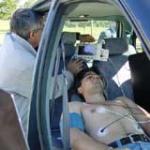
The hospital's parent, Kaleida Health System, is among an
expanding number of hospital systems adopting "enhanced
intensive care" technology — known as eICU — that allows
critical care doctors and nurses to monitor dozens of patients at
different hospitals simultaneously, much like an air traffic
controller keeps track of multiple planes.
From the Kaleida control station Monday, health professionals
were monitoring 58 patients at two hospitals via screens that
displayed patients' diagnosis and progress, doctors' notes and
real-time vital statistics like heart rate and blood pressure. The
remote caregivers alerted their onsite counterparts to changes or
potential problems through videoconferencing at the nurses'
stations.
Kaleida, which expects to bring its three other hospitals online in
the spring, stressed the technology is meant to enhance, not
replace, onsite care by allowing doctors to more quickly catch
and respond to trouble.
Kaleida is investing $4 million in personnel and equipment,
officials said.
The technology by Baltimore-based VISICU is in use at least 18
hospital systems nationwide, according to Kaleida, which this
summer became the 9th system to go online.
"I think that it changes the quality of the care in a way that could
not be equaled, even if you doubled or tripled the staffing onsite,"
said Dr. Cynthia Ambres, Kaleida's chief medical officer.
Those familiar with the technology predicted it would become
part of the future of critical care across the country, enabling
hospitals to make the best use of a limited number of intensive
care doctors.
Leapfrog Group, a nonprofit coalition of business and other
groups working to improve hospital operations, has cited a
severe shortage of intensivists practicing in the United States —
less than 6,000 at a time when nearly 5 million patients are
admitted to ICUs each year.
Sentara Healthcare was the first system to install eICU 4 1/2
years ago and now monitors 95 beds at five of its hospitals in
southeastern Virginia and northeastern North Carolina.
Sentara officials estimate the technology allowed them to save
97 lives in 2003, while covering 65 beds.
Instead of relying on a nurse to notice a problem, having her
page a physician and then having that doctor run to the ICU to
make a full evaluation, "all that information is brought to me,"
said Dr. Steven Fuhrman, Sentara's eICU medical director.
"The camera is such that I can count eyelashes," he said,
enabling him to check the patient's ventilator, intravenous
medication and anything else in the room while talking to the
patient and onsite staff.
"It's been described here as being in the room with your hands in
your pocket," Fuhrman said.
Ambres said the in-room cameras, which are not always on, are
seen as reassuring by patients, rather than an invasion of
privacy.
Lamarca, who was hospitalized in August, agreed.
"When you're in the ICU, you're very defenseless and they were
sensitive to that," she said. "I never felt it was an invasion of
privacy," said the Buffalo woman, adding that she could tell by
the position of the camera whether it was on or off.
15:05 Posted in Cybertherapy | Permalink | Comments (0) | Tags: Positive Technology, telemedicine