




Jan 01, 2005
Robocup Rescue
About Simulation League
The RoboCupRescue Simulation League competition is an international evaluation conference for the RoboCupRescue Simulation Project research.
The main purpose of the RoboCupRescue Simulation Project is to provide emergency decision support by integration of disaster information, prediction, planning, and human interface. A generic urban disaster simulation environment was constructed based on a computer network. Heterogeneous intelligent agents such as fire fighters, commanders, victims, volunteers, etc. conduct search and rescue activities in this virtual disaster world. Real-world interfaces such as helicopter images synchronizes the virtuality and the reality by sensing data. Mission-critical human interfaces such as PDA support disaster managers, disaster relief brigades, residents and volunteers decide their actions so as to minimize the disaster damage.
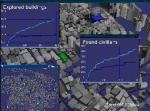
This problem introduces researchers advanced and interdisciplinary research themes. As AI/Robotics research, for example, behavior strategy (e.g. multi-agent planning, realtime/anytime planning, heterogeneity of agents, robust planning, mixed-initiative planning) is a challenging problem. For disaster researchers, RoboCupRescue works as a standard basis in order to develop practical comprehensive simulators adding necessary disaster modules.
18:40 Posted in AI & robotics | Permalink | Comments (0) | Tags: Positive Technology, robotics
Dec 29, 2004
Charles Tart: Virtual Reality & Altered States of Consciousness
The link between VR and altered states of consciousness is an interesting one. One of the first researchers that have discussed this relationship is Charles Tart. According to Tart, VR can be considered a new technological model of consciousness. In particular, he suggests that "stable patterns, stabilized systems of these internal virtual realities, constitute states of consciousness, our ordinary personality, and multiple personalities"
Of particular interest is Tart's explanation of the feeling of being "present" in a computer-generated world, although in its article he doesn't use the word presence. He suggests that presence emerges from a core psychological pattern which "automatically organizes the rest of experience around itself in a way that further supports the basic pattern". He thinks that this is the same process of perceiving a constellation. A constallation is not "real", because the spatial distribution of visible stars is random. However, once a pattern has organized, it is hard not to perceive it that way.
If you want to read more about Tart's theory of virtual reality, read these online articles:
Multiple Personality, Altered States and Virtual Reality: The World Simulation Process Approach
(This is the published version of the paper, which appeared as "Multiple Personality, Altered States and Virtual Reality: The World Simulation Process Approach" in the journal, "Dissociation," Vol. 3, 222-233)
Mind Embodied! Computer-Generated Virtual Reality as a New, Dualistic-Interactive Model for Transpersonal Psychology
(Based on a speech given at the L. E. Rhine Centenary Conference on Cultivating Consciousness for Enhancing Human Potential, Wellness and Healing, Durham, North Carolina, November 9, 1991. A modified version was later published in K. Rao (Editor), "Cultivating Consciousness: Enhancing Human Potential, Wellness and Healing." Westport, Connecticut: Praeger, 1993. Pp. 123-137.)

02:15 Posted in Telepresence & virtual presence | Permalink | Comments (0) | Tags: Positive Technology, Presence
Dec 28, 2004
Invited speech about Ambient Intelligence in Haifa
We have been invited by the Center for the Study of Information Society (Haifa, Israel) to present our framework about Ambient Intelligence.
The title of our presentation is: Ambient Intelligence: Conceptual and Practical Issues
More information can be found here:
http://infosoc.haifa.ac.il/events.htm
19:00 Posted in Positive Technology events | Permalink | Comments (0)