




Nov 29, 2006
Relaxation strategies and enhancement of hypnotic susceptibility
Relaxation strategies and enhancement of hypnotic susceptibility: EEG neurofeedback, progressive muscle relaxation and self-hypnosis.
Brain Res Bull. 2006 Dec 11;71(1-3):83-90
Authors: Batty MJ, Bonnington S, Tang BK, Hawken MB, Gruzelier JH
Hypnosis has been shown to be efficacious in a range of clinical conditions, including the management of chronic pain. However, not all individuals are able to enter a hypnotic state, thereby limiting the clinical utility of this technique. We sought to determine whether hypnotic susceptibility could be increased using three methods thought to facilitate relaxation, with particular interest in an EEG neurofeedback protocol which elevated the theta to alpha ratio. This was compared with progressive muscle relaxation and self-hypnosis. Ten subjects with moderate levels of susceptibility (2-7/12) were randomly assigned to each condition and assessed for hypnotic susceptibility prior to and upon completion of 10 sessions of training. Hypnotic susceptibility increased post-training in all groups, providing further evidence that operant control over the theta/alpha ratio is possible, but contrary to our predictions, elevation of the theta/alpha ratio proved no more successful than the other interventions. Nonetheless, all three techniques successfully enhanced hypnotic susceptibility in over half of the participants (17/30), a similar incidence to that reported using other methods. As previously reported, the majority who were not susceptible to modification were at the lower levels of susceptibility, and the greater increases tended to occur in the more susceptible subjects. However, here enhancement was disclosed in some at low levels, and capability was found of reaching high levels, both features not typically reported. Further research is warranted.
22:36 Posted in Biofeedback & neurofeedback | Permalink | Comments (0) | Tags: neurofeedback
Brain-computer interface technology as a tool to augment plasticity
Brain-computer interface technology as a tool to augment plasticity and outcomes for neurological rehabilitation.
J Physiol. 2006 Nov 16;
Authors: Dobkin BH
Brain-computer interfaces are a rehabilitation tool for tetraplegic patients that aim to improve quality of life by augmenting communication, control of the environment, and self-care. The neurobiology of both rehabilitation and BCI control depends upon learning to modify the efficacy of spared neural ensembles that represent movement, sensation, and cognition through progressive practice with feedback and reward. To serve patients, BCI systems must become safe, reliable, cosmetically acceptable, quickly mastered with minimal ongoing technical support, and highly accurate even in the face of mental distractions and the uncontrolled environment beyond a laboratory. BCI technologies may raise ethical concerns if their availability affects the decisions of patients who become locked-in with brain stem stroke or amyotrophic lateral sclerosis to be sustained with ventilator support. If BCI technology becomes flexible and affordable, volitional control of cortical signals could be employed for the rehabilitation of motor and cognitive impairments in hemiplegic or paraplegic patients by offering on-line feedback about cortical activity associated with mental practice, motor intention, and other neural recruitment strategies during progressive task-oriented practice. Clinical trials with measures of quality of life will be necessary to demonstrate the value of near-term and future BCI applications.
22:35 Posted in Brain-computer interface | Permalink | Comments (0) | Tags: brain-computer interface
Model train controlled via brain-machine interface
Re-blogged from Pink Tentacle
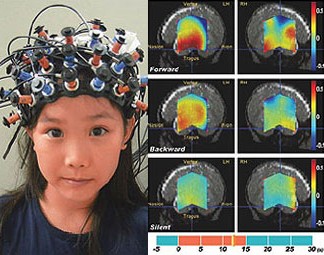
Hitachi has successfully tested a brain-machine interface that allows users to turn power switches on and off with their mind. Relying on optical topography, a neuroimaging technique that uses near-infrared light to map blood concentration in the brain, the system can recognize the changes in brain blood flow associated with mental activity and translate those changes into voltage signals for controlling external devices. In the experiments, test subjects were able to activate the power switch of a model train by performing mental arithmetic and reciting items from memory.
Link to Pink Tentacle post
22:24 Posted in Brain-computer interface | Permalink | Comments (0) | Tags: brain-computer interface
Moodjam mood visualization
Via Infoaesthetic

Moodjam is an online visualization of people's moods visualized as beautiful color strips. Users can keep a record of their moods every hour, day, and weeks and share them with friends, family or co-workers.
22:19 Posted in Emotional computing, Information visualization | Permalink | Comments (0) | Tags: information visualization, emotional computing
3D - Computer Based Pain Visualisation Tool
Via Medgadget

Researchers from Brunel University in the UK have developed a PDA-based pain recording and monitoring system:
Brunel University today unveils the World's first computer based, three-dimensional (3D) solution for pain visualisation. The tool will help patients record their own pain, as well as providing practitioners with a way to collect information on patient experience of pain and allows greater insight into the way pain travels around the body...
The innovative pain visualisation tool is displayed via a web browser as a 3D body. Users can log pain data on an easy-to-use PDA monitor at regular intervals. Pain can be classified as: burning, aching, stabbing, pins and needles and numbness with each pain type allocated a colour, which is represented on the 3D rotating tool.
The data is collected and the pain entries can be stored and replayed over an extended period as a rotating multimedia image, providing physicians with more detailed understanding of surface pain journeys.
Brunel University today unveils the World's first computer based, three-dimensional (3D) solution for pain visualisation. The tool will help patients record their own pain, as well as providing practitioners with a way to collect information on patient experience of pain and allows greater insight into the way pain travels around the body...
The innovative pain visualisation tool is displayed via a web browser as a 3D body. Users can log pain data on an easy-to-use PDA monitor at regular intervals. Pain can be classified as: burning, aching, stabbing, pins and needles and numbness with each pain type allocated a colour, which is represented on the 3D rotating tool.
The data is collected and the pain entries can be stored and replayed over an extended period as a rotating multimedia image, providing physicians with more detailed understanding of surface pain journeys.

22:07 Posted in Research institutions & funding opportunities | Permalink | Comments (0) | Tags: research tools
Driving a Wheelchair with Your Shirt
From Medgadget

Researchers Fishbach and Mussa-Ivaldi at Northwestern University's Department of Physical Medicine and Rehabilitation have developed a high-tech fabric which promises to help wheelchair bound patients.
From the article at MIT Tech Review:
Adaptive, sensor-laden garments could provide a new way for quadriplegics to control their wheelchairs. The system, which is still in an early stage of development, identifies the ideal set of movements that can be employed as control commands for each individual user. "We think this will benefit the most difficult patients, such as those who can move only their head or shoulders," says Alon Fishbach, a scientist at Northwestern who is among those developing the device.
People with high-level spinal-cord injuries often lose control of their hands, but they may still be able to move their shoulders or chests. More and more such patients survive their injuries, thanks to respiratory devices that help them breathe. But these people have limited options when selecting devices to control their wheelchairs or computers. They might use a sip/puff switch, which converts the user's sip or puff of air into a specific command, or a headswitch, which records head movements via a switch on the back of the wheelchair. "But the disadvantage of these devices is that patients must fit the capacities of the machine, rather than the other way around," says Ferdinando Mussa-Ivaldi, another Northwestern scientist working on the device. "If a patient can move their right side more than their left, an intelligent interface could pick up on this."
To overcome this design flaw, the researchers are developing an adaptive device using sensor-laden fabric. The garment is printed with 52 flexible, piezoresistive sensors developed at the University of Pisa. These sensors are made of electroactive polymers that change voltage depending on the angle at which they are stretched. The sensors can detect fine scale movements of the upper body and arms.
The researchers are currently focusing on a system to control wheelchairs, but they say the device could be used to control a wide range of machines.
21:13 Posted in Wearable & mobile | Permalink | Comments (0) | Tags: neurotechnology, wearable
Nov 28, 2006
bliin YourLIVE!
Re-blogged from Mauro Cherubini's moleskine
bliin YourLIVE! is a social networking service where users can spot, trace and share experiences — pictures, videos, audio and text — with one another in real-time on a Google Map.
Users create ‘bliins’ to navigate and monitor their interests in a location or area. bliins can be saved and shared amongst users. bliin is powered by GeoTracing and built on KeyWorx.

23:58 Posted in Social Media | Permalink | Comments (0) | Tags: social computing
Motor imagery of complex everyday movements
Motor imagery of complex everyday movements. An fMRI study.
Neuroimage. 2006 Nov 15;
Authors: Szameitat AJ, Shen S, Sterr A
The present study aimed to investigate the functional neuroanatomical correlates of motor imagery (MI) of complex everyday movements (also called everyday tasks or functional tasks). 15 participants imagined two different types of everyday movements, movements confined to the upper extremities (UE; e.g., eating a meal) and movements involving the whole body (WB; e.g., swimming), during fMRI scanning. Results showed that both movement types activated the lateral and medial premotor cortices bilaterally, the left parietal cortex, and the right basal ganglia. Direct comparison of WB and UE movements further revealed a homuncular organization in the primary sensorimotor cortices (SMC), with UE movements represented in inferior parts of the SMC and WB movements in superior and medial parts. These results demonstrate that MI of everyday movements drives a cortical network comparable to the one described for more simple movements such as finger opposition. The findings further are in accordance with the suggestion that motor imagery-based mental practice is effective because it activates a comparable cortical network as overt training. Since most people are familiar with everyday movements and therefore a practice of the movement prior to scanning is not necessarily required, the current paradigm seems particularly appealing for clinical research and application focusing on patients with low or no residual motor abilities.
23:50 Posted in Mental practice & mental simulation | Permalink | Comments (0) | Tags: mental practice
A Smarter Computer to Pick Stocks
| Via KurzweilAI.net Wall Street is adopting nonlinear decision making processes akin to how a brain operates, including neural networks, and genetic algorithms, and other advanced computer-science techniques. |
23:41 Posted in AI & robotics | Permalink | Comments (0) | Tags: artificial intelligence