




Dec 06, 2006
Pocket Projectors
Via KurzweilAI.net
The Microvision system, composed of semiconductor lasers and a tiny mirror, will be small enough to integrate projection technology into a phone or an iPod.

18:39 Posted in Future interfaces | Permalink | Comments (0) | Tags: future interfaces
Visuomotor learning in immersive 3D virtual reality in Parkinson's disease and in aging
Visuomotor learning in immersive 3D virtual reality in Parkinson's disease and in aging.
Exp Brain Res. 2006 Dec 5;
Authors: Messier J, Adamovich S, Jack D, Hening W, Sage J, Poizner H
Successful adaptation to novel sensorimotor contexts critically depends on efficient sensory processing and integration mechanisms, particularly those required to combine visual and proprioceptive inputs. If the basal ganglia are a critical part of specialized circuits that adapt motor behavior to new sensorimotor contexts, then patients who are suffering from basal ganglia dysfunction, as in Parkinson's disease should show sensorimotor learning impairments. However, this issue has been under-explored. We tested the ability of 8 patients with Parkinson's disease (PD), off medication, ten healthy elderly subjects and ten healthy young adults to reach to a remembered 3D location presented in an immersive virtual environment. A multi-phase learning paradigm was used having four conditions: baseline, initial learning, reversal learning and aftereffect. In initial learning, the computer altered the position of a simulated arm endpoint used for movement feedback by shifting its apparent location diagonally, requiring thereby both horizontal and vertical compensations. This visual distortion forced subjects to learn new coordinations between what they saw in the virtual environment and the actual position of their limbs, which they had to derive from proprioceptive information (or efference copy). In reversal learning, the sign of the distortion was reversed. Both elderly subjects and PD patients showed learning phase-dependent difficulties. First, elderly controls were slower than young subjects when learning both dimensions of the initial biaxial discordance. However, their performance improved during reversal learning and as a result elderly and young controls showed similar adaptation rates during reversal learning. Second, in striking contrast to healthy elderly subjects, PD patients were more profoundly impaired during the reversal phase of learning. PD patients were able to learn the initial biaxial discordance but were on average slower than age-matched controls in adapting to the horizontal component of the biaxial discordance. More importantly, when the biaxial discordance was reversed, PD patients were unable to make appropriate movement corrections. Therefore, they showed significantly degraded learning indices relative to age-matched controls for both dimensions of the biaxial discordance. Together, these results suggest that the ability to adapt to a sudden biaxial visuomotor discordance applied in three-dimensional space declines in normal aging and Parkinson disease. Furthermore, the presence of learning rate differences in the PD patients relative to age-matched controls supports an important contribution of basal ganglia-related circuits in learning novel visuomotor coordinations, particularly those in which subjects must learn to adapt to sensorimotor contingencies that were reversed from those just learned.
18:37 Posted in Cybertherapy | Permalink | Comments (0) | Tags: cybertherapy, virtual reality
Interactive pillows
re-blogged from infoaesthetics
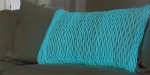
a pair of interactive pillows designed to enhance long-distance communication. users can interact with a pillow in a specific location, which activate dynamic textile patterns in a pillow located elsewhere: by leaning against, touching, or hugging a pillow, the pattern on the other pillow activates & glows dynamically. these ambient patterns expand the vocabulary for remote communication through tangible & aesthetic interactions.
00:49 Posted in Pervasive computing | Permalink | Comments (0) | Tags: ambient intelligence