




Aug 02, 2006
EJEL special issue on Communities of Practice and e-learning
In the issue of the Electronic Journal of E-Learning to be published in the summer of 2006, there will be a section focusing on Communities of Practice. This special section will examine, from a theoretical and practical perspective, how the concepts of Communities of Practice and e-learning can be combined.
Possible topics include:
- Communities of Practice for e-learning professionals;
- Establishing Communities of Practice to support e-learners
- Communities of Practice and informal e-learners;
- Technologies supporting Communities of Practice and e-learning
The Electronic Journal of e-Learning provides perspectives on topics relevant to the study, implementation and management of e-Learning initiatives.
The journal contributes to the development of both theory and practice in the field of e-Learning. The journal accepts academically robust papers, topical articles and case studies that contribute to the area of research in e-Learning.
10:33 Posted in Creativity and computers | Permalink | Comments (0) | Tags: collaborative computing
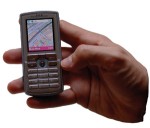
Urban Tapestries

Urban Tapestries aims to enable people to become authors of the environment around them – Mass Observation for the 21st Century. Like the founders of Mass Observation in the 1930s, we are interested creating opportunities for an "anthropology of ourselves" – adopting and adapting new and emerging technologies for creating and sharing everyday knowledge and experience; building up organic, collective memories that trace and embellish different kinds of relationships across places, time and communities.
It is part of an ongoing research programme of experiments with local groups and communities called Social Tapestries.
10:23 Posted in Information visualization, Telepresence & virtual presence, Wearable & mobile | Permalink | Comments (0) | Tags: locative media
ECGBL 2007: The European Conference on Games Based Learning
University of Paisley, Scotland, UK 25-26 October 2007
Over the last ten years, the way in which education and training is delivered has changed considerably with the advent of new technologies. One such new technology that holds considerable promise for helping to engage learners is Games-Based Learning (GBL).
The Conference offers an opportunity for scholars and practitioners interested in the issues related to GBL to share their thinking and research findings. The conference examines the question “Can Games-Based Learning Enhance Learning?” and seeks high-quality papers that address this question. Papers can cover various issues and aspects of GBL in education and training: technology and implementation issues associated with the development of GBL; use of mobile and MMOGs for learning; pedagogical issues associated with GBL; social and ethical issues in GBL; GBL best cases and practices, and other related aspects. We are particularly interested in empirical research that addresses whether GBL enhances learning. This Conference provides a forum for discussion, collaboration and intellectual exchange for all those interested in any of these fields of research or practice.
Important dates:
Abstract submission deadline: 17 May 2007
Notification of abstract acceptance: 24 May 2007
Full paper due for review: 5 July 2007
Notification of paper acceptance: 16 August 2007
Final paper due (with any changes): 6 September 2007
A full call for papers, online submission and registration forms and all other details are available on the conference website.
10:15 Posted in Creativity and computers, Positive Technology events, Virtual worlds | Permalink | Comments (0) | Tags: serious gaming
Aug 01, 2006
Drinking Games
Via Medgadget
Miles Cox, professor of the psychology of addictive behaviors at the University of Wales, is experimenting a computer-based approach to get alcoholics to ignore the potent cues that trigger their craving. The study has been covered by MIT Technology Review:
Just as these responses can be conditioned, they can also be de-conditioned, reasons Cox. His computer program helps abusers deal with the sight of alcohol, since it's often the first cue they experience in daily life. The program presents a series of pictures, beginning with an alcohol bottle inside a thick, colored frame. As fast as they can, users must identify the color of the frame. As users get faster, the test gets harder: the frame around the bottles becomes thinner. Finally, an alcohol bottle appears next to a soda bottle, both inside colored frames. Users must identify the color of the circle around the soda. The tasks teach users to "ignore the alcohol bottle" in increasingly difficult situations, says Cox.Such tests have long been used to study attention phenomena in alcohol abusers, but they have never been used for therapy, says Cox. His group adapted the test for this new purpose by adding elements of traditional therapy. Before the tests, users set goals on how quickly they want to react; a counselor makes sure the goals are achievable. After each session, users see how well they did. The positive feedback boosts users' motivation and mood, Cox says.
Find more on the ESRC study page
17:20 Posted in Cybertherapy, Serious games | Permalink | Comments (0) | Tags: serious gaming, cybertherapy
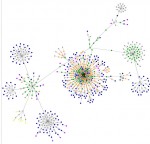
PTJ sitegraph
16:08 Posted in Information visualization | Permalink | Comments (0) | Tags: complex networks
Computer's schizophrenia diagnosis inspired by the brain
Via New Scientist
University of California at San Francisco researchers may have created a computerized diagnostic tool utilizing MRI based technology for determining whether someone has schizophrenia. From New Scientist:"Raymond Deicken at the University of California at San Francisco and colleagues have been studying the amino acid Nacetylaspartate (NAA). They found that levels of NAA in the thalamus region of the brain are lower in people with schizophrenia than in those without.To find out whether software could diagnose the condition from NAA levels, the team used a technique based on magnetic resonance imaging to measure NAA levels at a number of points within the thalamus of 18 people, half of whom had been diagnosed with schizophrenia. Antony Browne of the University of Surrey, UK, then analysed these measurements using an artificial neural network, a program that processes information by learning to recognise patterns in large amounts of data in a similar way to neurons in the brain.
Browne trained his network on the measurements of 17 of the volunteers to teach it which of the data sets corresponded to schizophrenia and which did not. He then asked the program to diagnose the status of the remaining volunteer, based on their NAA measurements. He ran the experiment 18 times, each time withholding a different person's measurements. The program diagnosed the patients with 100 per cent accuracy."
11:50 Posted in AI & robotics, Cybertherapy | Permalink | Comments (0)
Freq2
From Networked Performance (via Pixelsumo]
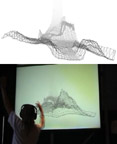
Freq2, by Squidsoup, uses your whole body to control the precise nature of a sound - a form of musical instrument. The mechanism used is to trace the outline of a person's shadow, using a webcam, and transform this line into an audible sound. Any sound can be described as a waveform - essentially a line - and so these lines can be derived from one's shadow. What you see is literally what you hear, as the drawn wave is immediately audible as a realtime dynamic drone.
Freq2 adds to this experience by adding a temporal component to the mix; a sonic composition in which to frame the instrument. The visuals, an abstract 3-dimensional landscape, extrudes in realtime into the distance, leaving a trail of the interactions that have occurred. This `memory' of what has gone before is reflected in the sounds, with long loops echoing passed interactions. The sounds, all generated in realtime from the live waveform, have also been built into more of a compositional soundscape, with the waveform being played at a range of pitches and with a rhythmic component.
Watch video
11:39 Posted in Cyberart | Permalink | Comments (0) | Tags: cyberart
Oribotics
via textually.org
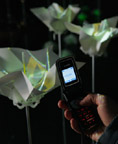
Oribotics - by Matthew Gardiner - is the fusion of origami and technology, specifically 'bot' technology, such as robots, or intelligent computer agents known as bots. The system was designed to create an intimate connection between the audience and the bots; a cross between gardening, messaging a friend, and commanding a robot. It was developed during an Australian Network for Artists and Technology (ANAT) artists lab; achieved with Processing as an authoring tool, and connected a mobile phone via a USB cable.
"Ori-botics is a joining of two complex fields of study. Ori comes from the Japanese verb Oru literally meaning 'to fold'. Origami the Japanese word for paper folding, comes from the same root. Oribotics is origami that is controlled by robot technology; paper that will fold and unfold on command. An Oribot by definition is a folding bot. By this definition, anything that uses robotics/botics and folding together is an oribot. This includes some industrial applications already in existance, such as Miura's folds taken to space, and also includes my two latest works. Orimattic, and Oribotics."
11:38 Posted in AI & robotics, Cyberart | Permalink | Comments (0) | Tags: cyberart
Jul 31, 2006
Immersive Medical Telepresence conference
Phoenix, Arizona, 6-7 September 2006

From the conference website
The Health Sciences, perhaps more than any other discipline, is dependent of images / video and the analysis of these images to be successful. This is true in biomedical research, health education and of course in clinical care. These images are increasingly digital and improving in resolution by orders of magnitude. This simultaneously allows more flexibility with the analysis of the image and much better analysis. The data resources are logically growing exponentially there is a growing need to share and compare images.
The ability to effectively use and share these resources is often a local issue with individual solutions being developed. There are exceptions and when they are discovered they are often treated as significant success stories. For example, the SUMMIT Project at Stanford University has created a significant set of stereoscopic and haptically enabled Digital Anatomy resources. These resources and the expertise at Stanford will be used across the nation and now internationally to teach anatomy courses.
As the health sciences continue to become more specialized and the educational resources become more difficult to locate, advanced networking that allows secure, reliable access to expertise and high quality resources is critical. The ability to create virtual organizations and collaborate with and among students, professors, researchers, and clinicians irrespective of location is of increasing value.
At the same time, large-capacity research networks (e.g., Internet2 and peered networks, GLORIAD) and high-quality video applications (e.g., DV-over-IP, developed by the WIDE Project and stereoscopic HD video-over-IP realized by GIST are making such virtual collaboration technically possible and financially affordable. However, the absence of (human) networking opportunities has hampered the development of sustainable testbeds and slowed the rate of innovation.
This workshop will focus on our ability to effectively use and manipulate image / video resources irrespective of their location. It will also showcase many emerging technologies relevant to the medical field. Most importantly, it will provide an opportunity for those in the medical community to learn alongside experts in the area of video technologies and large capacity networking about the challenges ahead and to begin a discussion about how those challenges can be met.
23:26 Posted in Positive Technology events, Telepresence & virtual presence, Virtual worlds | Permalink | Comments (0) | Tags: virtual reality, telepresence
Applications of Virtual Reality Technology in the Measurement of Spatial Memory in Patients with Mood Disorders
The January 2006 CNS Spectrums included an article about virtual reality (VR) technology as a treatment option in psychiatry and Dr. Gorman welcomed letters discussing novel applications of VR in psychiatry. Much of the published work in this area is treatment-related. It appears that a limited number of researchers have considered using this technology for clinical assessment and research purposes. This is likely to change as immersive VR shows promise for increasing ecological validity in assessment and providing a much richer set of behavioural data.
In collaboration with the Informatics Research Institute (IRI) at Newcastle University in Newcastle upon Tyne, England, we are assessing the validity of this approach. The IRI manages an immersive VR suite, and our collaboration has allowed us to develop a novel paradigm to test spatial memory in patients with mood disorders. Our interest in spatial memory in this group stems from neuroimaging research reporting atrophy in the hippocampal region for patients with major depressive disorder and bipolar disorder. The hippocampus is involved in spatial memory, and individuals with hippocampal lesions are impaired on tasks of spatial memory.
17:30 Posted in Cybertherapy, Virtual worlds | Permalink | Comments (0) | Tags: virtual reality, cybertherapy
Mapping implied body actions in the human motor system
Mapping implied body actions in the human motor system.
J Neurosci. 2006 Jul 26;26(30):7942-9
Authors: Urgesi C, Moro V, Candidi M, Aglioti SM
The human visual system is highly tuned to perceive actual motion as well as to extrapolate dynamic information from static pictures of objects or creatures captured in the middle of motion. Processing of implied motion activates higher-order visual areas that are also involved in processing biological motion. Imagery and observation of actual movements performed by others engenders selective activation of motor and premotor areas that are part of a mirror-neuron system matching action observation and execution. By using single-pulse transcranial magnetic stimulation, we found that the mere observation of static snapshots of hands suggesting a pincer grip action induced an increase in corticospinal excitability as compared with observation of resting, relaxed hands, or hands suggesting a completed action. This facilitatory effect was specific for the muscle that would be activated during actual execution of the observed action. We found no changes in responsiveness of the tested muscles during observation of nonbiological entities with (e.g., waterfalls) or without (e.g., icefalls) implied motion. Thus, extrapolation of motion information concerning human actions induced a selective activation of the motor system. This indicates that overlapping motor regions are engaged in the visual analysis of physical and implied body actions. The absence of motor evoked potential modulation during observation of end posture stimuli may indicate that the observation-execution matching system is preferentially activated by implied, ongoing but not yet completed actions.
16:45 Posted in Mental practice & mental simulation | Permalink | Comments (0) | Tags: mental practice, motor imagery