



Aug 08, 2006
The Travels of Mariko Horo
Re-blogged from Networked Performance
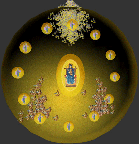
The Travels of Mariko Horo by Tamiko Thiel: Sometime between the 12th and the 22nd centuries Mariko HMrM, Mariko the Wanderer, journeys westward from Japan in search of the Buddhist Paradise floating in the Western Seas. She does find Paradise, but finds also a chilling, darker side to the West, an island where lost souls are held in an eternal Limbo. She encapsulates her impressions of the places she visits in a series of 3D virtual worlds and invites you to see the West through her eyes.
The Travels of Mariko is an interactive 3D virtual reality installation. The image is generated in real time on a fast gaming PC and projected on a large 9 x 12 screen to produce an immersive experience. Users move their viewpoint through the virtual environment with a joystick or similar navigational input device. Mariko is a fictitious character Thiel invented to incorporate the viewpoint for the project - users will never actually see Mariko, except perhaps in a mirror. In essence they will be Mariko, seeing the exotic and mysterious Occident through her eyes and experiences.
The virtual environment is sensitive to their presence, changing around them as a result of their movements and actions: An empty church fills with saints who vanish into the heavens. A basilica transports the user directly into the Western Cosmos, where angels sing the praises of the Goddess of Compassion. A pavilion takes users deep into the underwater realm of the Heavenly King. A plain wooden chapel leads into a Limbo of constant torment.
Music for Mariko Horo is embedded in the piece itself, localized to specific places within the 3D world. The composer Ping Jin, Professor of Music at SUNY/New Paltz, studied music both in his native China and in the USA. Ping describes the music as "creating a sonic dimension for Mariko's meditation on the mythic West. Created from both sampled and computer generated sounds, there are fusions and juxtapositions of Eastern and Western sounds to enhance the scene and mood of each section."
World premiere:
July 29 - November 26, 2006: "Edge Conditions" show, part of the Pacific Rim Theme of ISEA2006 Symposium/ZeroOne San Jose Festival at the San Jose Museum of Art, USA.
14:13 Posted in Cyberart, Virtual worlds | Permalink | Comments (0) | Tags: cyberart, virtual reality
The Talented Mr. Ripley
Via Thinking Meat
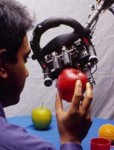
Ripley is a robot designed by Deb Roy of the Cognitive Machines Group at MIT's Media Lab.
This robot was designed for learning about the environment by moving and touching objects in it. The underlying theoretical framework is the "Grounded Situation Model". In this approach, developed by Deb Roy and his colleague Nikolaos Mavridis, "the robot updates beliefs about its physical environment and body, based on a mixture of linguistic, visual and proprioceptive evidence. It can answer basic questions about the present or past and also perform actions through verbal interaction".
This story on NPR reports about the project, and includes an interview with Deb Roy.
From the MIT's Media Lab website
We have constructed a 7 degree-of-freedom robot, Ripley, to investigate connections between natural language semantics, perception, and action. Our goal is to enable Ripley to perform collaborative manipulation tasks mediated by natural spoken dialogue. Key issues include representation and learning of spatial language, object and temporal reference, and physical actions / verbs. Furthermore, a "Grounded Situation Model" representation has been designed for Ripley, as well as associated processes, and a cognitive architecture was implemented through numerous intercommunicating modules.
Links to Ripley video clips (from the MIT Media Lab website):
Ripley imagines and remembers [high resolution (12M) | low resolution (440K)]
Ripley tracks faces [high resolution (6M) | low resolution (280K)]
Ripley imagines objects [high resolution (13.5M) | low resolution (826k)]
Ripley grasping objects [high resolution (201M) | low resolution (23M)]
Ripley changing perspectives [.mov, 17M)]
Training HMM model to pick up [.mov, 844K)]
HMM model generating pick up [.mov, 791K)]
14:07 Posted in AI & robotics | Permalink | Comments (0) | Tags: artificial intelligence
Neural correlates of a mystical experience in Carmelite nuns
13:39 Posted in Meditation & brain | Permalink | Comments (0) | Tags: meditation and brain
Aug 07, 2006
Social Impact Games
14:43 Posted in Serious games | Permalink | Comments (0) | Tags: serious gaming