



Jul 17, 2007
Global mobile phone use to hit record 3.25 billion
Global mobile phone use to hit record 3.25 billion ( i.e. half world population )
00:27 Posted in Wearable & mobile | Permalink | Comments (0) | Tags: mobile phones
Plumi — free software video sharing platform
EngageMedia are very excited to announce the release of Plumi, a free software video sharing platform. Plumi enables you to create a sophisticated video sharing and community site out-of-the-box. In a web landscape where almost all video sharing sites keep their distribution platform under lock and key Plumi is one contribution to creating a truly democratic media.
00:23 | Permalink | Comments (0) | Tags: future interfaces
Antinormalizer
Via Smart Mobs
Brett Stalbaum and Derek Lomas from UC San Diego have developed Antinormalizer, a location media program that provides a creative approach of the relationship between people and their cell phones.
From Smart Mobs:
“What’s Antinormalizer?” you’ll ask. It’s basically a “hot spots” or location media program. A GPS system is aware of the mobile owner’s location and triggers an audio file to be played at that particular location. Derek scripted a number of activities delivered by these audios for people to perform with the goal of changing the “social lubrication” in a certain area, modify the normal social script in order to initiate interesting behaviors.
With Antinormalizer people play a game: instead of doing the normal stuff (like picking up the phone and simply talking to the other person), people are told to do something “outrageous,” so out of the ordinary, while their friends are taking pictures of that abnormal behavior. The best picture wins the game. The range of the abnormal behaviors can vary from reading your book while laid down on a parking spot, to playing some jungle rhythms as loud as you can, using paint bucket bottoms. If you don’t find that challenging enough, you can always clime a ten foot statue in the campus or talk to your friend across the street while you’re both sitting in a trashcan.
00:20 Posted in Locative media | Permalink | Comments (0) | Tags: locative media
Gesture-control for regular TV
Australian engineers Prashan Premaratne and Quang Nguye have designed a novel gesture-control for regular TV.

The controller's built-in camera can recognise seven simple hand gestures and work with up to eight different gadgets around the home. According to designers:
“Crucially for anyone with small children, pets or gesticulating family members, the software can distinguish between real commands and unintentional gestures“.
Premaratne and Nguye predict the system availability on the market within three year.
00:13 Posted in Future interfaces | Permalink | Comments (0) | Tags: future interfaces
Delicate Boundaries
Re-blogged from We Make Money Not Art
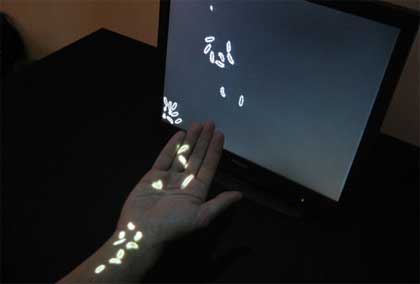
Delicate Boundaries, a work by Chris Sugrue, uses human touch to dissolve the barrier of the computer screen. Using the body as a means of exchange, the system explores the subtle boundaries that exist between foreign systems and what it might mean to cross them. Lifelike digital animations swarm out of their virtual confinement onto the skin of a hand or arm when it makes contact with a computer screen creating an imaginative world where our bodies are a landscape for digital life to explore.
Video.
00:03 Posted in Cyberart, Future interfaces | Permalink | Comments (0) | Tags: future interfaces