




Jul 14, 2007
RunBot

Researchers from Germany and the United Kingdom have developed a bipedal walking robot, capable of self-stabilizing via a highly-developed learning process.
From the study abstract:
In this study we present a planar biped robot, which uses the design principle of nested loops to combine the self-stabilizing properties of its biomechanical design with several levels of neuronal control. Specifically, we show how to adapt control by including online learning mechanisms based on simulated synaptic plasticity. This robot can walk with a high speed (>3.0 leg length/s), self-adapting to minor disturbances, and reacting in a robust way to abruptly induced gait changes. At the same time, it can learn walking on different terrains, requiring only few learning experiences. This study shows that the tight coupling of physical with neuronal control, guided by sensory feedback from the walking pattern itself, combined with synaptic learning may be a way forward to better understand and solve coordination problems in other complex motor tasks.
The paper: Adaptive, Fast Walking in a Biped Robot under Neuronal Control and Learning (Manoonpong P, Geng T, Kulvicius T, Porr B, Worgotter F (2007) Adaptive, Fast Walking in a Biped Robot under Neuronal Control and Learning. PLoS Comput Biol 3(7): e134)
16:18 Posted in AI & robotics | Permalink | Comments (0) | Tags: artificial intelligence, robotics
The EyesWeb Project

From InfoMus Lab: Laboratorio di Informatica Musicale’s, Genova, Italy
The EyesWeb Project - The EyesWeb research project aims at exploring and developing models of interaction by extending music language toward gesture and visual languages, with a particular focus on the understanding of affect and expressive content in gesture. For example, in EyesWeb we aim at developing methods able to distinguish the different expressive content from two instances of the same movement pattern, e.g., two performances of the same dance fragment. Our research addresses the fields of KANSEI Information Processing and of analysis and synthesis of expressiveness in movement. More.
The EyesWeb open platform (free download) has been originally conceived for supporting research on multimodal expressive interfaces and multimedia interactive systems. EyesWeb has also been widely employed for designing and developing real-time dance, music, and multimedia applications. It supports the user in experimenting computational models of non-verbal expressive communication and in mapping gestures from different modalities (e.g., human full-body movement, music) onto multimedia output (e.g., sound, music, visual media). It allows fast development and experiment cycles of interactive performance set-ups by including a visual programming language allowing mapping, at different levels, of movement and audio into integrated music, visual, and mobile scenery.
EyesWeb has been designed with a special focus on the analysis and processing of expressive gesture in movement, midi, audio, and music signals. It was the basic platform of the EU-IST Project MEGA and it has been employed in many artistic performances and interactive installations. More.
16:15 Posted in Future interfaces | Permalink | Comments (0) | Tags: cybermusic
New NIH Neurotech Funding Opportunities

NIH announced new Federal funding to advance understanding of the nervous system, behavior or the diagnosis and treatment of nervous system diseases and disorders, through support of research, development, and enhancement of a wide range of neurotechnologies.
16:11 Posted in Neurotechnology & neuroinformatics | Permalink | Comments (0) | Tags: neurotechnology, neuroinformatics
Jul 13, 2007
A VR extended neuropsychological assessment for topographical disorientation
A virtual reality extended neuropsychological assessment for topographical disorientation: a feasibility study.
J Neuroengineering Rehabil. 2007 Jul 11;4(1):26
Authors: Morganti F, Gaggioli A, Strambi L, Rusconi ML, Riva G
ABSTRACT: BACKGROUND: Topographical disorientation represents one of the main consequences of brain injury. Up to now several methodological approaches have been used in the assessment of the brain injured patient's navigational abilities showing a moderate correlation with the impairments observed in everyday contexts. METHODS: We propose a combination of standardized neuropsychological tests and a more situated virtual reality-based assessment for the evaluation of spatial orientation in brain injured patients. RESULTS: When tested with this virtual reality integrated procedure patients showed performance and execution times congruent with their neuropsychological evaluation. When compared to a control group, patients revealed significantly slower times and greater errors in solving virtual reality based spatial tasks. CONCLUSIONS: The use of virtual reality, when combined with classical neuropsychological tests, can provide an effective tool for the study of topographical disorientation.
19:44 Posted in Research tools | Permalink | Comments (0) | Tags: virtual reality
Direct instrumental conditioning of neural activity using fMRI feedback
Direct instrumental conditioning of neural activity using functional magnetic resonance imaging-derived reward feedback.
J Neurosci. 2007 Jul 11;27(28):7498-507
Authors: Bray S, Shimojo S, O'Doherty JP
19:39 Posted in Biofeedback & neurofeedback | Permalink | Comments (0) | Tags: neurofeedback
Jul 11, 2007
Gadgets may help merge virtual reality with real life
reBlogged from networked performance
LindenLab, the company behind Second life, hopes to introduce hand-held and wearable systems that act as gateways between the real and virtual worlds. Linden Lab and other virtual worlds also are developing versions that run on existing mobile phones.
Researchers at a recent virtual worlds conference at MIT said that special eyewear, display "badges," and speakers worn about the neck will allow us to live more fully through our avatars - those idealized versions of ourselves that typically boast better proportions than the saggy originals.
Read full article
22:00 Posted in Augmented/mixed reality | Permalink | Comments (0) | Tags: mixed reality
Randomized controlled trial of virtual reality simulator training: transfer to live patients
Randomized controlled trial of virtual reality simulator training: transfer to live patients.
Am J Surg. 2007 Aug;194(2):205-11
Authors: Park J, MacRae H, Musselman LJ, Rossos P, Hamstra SJ, Wolman S, Reznick RK
BACKGROUND: New Residency Review Committee requirements in general surgery require 50 colonoscopies. Simulators have been widely suggested to help prepare residents for live clinical experience. We assessed a computer-based colonoscopy simulator for effective transfer of skills to live patients. METHODS: A randomized controlled trial included general surgery and internal medicine residents with limited endoscopic experience. Following a pretest, the treatment group (n = 12) practiced on the simulator, while controls (n = 12) received no additional training. Both groups then performed a colonoscopy on a live patient. Technical ability was evaluated by expert endoscopists using previously validated assessment instruments. RESULTS: In the live patient setting, the treatment group scored significantly higher global ratings than controls (t(22) = 1.84, P = .04). Only 2 of the 8 computer-based performance metrics correlated significantly with previously validated global ratings of performance. CONCLUSIONS: Residents trained on a colonoscopy simulator prior to their first patient-based colonoscopy performed significantly better in the clinical setting than controls, demonstrating skill transfer to live patients. The simulator's performance metrics showed limited concurrent validity, suggesting the need for further refinement.
21:54 Posted in Virtual worlds | Permalink | Comments (0) | Tags: virtual reality
MIT Media Lab: Responsive Environment Group
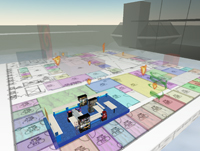
"Dual reality" is the concept of maintaining two worlds, one virtual and one real, that reflect, influence, and merge into each other by means of deeply embedded sensor/actuator networks. Both the real and virtual components of a dual reality are complete unto themselves, but are enriched by their mutual interaction. The Dual Reality Media Lab is an example of such a dual reality, as enabled the Plug sensor / actuator network that links our actual lab space to a virtual lab space in the Second Life online virtual world. [MOV]
21:47 Posted in Pervasive computing | Permalink | Comments (0) | Tags: interreality
Myomo e100 NeuroRobotic System
Via Medgadget
US company Myomo has announced that the e100 NeuroRobotic System, a technology designed to help in the rehabilitation process of patients by "engaging and reinforcing both neurological and motor pathways," has received FDA clearance to market.
How it Works
- Patient's brain is the controller: When a patient attempts movement during therapy, their muscles contract and electrical muscle activity signals fire
- Non-invasive sensing: An EMG sensor sits on the skin's surface to detect and continuously monitor a person's residual electrical muscle activity
- Proprietary system software: Advanced signal processing software filters and processes the user's EMG signal, and then forwards the data to a robotic device
- Proportional assistance: Portable, wearable robotics use the person's EMG signal to assist with desired movement; power assistance is customized to patient ability with Myomo's real-time adjustable control unit.

Product page: Myomo e100 NeuroRobotic System ...
21:36 Posted in AI & robotics, Cybertherapy | Permalink | Comments (0) | Tags: cybertherapy
Using a Robot to Teach Human Social Skills
Via KurzweilAI
A humanoid robot designed to teach autistic children social skills has begun testing in British schools. Known as KASPAR (Kinesics and Synchronisation in Personal Assistant Robotics), the $4.33 million bot smiles, simulates surprise and sadness
Read full article
21:26 Posted in AI & robotics, Cybertherapy | Permalink | Comments (0) | Tags: artificial intelligence, robotics, cybertherapy
Jul 09, 2007
Postdoctoral Position in Theoretical Neuroscience at CNCR, Amsterdam
20:51 Posted in Research institutions & funding opportunities | Permalink | Comments (0) | Tags: neuroscience