




Oct 29, 2006
IDC 2007 Interaction Design and Children Conference - Aalborg, Denmark
Via UsabilityNews
Event Date: 6 June 2007 to 8 June 2007
The increased focus on children’s role in the design and evaluation of interactive technologies has provided several interesting research studies and results. Currently, we are aware of the fact that children are very different than adults, they are independent individuals with their own strong opinions, needs, likes, and dislikes, and they should be treated as such.
To address emerging research and development, IDC 2007 will look for papers, demonstrations, posters that may include at least one of the following broad areas:
- Emerging technologies for children (e.g., innovative educational simulations, online games, accessible fabrication devices, mobile communications devices, wireless embedded technologies, sensors and actuators, "smart" materials, authoring/programming tools)
- The impact these technologies can have on children's lives (e.g., in schools, at home, in public spaces)
- New research methods which give children a voice in the design, development, and evaluation processes (e.g., participatory design methods, usability testing, etc.)
Please refer to the call for papers.
22:23 Posted in Positive Technology events | Permalink | Comments (0) | Tags: interaction design, positive technology events
Patient Readiness and Willingness to Pay for Online Services
Re-blogged from eHealth
In a new article from the Journal of Medical Internet Research, Kenneth Adler of Tuscon reports on his study of 346 patients in his practice regarding their use of online services and willingness to pay for them. Conclusion: patient's of any age would be willing to pay $10 per year for a web portal where they could view their test results and other medical information. While this may seem small, the author points out that if around 50% of patients in a large practice were willing to pay this, the program would pay for itself. Reimbursement for email consultations or eVisits is still rare so this business model is one to consider.
22:17 Posted in Cybertherapy | Permalink | Comments (0) | Tags: cybertherapy
Oct 28, 2006
Recovery of hand function through mental practice: A study protocol.
Recovery of hand function through mental practice: A study protocol.
BMC Neurol. 2006 Oct 26;6(1):39
Authors: Ietswaart M, Johnston M, Dijkerman HC, Scott CL, Joice SA, Hamilton S, Macwalter RS
BACKGROUND: The study aims to assess the therapeutic benefits of motor imagery training in stroke patients with persistent motor weakness. There is evidence to suggest that mental rehearsal of movement can produce effects normally attributed to practising the actual movements. Imagining hand movements could stimulate the redistribution of brain activity, which accompanies recovery of hand function, thus resulting in a reduced motor deficit. Methods/ Design A multi-centre randomised controlled trial recruiting individuals between one and six months post-stroke ( n = 135). Patients are assessed before and after a four-week evaluation period. In this trial, 45 patients daily mentally rehearse movements with their affected arm under close supervision. Their recovery is compared to 45 patients who perform closely supervised non-motor mental rehearsal, and 45 patients who are not engaged in a training program. Motor imagery training effectiveness is evaluated using outcome measures of motor function, psychological processes, and level of disability. DISCUSSION: The idea of enhancing motor recovery through the use of motor imagery rehabilitation techniques is important with potential implications for clinical practice. The techniques evaluated as part of this randomised controlled trial are informed by the current understanding in cognitive neuroscience and the trial is both of scientific and applied interest. Trial Registration; Clinical Trial Registration; current clinical trial protocol registration NCT00355836.
18:40 Posted in Mental practice & mental simulation | Permalink | Comments (0) | Tags: mental practice
Brain-machine interfaces: past, present and future
Brain-machine interfaces: past, present and future.
Trends Neurosci. 2006 Sep;29(9):536-46
Authors: Lebedev MA, Nicolelis MA
Since the original demonstration that electrical activity generated by ensembles of cortical neurons can be employed directly to control a robotic manipulator, research on brain-machine interfaces (BMIs) has experienced an impressive growth. Today BMIs designed for both experimental and clinical studies can translate raw neuronal signals into motor commands that reproduce arm reaching and hand grasping movements in artificial actuators. Clearly, these developments hold promise for the restoration of limb mobility in paralyzed subjects. However, as we review here, before this goal can be reached several bottlenecks have to be passed. These include designing a fully implantable biocompatible recording device, further developing real-time computational algorithms, introducing a method for providing the brain with sensory feedback from the actuators, and designing and building artificial prostheses that can be controlled directly by brain-derived signals. By reaching these milestones, future BMIs will be able to drive and control revolutionary prostheses that feel and act like the human arm.
18:29 Posted in Brain-computer interface | Permalink | Comments (0) | Tags: brain-computer interface
Oct 27, 2006
How many megapixels equivalent does the eye have?
22:06 Posted in Research tools | Permalink | Comments (0) | Tags: research tools
PaPeRo Robot Childcare In Japan
Via Technovelgy
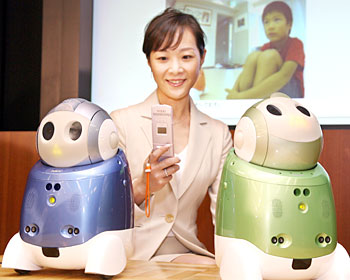
NEC and NTT have jointly produced PaPeRo (short for Partner-type Personal Robot), the latest of a series of domestic robots. PaPeRo uses a camera in each eye to navigate and has image recognition capabilities to track and identify individual children. Further, it is equipped with a mobile phone that allows parents to control him at distance, as well as to talk to children directly or with text messages
22:02 Posted in AI & robotics | Permalink | Comments (0) | Tags: artificial intelligence, robotics
Five-year, $50 million digital media and learning initiative launched by The MacArthur Foundation
Via Interactive Multimedia Technology
Building the Field of Digital Media and Learning: MacArthur Foundation, private grantmaking institution focused on human and community development, global security and sustainability, launches a $50 million Digital Media and Learning initiative:
"The MacArthur Foundation launched its five-year, $50 million digital media and learning initiative in 2006 to help determine how digital technologies are changing the way young people learn, play, socialize, and participate in civic life. Answers are critical to developing educational and other social institutions that can meet the needs of this and future generations. The initiative is both marshaling what is already known about the field and seeding innovation for continued growth"
22:01 Posted in Research institutions & funding opportunities | Permalink | Comments (0) | Tags: funding opportunities
Vision-body link tested in robot experiments
Tests involving real and simulated robots suggest the relationship between physical movement and sensory input could be crucial to create smarter machines...
Read the full story
22:01 Posted in AI & robotics | Permalink | Comments (0) | Tags: artificial intelligence, robotics
The science of the invisible
From CBC News
British and U.S. researchers have developed a cloak that renders the wearer invisible. The shield, a set of metamaterial concentric rings, can redirect microwave beams so they flow around a “hidden” object inside. The cloak is designed for operation over a band of microwave frequencies, and works only in two dimensions.
Metamaterial Electromagnetic Cloak at Microwave Frequencies.
Authors: D. Schurig, J.J. Mock, B.J. Justice, S.A. Cummer, J.B. Pendry, A.F. Starr, D.R. Smith.
Science DOI: 10.1126/science.1133628
Recently published theory has suggested that a cloak of invisibility is in principle possible, at least over a narrow frequency band. We present here the first practical realization of such a cloak: in our demonstration, a copper cylinder is 'hidden' inside a cloak constructed according to the previous theoretical prescription. The cloak is constructed using artificially structured metamaterials, designed for operation over a band of microwave frequencies. The cloak decreases scattering from the hidden object whilst at the same time reducing its shadow, so that the cloak and object combined begin to resemble free space.
10:33 | Permalink | Comments (0) | Tags: future interfaces
Oct 26, 2006
An experimental study of the emergence of human communication systems
An experimental study of the emergence of human communication systems [pdf]
Author: B. Galantucci
Cognitive Science, (29):737–767, 2005.
The emergence of human communication systems is typically investigated via 2 approaches with complementary strengths and weaknesses: naturalistic studies and computer simulations. This study was conducted with a method that combines these approaches. Pairs of participants playedvideogames requiring communication. Members of a pair were physically separated but exchanged graphic signals through a medium that prevented the use of standard symbols (e.g., letters). Communication systems emerged and developed rapidly during the games, integrating the use of explicit signs with information implicitly available to players and silent behavior-coordinating procedures. The systems that emerged suggest 3 conclusions: (a)signs originate from different mappings;(b)sign systems developp arsimoniously; (c) sign forms are perceptually distinct, easy to produce, and tolerant to variations.

22:10 Posted in Research tools | Permalink | Comments (0) | Tags: research tools
Middle-East Conflict Informs Game
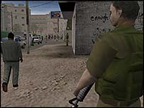
"Global Conflict: Palestine gives the option of three perspectives. A game based in the midst of the conflict in the Palestinian territories is set to be the latest release in the trend of politically-conscious gaming. Global Conflict: Palestine centres on the activities of a young journalist. The player must navigate between different Palestinian and Israeli sources to get to the truth of a story. "You can take a pro-Palestinian angle, a balanced angle, or a pro-Israeli angle," said Simon Egenfeldt-Nielsen, of Serious Games Interactive. Mr Egenfeldt-Nielsen told the BBC's Culture Shock programme: "The game is much more about the personal experience; the emotional experience."
The player walks around a city resembling Jerusalem and its surrounding areas talking to people. As the conflict intensifies, however, the situation becomes increasingly complex and exposes some of the reasons for the ongoing violence ... Different perspectives: Global Conflict: Palestine, which is released early next year, follows music channel MTV's internet-based Darfur Is Dying, which went online earlier this year and had 700,000 players in its first month. Later, tens of thousands of players sent e-mail messages to politicians to urge action over Darfur."
From Middle-East Conflict Informs Game, BBC News.
21:56 Posted in Serious games | Permalink | Comments (0) | Tags: serious gaming
Smart clothing for smart users
10November 2006 - 12 November2006
Amsterdam, Mediamatic
10:00 hr, from 10.11.06 t/m 12.11.06
Oosterdokskade 5
Amsterdam
T 020 638 9901
http://www.mediamatic.net
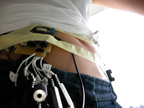
Tiny chips, cheap sensors and the possibilities of emerging smart fabrics, conductive yarns and cheap wireless communication (bluetooth or even rfid) make wearables easier and cheaper to make. Arduino boards are small physical computing platforms: Arduino developed a fairly simple integrated development environment to deal with the small portable input/output board. With all these tools at our fingertips, nothing is stopping us from making our own smart coats, reactive hats and luminescent skirts.
To help you get started, Mediamatic is organizing a wearables workshop where you can develop your own Arduino-driven wearable. Assisted by Massimo Banzi, one of the creators of the Arduino board and several coding/soldering/sewing helpers, you have three days to make your prototype in the stimulating surroundings of the Mediamatic Winter Garden.
What?
During the workshop, you will design your own wearable. You will define the sensor inputs and the actuator outputs. You will program the Arduino board to react correctly to the different inputs. You will do this in Arduino's own IDE, which helps you write a kind of simplified Java code similar to Processing. Then you will stitch/glue/felt together your prototype so you can participate in the wearables fashion show!
Who?
Computer scientists, fashion designers, hardware hackers, art students, fabric experts, product developers, dancers- everyone is welcome. However, note that some technical affinity is required. Some experience in programming and electronics is useful, specifically in soldering and java, but not strictly necessary. We would advice participants to come in teams of max. 3 people, so you can distribute soldering, coding and sewing tasks.
Where?
The workshop will take place in the latest Mediamatic exhibition: the Winter Garden. The Winter Garden is an indoor botanical garden filled with plants and robots. From the minimalistic electronic creatures of Ralf Schreiber to the virtual forest of Michiel Samyn to the interactive plant by Christa Sommerer and
Laurent Mignonneau to the pheromone tinged garden benches of Mateusz Herczka and the communicative crickets of Felix Hess- the Winter Garden is full of wonders.
What to bring?
If there is a specific sensor or actuator you would like to use during the workshop, we advise you to bring it yourself. You can also bring the actual clothing article beforehand, and not sew it during the workshop, or you can bring fabric and other material for the base of your wearable. You'll have to bring your own laptop to do your coding, and we advise you to download the Arduino software and have a look at it beforehand. Also, bring lunch.
How to prepare?
Besides looking at the Arduino software you can have a look at the Mediamatic wearables reader - a collection of interesting articles, websites and blogposts that can get you started in the world of wearables. Virtual Platform and V2 are organizing a wearables symposium in Rotterdam called Fleshing Out the day before the Mediamatic Arduino workshop with speakers such as Ionat Zurr (SymbioticA: the art and science collaborative research laboratory), Tobie Kerridge (Royal College of Art, London) and Joanna Berzowska (Design and Computation Arts , Concordia University, Montreal).
When?
The Fleshing Out Symposium is on Thursday November 9th at V2. The Mediamatic Arduino Wearables Workshop is from Friday November 10th to Sunday November 12th. The Kiem Cuisine Wearables dinner is Friday at 19:30 at Mediamatic. The Wearables fashion show is Sunday evening at 18:00.
Costs?
The Fleshing out symposium costs 40 euros. Students receive a discount of 20 euros. The Wearable Arduino workshop costs 125 euros. Dutch students receive a discount of 50 euros.
21:50 Posted in Wearable & mobile | Permalink | Comments (0) | Tags: cyberart
EvoMUSART 2007
From Networked Performance

EvoMUSART 2007: 5th European Workshop on Evolutionary Music and Art: 11-13 April, 2007, Valencia, Spain: EVOSTAR: EVOMUSART: "ArtEscapes: Variations of Life in the Media Arts"
The use of biological inspired techniques for the development of artistic systems is a recent, exciting and significant area of research. There is a growing interest in the application of these techniques in fields such as: visual art and music generation, analysis, and interpretation; sound synthesis; architecture; video; and design.
EvoMUSART 2007 is the fifth workshop of the EvoNet working group on Evolutionary Music and Art. Following the success of previous events and the growth of interest in the field, the main goal of EvoMUSART 2007 is to bring together researchers who are using biological inspired techniques for artistic tasks, providing the opportunity to promote, present and discuss ongoing work in the area.
The workshop will be held from 11-13 April, 2007 in Valencia, Spain, as part of the Evo* event.
The event includes the exhibition "ArtEscapes: Variations of Life in the Media Arts", giving an opportunity for the presentation of evolutionary art and music. The submission of art works for the exhibition session is independent from the submission of papers.
Accepted papers will be presented orally at the workshop and included in the EvoWorkshops proceedings, published by Springer Verlag in the Lecture Notes in Computer Science series.
Further information can be found on the following pages:
Evo*2007: http://www.evostar.org
EvoMUSART2007: http://evonet.lri.fr/TikiWiki/tiki-index.php?page=EvoMUSART
21:39 Posted in Creativity and computers, Cyberart | Permalink | Comments (0) | Tags: cyberart, creativity and computers
Brain Waves Drawing
Brain Waves Drawing: Live Performance by Hideki Nakazawa: Nov 4-5, 2006 at Fuchu Art Museum, Tokyo Supported by Nihon Kohden.

Not to Draw by Hand. To Draw by Brain: Artists usually draw pictures by hand with brushes or pencils. However, the activities of brains must be more important and essential than the ones of hands at the moment of creating art. Therefore, I decided to draw pictures with electrodes being set on my head through controlling the activities of my own brain. The curved lines so-called "brain waves" in medicine must be the "drawings" in the world of fine art, directly drawn by my brain without using hands.
21:34 Posted in Brain-computer interface, Cyberart | Permalink | Comments (0) | Tags: brain-computer interface, cyberart
Social network vizster
Re-blogged from InfoAesthetics

Vizter is a sophisticated social network data visualization system that end-users of social networking services can use to facilitate discovery & increased awareness of their online community. vizster presents social networks using a simple network node-link representation, where nodes represent members of the system & links represent the articulated 'friendship' links between them. network members are depicted using both their self-provided name & a representative image. the networks are presented as 'egocentric' networks, consisting of an individual & their immediate friends. users can expand the display by selecting nodes to make visible others’ immediate friends as well. in addition, inferred community groupings of two or more nodes are visibly represented as 'blobs' surrounding community members, taking advantage of low spatial frequencies to make community structures apparent.
20:05 Posted in Information visualization, Social Media | Permalink | Comments (0) | Tags: social network data visualization system
BioMAP: A new tool for evaluating learning disabilities in children
Via Medgadget

BioMAP (Biological Marker of Auditory Processing) is a new, easy-to-use diagnostic tool that can quickly identify a sizeable subset of learning disabled children. Based on more than a decade of neuroscience research at Northwestern University, it is expected to become one of the most important resources for learning disabilities specialists trying to identify appropriate treatments for children with dyslexia and other language-based learning disabilities:
"Learning disabilities are believed to affect nearly one in 10 children, but their causes are difficult to pinpoint," says Nina Kraus, director of Northwestern University's Auditory Neuroscience Laboratory. Kraus and Northwestern researchers Trent Nicol and Steven Zecker have found that a third of the 1,000-plus children they have tested show a dysfunction in the way the brainstem encodes basic sounds of speech...
"The beauty of BioMAP as a diagnostic tool is that it does not require a child to follow directions or perform an assigned task," says Kraus. "Instead, it objectively measures whether a child's nervous system is able to accurately translate sounds into brain waves." If it can't, the affected child will have difficulty discriminating between speech sounds. And that difficulty at the most fundamental level complicates a wide range of learning activities, including reading and writing, Kraus finds.
Getting objective measures from BioMAP software is simple. "All a child needs to do is stay awake and sit quietly for 20 to 30 minutes," says Kraus, Northwestern's Hugh Knowles Professor of Communication Sciences, Neurobiology and Otolaryngology.
20:04 Posted in Cybertherapy | Permalink | Comments (0) | Tags: cybertherapy
'Tower of Babel' translator made
Re-blogged from KurzweilAI.net
A new device being created by researchers at Carnegie Mellon University uses electrodes attached to the neck and face to detect the movements that occur as a person silently mouths words and phrases.
Using this data, a computer can work out the sounds being formed and then build these sounds up into words. The system is then able to translate the words into another language, which is read out by a synthetic voice.
Read the full story
19:44 Posted in Brain training & cognitive enhancement | Permalink | Comments (0) | Tags: cognitive enhancement
DNA-based switch will allow interfacing organisms with computers
Re-blogged from Kurzweil.net
Researchers at the University of Portsmouth have developed an electronic switch based on DNA, a world-first bionanotechnology breakthrough that provides the foundation for the interface between living organisms and the computer world...
Read the full story here
19:37 Posted in Future interfaces | Permalink | Comments (0) | Tags: future interfaces
Cognitive Enhancement: Methods, Ethics, Regulatory Challenges
Via IEET
Have a look at this very interesting article entitled "Cognitive Enhancement: Methods, Ethics, Regulatory Challenges" written by Nick Bostrom and Anders Sandberg. It focuses on the current state of the art in cognitive enhancement methods and consider their prospects for the near-term future. Authors also review some of ethical issues arising from these technologies.
19:13 Posted in Brain training & cognitive enhancement | Permalink | Comments (0) | Tags: assisted cognition, bionics, cognitive enhancement
Cellphones Make Goldfish Do Flips
Re-blogged from Textually.org
According to Undeniable Facts with 10 cell phones, you can make goldfish do a flip [via Digg]
There's even a video to prove it:

19:02 | Permalink | Comments (0) | Tags: positive technology