




Sep 30, 2006
Gaming Realities
|
|

What role do videogames play in our lives today? As the boundaries between the virtual and the real blur more and more in the new gaming worlds we have come to inhabit, new conditions arise.
With the theme Gaming Realities, medi@terra 06 aims to explore the different dimensions and developments in the gaming fields and the impact they have on the different fields of society today. This year's Festival and International Conference set up to explore the diverse ideas, narratives, and ideologies involved in the video games.
Videogames express and reflect today's world, its aesthetics and technologies, give rise to new identities and new mentalities. Medi@terra Festival has invited individuals who have realised the importance and dimensions which this field has acquired, asking them to deposit their viewpoints and experiences with regard to the connections of the game to society, the identity and psychology of the player, the space and narration of the game, new technologies and conceptions and possibilities for the computer game to comprise the key art of 21st century.
'Gaming Realities: the Challenge of Digital Culture' is a three days International Conference [6-8 October, Athens] organised by Fournos Centre for the Digital Culture.
19:43 Posted in Positive Technology events, Serious games | Permalink | Comments (0) | Tags: serious gaming
Perimeters, Boundaries, and Borders
|
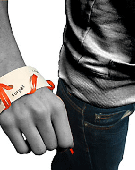
Artists, architects, designers, and other practitioners are constantly fashioning new forms and challenging disciplinary boundaries as they employ techniques such as rapid prototyping and generative processes. In the exhibition Perimeters, Boundaries, and Borders, at Lancaster, UK's Citylab, organizers Fast-uk and Folly explore the range of objects, buildings, and products being conceptualized with the aid of digital technologies. Aoife Ludlow's 'Remember to Forget?' is a series of jewelry designs that envisioned accessories incorporating RFID tags that allow the wearer to record information and emotions associated with those special items that we put on daily. Tavs Jorgensen uses a data glove in his 'Motion in Form' project. After gesturing around an object, data collected by the glove is given physical shape using CNC (Computer Numerical Control) milling, creating representations of the movements in materials such as glass or ceramics. Addressing traces of a different sort is Cylcone.soc, a data mapping piece by Gavin Bailey and Tom Corby. These works and many more examples from the frontiers of art and design are on view until October 21st." Rhizome News. |
19:39 Posted in Emotional computing, Pervasive computing | Permalink | Comments (0) | Tags: ambient intelligence, emotional computing, pervasive technology, persuasive technology
Increasing cortical activity in auditory areas through neurofeedback fMRI
Increasing cortical activity in auditory areas through neurofeedback functional magnetic resonance imaging.
Neuroreport. 2006 Aug 21;17(12):1273-8
Authors: Yoo SS, O'Leary HM, Fairneny T, Chen NK, Panych LP, Park H, Jolesz FA
We report a functional magnetic resonance imaging method to deliver task-specific brain activities as biofeedback signals to guide individuals to increase cortical activity in auditory areas during sound stimulation. A total of 11 study participants underwent multiple functional magnetic resonance imaging scan sessions, while the changes in the activated cortical volume within the primary and secondary auditory areas were fed back to them between scan sessions. On the basis of the feedback information, participants attempted to increase the number of significant voxels during the subsequent trial sessions by adjusting their level of attention to the auditory stimuli. Results showed that the group of individuals who received the feedback were able to increase the activation volume and blood oxygenation level-dependent signal to a greater degree than the control group.
19:27 Posted in Biofeedback & neurofeedback | Permalink | Comments (0) | Tags: neurofeedback
Endoscopic eye tracking system for fMRI
Endoscopic eye tracking system for fMRI.
J Neurosci Methods. 2006 Sep 13;
Authors: Kanowski M, Rieger JW, Noesselt T, Tempelmann C, Hinrichs H
Here we introduce a new video-based real-time eye tracking system suitable for functional magnetic resonance imaging (fMRI) application. The described system monitors the subject's eye, which is illuminated with infrared light, directly at the headcoil using an endoscopic fibre optical system. This endoscopic technique assures reliable, easy-to-use and fast adjustment. It requires only a minimal amount of equipment at the headcoil and inside the examination room. Moreover, the short distance between the image acquisition optics and the eye provides high spatial tracking resolution. Interference from physiological head movement is effectively reduced by simultaneous tracking of both eye and head movements.
19:25 Posted in Neurotechnology & neuroinformatics, Research tools | Permalink | Comments (0) | Tags: neuroinformatics, eye-tracking
Utilizing Gamma Band to Improve Mental Task Based Brain-Computer Interface Design
Utilizing Gamma Band to Improve Mental Task Based Brain-Computer Interface Design
IEEE Transactions on Neural Systems and Rehabilitation Engineering, Volume 14, Issue 3, Sept. 2006 Page(s): 299 - 303
Palaniappan, R.
A common method for designing brain–computer Interface (BCI) is to use electroencephalogram (EEG) signals extracted during mental tasks. In these BCI designs, features from EEG such as power and asymmetry ratios from delta, theta, alpha, and beta bands have been used in classifying different mental tasks. In this paper, the performance of the mental task based BCI design is improved by using spectral power and asymmetry ratios from gamma (24–37 Hz) band in addition to the lower frequency bands. In the experimental study, EEG signals extracted during five mental tasks from four subjects were used. Elman neural network (ENN) trained by the resilient backpropagation algorithm was used to classify the power and asymmetry ratios from EEG into different combinations of two mental tasks. The results indicated that 1) the classification performance and training time of the BCI design were improved through the use of additional gamma band features; 2) classification performances were nearly invariant to the number of ENN hidden units or feature extraction method.
19:24 Posted in Neurotechnology & neuroinformatics | Permalink | Comments (0) | Tags: brain-computer interface
Brain-computer interfaces for control of neuroprostheses
Brain-computer interfaces for control of neuroprostheses: from synchronous to asynchronous mode of operation.
Biomed Tech (Berl). 2006;51(2):57-63
Authors: Müller-Putz GR, Scherer R, Pfurtscheller G, Rupp R
Transferring a brain-computer interface (BCI) from the laboratory environment into real world applications is directly related to the problem of identifying user intentions from brain signals without any additional information in real time. From the perspective of signal processing, the BCI has to have an uncued or asynchronous design. Based on the results of two clinical applications, where 'thought' control of neuroprostheses based on movement imagery in tetraplegic patients with a high spinal cord injury has been established, the general steps from a synchronous or cue-guided BCI to an internally driven asynchronous brain-switch are discussed. The future potential of BCI methods for various control purposes, especially for functional rehabilitation of tetraplegics using neuroprosthetics, is outlined.
19:21 Posted in Brain-computer interface, Neurotechnology & neuroinformatics | Permalink | Comments (0) | Tags: brain-computer interface
Beyond emoticons
Anthony Boucouvalas and colleagues at Bournemouth University in the UK have created a system that contorts an image of a user's face to express different emotions, New Scientist reports. According to Boucouvalas and coll., the system might be used to enrich text-based internet chat.
From the article:
A user first uploads a picture of their face with a "neutral" expression. Then they use their mouse to mark the ends of their eyebrows, the corners of their mouth and the edges of their eyes and lips. The software uses these points to morph the face to express different emotions: happiness, sadness, fear, anger, surprise, and disgust. A user can select an emotion and one of three intensity levels when using the system.
Read the full story here
See also Illustrations from Smiley Arena
19:05 Posted in Emotional computing | Permalink | Comments (0) | Tags: affective computing