




Oct 20, 2005
Post-doc in "Cognitive processes in media use" - Catholic University, Milan
A 12 month full-time contract for a research post will be available in the Department of Psychology at the Catholic University of the Sacred Heart in Milano, Italy. The contract will start in February 2006.
The contract can be renewed for further 12-month periods. The research post is connected to a project entitled "Cognitive processes in media use" and is completely funded by the Catholic University of the Sacred Heart. The project is aimed at carrying out experimental investigations about the cognitive processes and the levels of consciousness which accompany the use of multimedia interactive tools. The project is being led by Professor Alessandro Antonietti
Requirements
Ph. D. degree in psychology or allied disciplines.
A clear interest in the topic of the project and proven qualifications for doing research.
Language skills: fluent English (written and speech). No previous knowledge of Italian is required.
Place
The research activities will be based in the Department and Faculty of Psychology at the Catholic University of the Sacred Heart in Milano.
Salary
The salary is 1,345.00 euros per month. The salary is free from taxes; An insurance deduction (5.00%) might be applied (it depends on the nationality of the candidate).
Applications
The official announcement will be delivered in January 2006.
The application forms and further particulars will available from January 2006 from the website of the Catholic University of the Sacred Heart
Candidates will apply by sending the following documents:
- the application forms
- curriculum vitae including list of publications
- the research plan (approximately 6 page written in English) that the candidate would carry out.
Informal enquiries can be made to:
Alessandro Antonietti
(Tel) ++39-02-72342909
(E-mail) alessandro.antonietti@unicatt.it
(Postal address) Catholic University of the Sacred Heart, Largo Gemelli 1, 20123 Milano, Italy
15:01 Posted in Research institutions & funding opportunities | Permalink | Comments (0) | Tags: Positive Technology
Personal and Ubiquitous Computing on Experience, Enchantment, and Interaction Design
Via Usability News A special issue of Personal and Ubiquitous Computing is calling for contributions about "Experience, Enchantment, and Interaction Design".
An indicative list of possible topics is:
- The enchantment of digital technology
- Novel and enchanting interactions
- The possibility of designing for enchantment
- Measuring and evaluating enchantment
- Approaches to enchantment from art, design and literature
- Critical theory
- Designing for experience, openness and potential
- Design practices to confer depth on a design
- Ambiguity, depth and meaning in interaction design
- Relationships between enchantment and other varieties of experience
Important dates
Paper Submission: 25 November, 2005
Notification of acceptance: 27 January 2006
Final Corrections to papers: 31 March, 2006
13:39 Posted in Positive Technology events | Permalink | Comments (0) | Tags: Positive Technology
First International Conference on Persuasive Technology and Well-Being
From the conference website
Can computers help fight obesity? Can technology motivate you to waste less energy? Can communication devices help overcome racial prejudice? Can a virtual agent persuade you to break your smoking habit? Can a mobile phone help you study? Can a robot challenge you to perform rehabilitation exercises?
PERSUASIVE 06 is aimed at exploring technology in the service of human well-being, within the broader context of a socially and ecologically sustainable society. Join academic researchers, designers, and technology developers from around the world in investigating the potential of persuasive technologies to positively affect human attitudes and behaviour.
The goal of PERSUASIVE 06 is to bring together a multidisciplinary group of social scientists studying persuasion, and engineers developing persuasive technologies in areas such as health and rehabilitation, housing, information and communication, and energy conservation, so they can meet, share experiences, present research, and exchange ideas. Key topics include:
· Health, comfort, and wellbeing
· Sustainability
· Education and training
· Communication
· Ethics of persuasive technology
· Theories of persuasion and related topics such as motivation, credibility, trust and control
· Persuasive technologies as change agents
The conference will take place 15-16 May 2006 hosted by Eindhoven University of Technology, the Netherlands
13:30 Posted in Positive Technology events | Permalink | Comments (0) | Tags: Positive Technology
NIH starts program to improve clinical and translational science
Via Medgadget
| The NIH has published on The New England Journal of Medicine the creation of the Institutional Clinical and Translational Science Awards (CTSAs) program: The grants will encourage institutions to propose new approaches to clinical and translational research, including new organizational models and training programs at graduate and post-graduate levels. In addition, they will foster original research in developing clinical research methodologies, such as clinical research informatics, laboratory methods, other technology resources and community-based research capabilities. Potential benefits to patients include: new medical monitoring devices that they can use in their own homes; improved methods for predicting the toxicity of new drugs in specific individuals; and a seamless and safe experience for those who participate in clinical trials. |
12:41 Posted in Research institutions & funding opportunities | Permalink | Comments (0) | Tags: Positive Technology
EU launches € 52,5 million call in the area of Networked Audio Visual Systems
European Union has published a new call for proposals in the area of Networked Audio Visual Systems. In this field DG INFSO aims at supporting research and development of open, trusted and interoperable multimedia user platforms and devices. The main focus is notably on platforms used on broadcasting and on delivery of fully interactive services to the home user capabilities. These developments will lead to the concept of "extended home", where the users will enjoy seamless access to a diversity of multimedia content.
Important information:
Allocated budget: € 52,5 million
Closing Date(s): 20 December 2005 at 17h00 (Brussels local time)
OJ Reference: OJ C259 of 19.10.2005
Specific programme: Integrating and Strengthening the European Research Area
Activity area(s): Information Society Technologies (IST)
12:36 Posted in Research institutions & funding opportunities | Permalink | Comments (0) | Tags: Positive Technology
Redrawing the US through individual perception
Via Wired
The CommonCensus Map Project is redrawing the map of the United States based on users' voting, to show how the country is organized culturally, as opposed to traditional political boundaries. It shows how the country is divided into 'spheres of influence' between different cities at the national, regional, and local levels.
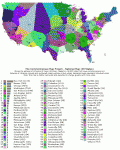
The third national map has been produced, based on the first 16,000 votes
12:20 Posted in Information visualization | Permalink | Comments (0) | Tags: Positive Technology, complex networks