




Oct 21, 2005
The symptoms of computer addiction..
Psychological Symptoms
Having a sense of well-being or euphoria while at the computer
Physical Symptoms
(According to Maressa Hecht Orack, Ph.D.)
19:35 Posted in Emotional computing | Permalink | Comments (0) | Tags: Positive Technology, experience computing
Face recognition implemented on cellphones
Via Extremetech
Deviceforge.com today reports that a company has just started marketing a technology that inexpensively adds face recognition to camera-equipped cellphones. Oki's "Face Sensing Engine" (FSE) "middleware" decodes facial images within 280mS on a 100MHz ARM9 processor, and can restrict access to mobile devices by recognizing their owners.
Besides security applications, this new technology could have interesting applications in the field of neurorehabilitation. For example, the implementation of face recognition may help brain-injured patients suffering from neurodegenerative diseases to recognize their relatives and friends
Oki lists the following key features of its FSE technology:
- Compact system footprint -- requires approximately 260KB on an ARM9 processor
- Fast image processing -- requires approximately 280mS on a 100MHz ARM9 processor
- Face recognition algorithm automatically adjusts to ambient lighting conditions
- Supported processor architectures -- ARM9, SH Mobile, and others
- Supported software platforms -- Symbian, uITRON, Linux, BREW, WIPI, Windows, Solaris, and others
19:25 Posted in Telepresence & virtual presence | Permalink | Comments (0) | Tags: Positive Technology, social presence
Virtual reality cue reactivity assessment in cigarette smokers
Cyberpsychol Behav. 2005 Oct;8(5):487-92
Authors: Bordnick PS, Graap KM, Copp HL, Brooks J, Ferrer M
Abstract. Drug craving has purportedly been linked to relapse and to substance use. For over two decades, cue reactivity has been a viable method to assess craving and physiological reactions to drug stimuli. However, traditional cue reactivity has faced the following limitations: austere situations or stimuli, lack of complex cues, lack of standardization, and limited generalization outside of the lab setting. In order to improve cue methodologies, a virtual  reality (VR) nicotine cue reactivity assessment system (VR-NCRAS) was developed and tested in a controlled experimental trial. Ten nicotine dependent smokers were exposed to VR smoking cues and VR neutral cues in a standardized, timed, computer controlled experiment. Subjective craving and physiological responses were recorded and compared across VR-NCRAS stimuli. Subjective cigarette craving increased significantly and corresponding physiological reactivity was observed in response to VR smoking cues. VR neutral cues did not result in subjective or physiological changes consistent with craving. Implications of these findings on substance abuse research and treatment are discussed.
18:55 Posted in Cybertherapy | Permalink | Comments (0) | Tags: Positive Technology, virtual reality
Stelarc's Prosthetic Head
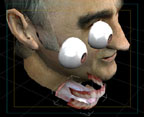
"...Words like "intelligence", "awareness" and "agency" describe particular and peculiar behaviors performed effectively and appropriately in certain locations and situations. We do not need to imagine that they indicate anything other than that. What is important is not what happens within us, but rather what happens between us in the medium of language in which we communicate, in the social institutions within which we operate and in the culture within which we've been conditioned - at this point in our history and so on, depending on our frame of reference. To talk of agency is to refer to an intentional act defined within a very small frame of reference. [...] In the body performances, the skin has been stretched, the body has been probed and its limbs have been extended. The interest is to construct alternate interfaces that explore the absent, alien, involuntary and automated. What we experience is emptiness, ambiguity and uncertainty. We fear what we have always been and what we have already become -- a zombie with no mind -- a body that performs involuntarily..." From Prosthetic Head: Intelligence, Awareness and Agency by Stelarc
18:45 Posted in Cyberart | Permalink | Comments (0) | Tags: Positive Technology
Can technology make us smarter?
Via Mind Hacks
CNET News.com interviews Mike Merzenich, a neuroscientist, on how high-tech is shaping human intelligence. Merzenich, who is also a high-tech entrepreneur, focuses on designing and developing computer applications that support cognitive skills such as memory, attention, and language processing.
In this interview, Merzenich claims that massive exposure to technologies such as video games, television and the Internet is affecting brain evolution. He observes that in each stage of cultural development human beings had to develop novel skills and abilities. The progressive accumulation of these skills determined significant changes in our central nervous system, which is now very different from the brain of our ancestors. As culture and technology are still evolving, the challenges faced by brains are continuously changing and elaborating. Starting from these premises, Merzenich suggests that continuous exercise can help to preserve and maintain cognitive skills and abilities, and assumes that brain fitness will be an important part of every future, well-organized life.
Read full article on News.com
More to explore
Merzenich's company Posit Science
18:35 Posted in Brain training & cognitive enhancement | Permalink | Comments (0) | Tags: Positive Technology, Cognitive prosthetics