




Oct 19, 2005
Special Issue of Virtual Reality Journal
A special issue of the journal Virtual Reality will be devoted to the use of Collaborative virtual environments to support creativity. Here is an excerpt from the journals' call for papers:
Creative processes often are collaborative in nature, with a group of people reflecting on an overall theme, jointly contributing thoughts interactively, and ultimately generating new ideas. Collaborative virtual environments (CVEs) to support this process, thus, should support the group, provide a creative atmosphere and comfortable environment, and support the seamless expression and visualization of ideas. This requires the environment to be inspiring, to  enable a wide range of design options, to allow multiple and appropriate types of interaction, to provide for seamless interaction, advanced visualization technologies and simplified sharing mechanisms. Example application areas of such systems are the design and development of computer games, art, product design, fashion, digital storytelling environments, entertainment services, advertising, and architecture or urban planning. The aim of this special issue is to provide an overview of innovative and state-of-theart research on Collaborative Environments in Virtual Reality which support the creative process. Paper contributions should discuss in general how to support creativity with collaborative tools and virtual environments.
Research questions cover a wide range of topics such as how to
- allow participants with various professional backgrounds, working languages,
and ways of expressing their ideas to collaborate with each other locally and
over distance - allow for quick and efficient selection of options to express and visualize
innovative ideas, going well beyond support for 2D drawings, text and voice - provide a non-technical, human-friendly and supportive work environment
with the focus on creativity - support the design of multi-dimensional interactive applications
- keep an overview on different activity lines in both the design and the use of
multilevel, multi-dimensional applications
17:15 Posted in Creativity and computers | Permalink | Comments (0) | Tags: Positive Technology, creativity
Knowledge management software for neuroscientists
Via Neurodudes
Neuroscholar is a KM software application for neuroscientists, which allows to store and annotate primary research data in conjunction with information from the literature (below a preview of the program's graphical user interface).

More to explore
The Neuroscholar demo can be accessed here.
The Neuroscholar source code can be downloaded from here.
Burns, G. A. (2001). Knowledge management of the neuroscientific literature: the data model and underlying strategy of the NeuroScholar system. Philos Trans R Soc Lond B Biol Sci 356(1412): 1187-208.
Burns, G., K. Stephan, B. Ludäscher, A. Gupta and R. Kötter (2001). Towards a federated neuroscientific knowledge management system using brain atlases. Neurocomputing 38-40: 1633-1641.
15:20 Posted in Research tools | Permalink | Comments (0) | Tags: Positive Technology, research tools
EU Commission Commission adopts Green Paper on a new strategy for mental health
The EU Commission adopted a Green Paper on Mental Health on 17 October designed to tackle mental illnesses in Europe. The Green Paper, 'Promoting the mental health of the population: Towards a strategy on mental health for the European Union', aims to launch a public consultation on how better to tackle mental illness and promote mental well-being in the EU.
 Mental illness affects over 27 per cent of European adults every year, and is responsible for the majority of the annual 58,000 deaths by suicide, more than the numbers who die from motor vehicle traffic accidents. Mental health levels can have a significant influence on the economic and social welfare of society. As well as the challenges of mental ill health for the health sector, and the implications for the affected citizens and their families, mental illness imposes significant costs on society and its economic, educational, social, criminal and justice systems. Moreover, stigma and discrimination linked to mental disorders undermine fundamental rights.
A conference to launch the Green paper will be held in Luxembourg on 24 October.
Draft agenda
The launch conference will be followed by three thematic meetings until end of May 2006:
1) Meeting 1: “Promotion and prevention in mental health” (fourth quarter of 2005);
2) Meeting 2: “Social inclusion and fundamental rights in mental health” (first quarter of 2006);
3) Meeting 2: “Information, data and knowledge in mental health” (second quarter of 2006).
15:12 Posted in Positive Technology events | Permalink | Comments (0) | Tags: Positive Technology
On-the-Move Interaction with Everyday Objects
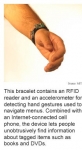
MIT researchers have designed and developed a bracelet called ReachMedia that is able to identify objects the user is holding and then to connect to the Internet, to search information concerning these objects. The system is also able to detect and recognize hand gestures through an integrated accellerometer, allowing the user to interact with available information.
More to explore
ReachMedia: On-the-Move Interaction with Everyday Objects, International Symposium on Wearable Computers (ISWC'05), Osaka Japan, October 18 - 21, 2005
14:45 Posted in Wearable & mobile | Permalink | Comments (0) | Tags: Positive Technology, wearable