




Mar 29, 2008
A Pilot Study Comparing the Effects of Mindfulness-Based and Cognitive-Behavioral Stress Reduction
A Pilot Study Comparing the Effects of Mindfulness-Based and Cognitive-Behavioral Stress Reduction.
J Altern Complement Med. 2008 Mar 27;
Authors: Smith BW, Shelley BM, Dalen J, Wiggins K, Tooley E, Bernard J
ABSTRACT Objectives: The objective of this pilot study was to compare the effects of two mind-body interventions: mindfulness-based stress reduction (MBSR) and cognitive-behavioral stress reduction (CBSR). Subjects: Fifty (50) subjects were recruited from the community and took part in MBSR (n = 36) and CBSR (n = 14) courses. Participants self-selected into MBSR or CBSR courses taught at different times. There were no initial differences between the MBSR and CBSR subjects on demographics, including age, gender, education, and income. Intervention: MBSR was an 8-week course using meditation, gentle yoga, and body scanning exercises to increase mindfulness. CBSR was an 8-week course using cognitive and behavioral techniques to change thinking and reduce distress. Design: Perceived stress, depression, psychological well-being, neuroticism, binge eating, energy, pain, and mindfulness were assessed before and after each course. Pre-post scores for each intervention were compared by using paired t tests. Pre-post scores across interventions were compared by using a general linear model with repeated measures. Settings/Locations: Weekly meetings for both courses were held in a large room on a university medical center campus. Results: MBSR subjects improved on all eight outcomes, with all of the differences being significant. CBSR subjects improved on six of eight outcomes, with significant improvements on well-being, perceived stress, and depression. Multivariate analyses showed that the MBSR subjects had better outcomes across all variables, when compared with the CBSR subjects. Univariate analyses showed that MBSR subjects had better outcomes with regard to mindfulness, energy, pain, and a trend for binge eating. Conclusions: While MBSR and CBSR may both be effective in reducing perceived stress and depression, MBSR may be more effective in increasing mindfulness and energy and reducing pain. Future studies should continue to examine the differential effects of cognitive behavioral and mindfulness-based interventions and attempt to explain the reasons for the differences.
17:35 Posted in Meditation & brain | Permalink | Comments (0) | Tags: meditation
Nature Precedings
13:08 Posted in Research tools | Permalink | Comments (0) | Tags: research tools
Mar 27, 2008
Avatars can mimic us
Via KurzweilAI.net
An international team has built vision- and speech-driven avatar technology that imitates 66 facial expressions and basic hand gestures in real time.

23:55 Posted in Virtual worlds | Permalink | Comments (0) | Tags: virtual reality
Street anatomy

11:35 | Permalink | Comments (0)
Study shows compassion meditation changes the brain
Via SharpBrains
Results of a study using functional magnetic resonance imaging (fMRI) published March 25 in the Public Library of Science One suggest that positive emotions such as loving-kindness and compassion can be learned in the same way as playing a musical instrument or being proficient in a sport. The scans revealed that brain circuits used to detect emotions and feelings were dramatically changed in subjects who had extensive experience practicing compassion meditation.
Abstract. Recent brain imaging studies using functional magnetic resonance imaging (fMRI) have implicated insula and anterior cingulate cortices in the empathic response to another's pain. However, virtually nothing is known about the impact of the voluntary generation of compassion on this network. To investigate these questions we assessed brain activity using fMRI while novice and expert meditation practitioners generated a loving-kindness-compassion meditation state. To probe affective reactivity, we presented emotional and neutral sounds during the meditation and comparison periods. Our main hypothesis was that the concern for others cultivated during this form of meditation enhances affective processing, in particular in response to sounds of distress, and that this response to emotional sounds is modulated by the degree of meditation training. The presentation of the emotional sounds was associated with increased pupil diameter and activation of limbic regions (insula and cingulate cortices) during meditation (versus rest). During meditation, activation in insula was greater during presentation of negative sounds than positive or neutral sounds in expert than it was in novice meditators. The strength of activation in insula was also associated with self-reported intensity of the meditation for both groups. These results support the role of the limbic circuitry in emotion sharing. The comparison between meditation vs. rest states between experts and novices also showed increased activation in amygdala, right temporo-parietal junction (TPJ), and right posterior superior temporal sulcus (pSTS) in response to all sounds, suggesting, greater detection of the emotional sounds, and enhanced mentation in response to emotional human vocalizations for experts than novices during meditation. Together these data indicate that the mental expertise to cultivate positive emotion alters the activation of circuitries previously linked to empathy and theory of mind in response to emotional stimuli.
Citation: Lutz A, Brefczynski-Lewis J, Johnstone T, Davidson RJ (2008) Regulation of the Neural Circuitry of Emotion by Compassion Meditation: Effects of Meditative Expertise. PLoS ONE 3(3): e1897. doi:10.1371/journal.pone.0001897
11:15 Posted in Meditation & brain | Permalink | Comments (0) | Tags: meditation, brain imaging
What's in your mind?
Previous 'mind-reading' studies have differentiated patterns of brain activity without understanding the underlying processes. A new study in Nature uses a model of neural encoding mechanisms to identify brain activity patterns
link (journal subscription needed to full-text access)
11:01 Posted in Research tools | Permalink | Comments (0)
Mar 26, 2008
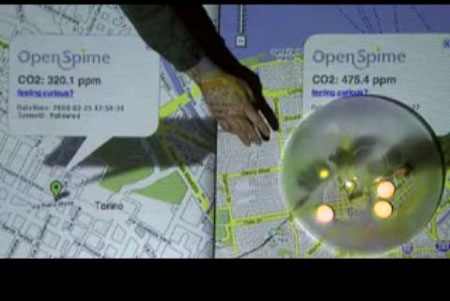
Towards Partecipative Ecology: the OpenSpime project
OpenSpime is a project of a pervasive technology infrastructure that allows individuals and corporations to better understand their environment, through the use of a series of GPS-enabled sensors.
A brainchild of Leandro Agrò, Roberto Ostinelli and David Orban, OpenSpime was inspired by Bruce Sterling's vision of "Internet of Things". Sterling describes a new type of technological device called "spime", a physical object that is part of the internet as it becomes trackable in space and time, through pervasive RFID communications and GPS navigation.
In this sense, OpenSpime platform represents one of the first concrete attempt to turn Internet of Things into reality.The first spime they've designed is a sensor that can measure the CO2 level in parts-per-million in the surrounding air, and through a wireless connection can send that information back to the OpenSpime servers. There they can be mashed up and aggregated on Google Maps.
check it out the concept video:
15:45 Posted in Information visualization | Permalink | Comments (0)
Cognitive processing and motor skill learning in motor-handicapped teenagers
Cognitive processing and motor skill learning in motor-handicapped teenagers: effects of learning method.
Somatosens Mot Res. 2007 Dec;24(4):163-9
Authors: Deviterne D, Gauchard GC, Lavisse D, Perrin PP
15:14 Posted in Mental practice & mental simulation | Permalink | Comments (0) | Tags: mental simulation
Assessing human reorientation ability inside virtual reality environments
Assessing human reorientation ability inside virtual reality environments: the effects of retention interval and landmark characteristics.
Cogn Process. 2008 Mar 20;
Authors: Bosco A, Picucci L, Caffò AO, Lancioni GE, Gyselinck V
The purpose of the present study was to assess the navigational behaviour of adult humans following a disorientation procedure that perturbed their egocentric frame of reference. The assessment was carried out in a virtual reality (VR) environment by manipulating the disorientation procedure, the retention interval, the relative positions of target and landmark. The results of experiment I demonstrated that adding a physical rotation to a virtual disorientation procedure did not yield an additional decrease in searching performance. The results of experiment II showed that shortening the delay between study and test phase decreased the errors more markedly for geometric than landmark ones. An orientation specificity effect due to the manipulation of the relative position between target and landmark was discussed across the experiments. In conclusion, VR seemed to be a valuable method for studying human reorientation. Moreover, the virtual experimental setting involved here promoted knowledge of the relationship between working memory and spatial reorientation paradigm.
12:16 Posted in Virtual worlds | Permalink | Comments (0) | Tags: virtual reality
Mar 25, 2008
Physicality and Interaction: A Special Journal Issue of Interacting with Computers
Planned publication date: September 2008
We live in an increasingly digital world yet our bodies and minds are naturally designed to interact with the physical. The products of the 21st century are and will be a synthesis of digital and physical elements embedded in new physical and social environments. As we design more hybrid physical/digital products, the distinctions for the user become blurred. It is therefore increasingly important that we understand what we gain, lose or confuse by the added digitality.
Augmented physical artefacts can be tailored and adapted to operate within a wide range of ecological settings. However, they also become more complex and require a fairly intensive design process to make them not simply practical and functional but also engaging. As a result, the need becomes even more pressing to comprehend the underlying computational intricacies, the physical form, properties and behaviour, the physical and social contexts, and the issues of aesthetics and creativity.
The issues in this field impact many areas of study: architecture, art, cognitive science, geography, human-computer interaction, philosophy, product design, sociology, tangible interface and ubiquitous computing.
We invite contributions that address physicality at various levels, including:
- design at the physical-digital frontier
- the philosophy of physicality
- artefact-focussed social interaction
- physically-inspired interaction in virtual worlds
- creativity and materiality
- interactive art and performance
- digital emulation of the physical
- the evolving role of digital artefacts in material culture
SUBMISSION DETAILS
Length guide: 4000 - 7000 words
Paper deadline: 1st April 2008
To expedite the reviewing process prospective authors are encouraged to send an abstract at their earliest convenience. Detailed author guidelines can be found here
10:20 Posted in Call for papers, Telepresence & virtual presence | Permalink | Comments (0) | Tags: virtual reality