




Jul 03, 2007
Is it possible to bring technology and spirituality together?
An excerpt from a paper by Mohammed Reza Rikhtegaran about the relationship between Technology, Man and Spirituality:
Is it possible to bring technology and spirituality together? Usually technology is referred to as an instrument of mass production related to profit and loss. But is technology merely an instrument? Regarding technology as mere instrument is correct but it keeps us from understanding the essence of technology and its relation with truth.
Unconcealedness and concealedness of Being are always together, and every stage of unconcealedness is related to its corresponding concealedness. The Greeks call this unconcealedness Aletheia, that is, Truth.1 It is quite strange that contemplation about the essence of technology brings us to considering and understanding the unconcealedness and concealedness of the truth. In other words the essence of technology is nothing technical, just as the essence of a tree is not itself a tree which can be seen among other trees.
The truth or essence of technology, is the disposing and dispossession of raw material for consumption through which mastery over the universe is achieved. In other words in the realm of technology, man is confronted with a sort of unconcealedness, based on which he uses things for the mere purpose of consumption and thereafter achieving the mastery. With this dispossession the relationality of man with things goes through a transformation and things turn into fixed stock. Dispossession is the essence of technology.2
The question is, how is it possible that technology — the basis of which is Western, and, worldly and is rooted in the left (wrong) dimension of human existence and the preoccupation of which is the domination of, and mastery over the material universe, be brought under the domination of the right dimension of the human existence? How to make it spiritually oriented and Eastern, while preserving it, and thereby sanctify it? It was mentioned that technology is based on a particular unconcealedness and a special relationality with Being. In other words, technology is itself a culture and considering its etymology culture is a kind of interpretation of earth. Thus, the very issue may be put in a different way, i.e., how is it possible to bring forth a union between the culture of technology and the culture of spirituality and at the same time retain both. The crux of the problem, therefore, is as to which cultural aspect we are to transfer the culture of technology, in other words, in which culture is it to be included. It is the question of the confrontation of the two cultures. It is the confrontation between the left (wrong) dimension and the right dimension of human existence. Therefore, there emerges the well-known confrontation between the East and the West. However, the very essence of the West and its culture which is the basis of technology, is earthly, whereas the essence of the East and its culture is the renunciation of this world. If technology is to be adopted by Eastern culture and knowledge, there shall be contradiction between the two. Thus a union between the two is not possible and the desire to have technology along with Eastern spirituality is wishful thinking.
Read the full paper from the book: Interface of Cultural Identity Development (1996), Edited by BAIDYANATH SARASWATI xxi+290pp. ISBN: 81-246-0054-6, Rs 600(HB)
23:05 Posted in Technology & spirituality | Permalink | Comments (0)
Virtual reality as a leisure activity for disabled individuals
Virtual reality as a leisure activity for young adults with physical and intellectual disabilities.
Res Dev Disabil. 2007 Jun 20;
Authors: Yalon-Chamovitz S, Weiss PL
Participation in leisure activities is a fundamental human right and an important factor of quality of life. Adults with intellectual disabilities (ID) and physical disabilities often experience limited opportunities to participate in leisure activities, virtual reality (VR) technologies may serve to broaden their repertoire of accessible leisure activities. Although the use of VR in rehabilitation has grown over the past decade, few applications have been reported for people with ID. Thirty-three men and women with moderate ID and severe cerebral palsy participated in the study. Each participant in the experimental group (n=17) took part in VR activity two to three times weekly for 12 weeks. Virtual games were provided via GestureTek's Gesture Xtreme video capture VR system. The VR-based activities were perceived by the participants to be enjoyable and successful. Moreover, participants demonstrated clear preferences, initiation and learning. They performed consistently and maintained a high level of interest throughout the intervention period. VR appears to provide varied and motivating opportunities for leisure activities among young adults with intellectual and physical disabilities. Its ease of use and adaptability make it a feasible option for this population.
22:55 Posted in Cybertherapy | Permalink | Comments (0)
Use of Virtual Reality Distraction to Reduce Claustrophobia Symptoms
Use of Virtual Reality Distraction to Reduce Claustrophobia Symptoms during a Mock Magnetic Resonance Imaging Brain Scan: A Case Report.
Cyberpsychol Behav. 2007 Jun;10(3):485-8
Authors: Garcia-Palacios A, Hoffman HG, Richards TR, Seibel EJ, Sharar SR
The present case series with two patients explored whether virtual reality (VR) distraction could reduce claustrophobia symptoms during a mock magnetic resonance imaging (MRI) brain scan. Two patients who met DSM-IV criteria for specific phobia, situational type (i.e., claustrophobia) reported high levels of anxiety during a mock 10-min MRI procedure with no VR, and asked to terminate the scan early. The patients were randomly assigned to receive either VR or music distraction for their second scan attempt. When immersed in an illusory three-dimensional (3D) virtual world named SnowWorld, patient 1 was able to complete a 10-min mock scan with low anxiety and reported an increase in self-efficacy afterwards. Patient 2 received "music only" distraction during her second scan but was still not able to complete a 10-min scan and asked to terminate her second scan early. These results suggest that immersive VR may prove effective at temporarily reducing claustrophobia symptoms during MRI scans and music may prove less effective.
22:52 Posted in Cybertherapy, Virtual worlds | Permalink | Comments (0) | Tags: cybertherapy
Technology and spirituality
I found two very interesting posts in Mauro Cherubini's blog about the use of techology in spiritual practice.
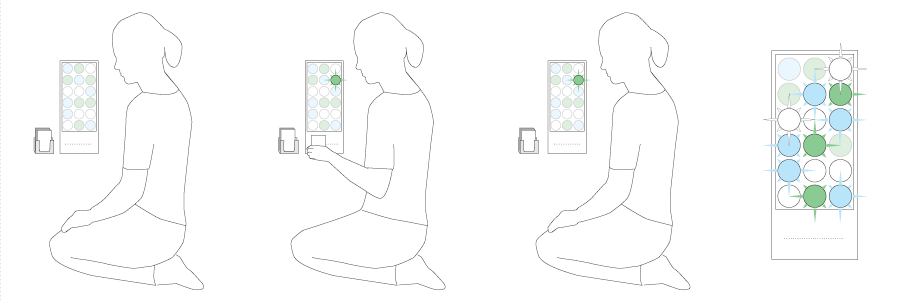
The first project - for this we pray - is an art installation inspired by the tradition of lighting candles during prayer.
for this we pray brings the experience of reflection to the everyday world of the jaded digital generation. Users select one of several prayer cards, and hold it close to a wall-mounted “shrine” reminiscent of a stained-glass window. The prayer card is recognized via RFID, and a light is turned on. As more prayers are "read" the shrine will fill with light.

the second post points to an article that examines how technology can be used in religious life:
Wyche, S. P., Hayes, G. R., Harvel, L. D., and Grinter, R. E. (2006). Technology in spiritual formation: an exploratory study of computer mediated religious communications. In CSCW ’06: Proceedings of the 2006 20th anniversary conference on Computer supported cooperative work, pages 199–208, New York, NY, USA. ACM Press. [pdf]
———
This paper aims at explaining the use of technology in religious life. The author performed a series of intervies with Protestant Ministers. Most pastors responded with a list of duties including educating the laity, preaching, and communication. More in details they reported using thechnological means to organize Bible study groups, for the pastoral care of the laity such as reaching sick parishioners or conunseling those in spiritual or personal crisis.
A good part of the article focus on thechnological enhancement to preaching and presentation. An interesting reported finding is that altough Ministers reported using commercial products for their presentations such as PowerPoint or Keynote, they expressed their misgivings about the fact that these software were designed with generic purposes in mind and that they do not support the peculiarities of spiritual training or presentation.
Some pastors expressed their feelings about the fact that using technology is essential for the church to be ‘contemporary’ but at the same time it is a matter of negotiation: a tradeoff between ‘relevance’ and ‘reverence’, but also a tradeoff between connection and distraction, remoteness and actual encounters. E. G., for spiritual practices solitude might be important.
Finally the authors reported interestingly that parishioners used technological access to spiritual material at work. So, we observe an ‘infiltration’ of domestic life in working settings. This allowed them to practice during the week instead of waiting for Sunday.
On a critical note, focusing the study on a single religion might have somehow biased the results. It might be interesting to broaden the spectrum of analysis to see if the same results apply.
I am very intrigued by the potential of bringing together technology and spirituality. So I decided to create a new category "technology and spirituality", and I hope to find soon new examples of this approach
22:45 Posted in Technology & spirituality | Permalink | Comments (0) | Tags: technology and spirituality
TWISTER
Via Pink Tentacle
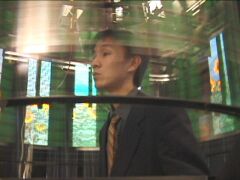
A research team from the University of Tokyo has developed a rotating panoramic display that immerses viewers in a 3D video environment. The Telexistence Wide-angle Immersive STEReoscope, or TWISTER, is the world’s first full-color 360-degree 3D display that does not require viewers to wear special glasses, says professor Tachi, who has spent over 10 years researching and developing the device.
22:32 Posted in Telepresence & virtual presence | Permalink | Comments (0) | Tags: virtual presence
Collaborative data visualization

a user study of a new website that supports asynchronous collaboration across a variety of visualization types. its collaborative features includes view sharing, discussion, graphical annotation & social navigation. results of the study show emergent patterns of social data analysis, including cycles of observation & hypothesis, & the complementary roles of social navigation & data-driven exploration. the study ran in 2 different parts: a pair of controlled lab studies & a 3-week live deployment on the IBM corporate intranet.
Abstract. This paper describes mechanisms for asynchronous collaboration in the context of information visualization, recasting visualizations as not just analytic tools, but social spaces. We contribute the design and implementation of sense.us, a web site supporting asynchronous collaboration across a variety of visualization types. The site supports view sharing, discussion, graphical annotation, and social navigation and includes novel interaction elements. We report the results of user studies of the system, observing emergent patterns of social data analysis, including cycles of observation and hypothesis, and the complementary roles of social navigation and data-driven exploration.
Voyagers and Voyeurs: Supporting Asynchronous Collaborative Information VisualizationACM Human Factors in Computing Systems (CHI), 2007
22:20 Posted in Information visualization | Permalink | Comments (0) | Tags: computer-supported collaborative work
Dislocate 07
Re-blogged from Networked Performance


Dislocate 07: ART, TECHNOLOGY, LOCALITY - Exhibition, Symposium and Workshop series :: 24th July - 5th August :: Tokyo and Yokohama - Ginza Art Laboratory (Wednesday - Sunday 3-8pm); Koiwa Project Space (Tuesday - Sunday 2-7pm); ZAIM 28th & 29th July 11am-4pm - Symposium and Workshops; Opening Event Koiwa Project Space 24th July 7pm; Performance Event ZAIM 29th July 6pm. All Events are Free.
The city is no longer built of concrete, a static posture no longer endures. Our surroundings have become a malleable space which can be warped, spliced and expanded at will. We no longer stand in one place alone, a mass convergence of coordinates is taking place beneath our feet. As we traverse these points of perpetual motion we are enclosed by structures of elsewhere, met with the sliding walls of other places which lead us through a never ending maze. Shrouded in alternative layers of space, we escape to another confinement through the mesh of new media.
As our presence is extended by the veins of technology our sense of space is transformed, our nervous system stems through endless reaches of universal skin. Our eyes see through a thousand windows, each with a different view, a collision of a multitude of global sounds meets our ears, our fingers pass beyond tiers of materiality.
But can we see what is before us? Are we listening to the resonance of our surroundings? Can we feel the texture of this place?
Engaged in distant or imaginary space, we flick through the channels with our remote control and choose when to plug in when to switch off. But as we are absorbed by these electronic pulses are we disappearing from the here and now?
Personal technologies offer a kaleidoscopic sensation of a multi-layered existence, but perhaps may also provide a microscope by which to examine the place which we are in at this moment.
22:13 | Permalink | Comments (0) | Tags: locative media
Pentagon to Merge Next-Gen Binoculars With Soldiers' Brains
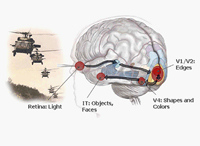
From Pentagon to Merge Next-Gen Binoculars With Soldiers' Brains by Sharon Weinberger, Wired:
"U.S. Special Forces may soon have a strange and powerful new weapon in their arsenal: a pair of high-tech binoculars 10 times more powerful than anything available today, augmented by an alerting system that literally taps the wearer's prefrontal cortex to warn of furtive threats detected by the soldier's subconscious.
In a new effort dubbed "Luke's Binoculars" -- after the high-tech binoculars Luke Skywalker uses in Star Wars -- the Defense Advanced Research Projects Agency is setting out to create its own version of this science-fiction hardware. And while the Pentagon's R&D arm often focuses on technologies 20 years out, this new effort is dramatically different -- Darpa says it expects to have prototypes in the hands of soldiers in three years...
The most far-reaching component of the binocs has nothing to do with the optics: it's Darpa's aspirations to integrate EEG electrodes that monitor the wearer's neural signals, cueing soldiers to recognize targets faster than the unaided brain could on its own. The idea is that EEG can spot "neural signatures" for target detection before the conscious mind becomes aware of a potential threat or target."
22:09 Posted in Brain-computer interface | Permalink | Comments (0) | Tags: future interfaces, brain-computer interface
EEG biofeedback in the treatment of attention deficit hyperactivity disorder
EEG biofeedback in the treatment of attention deficit hyperactivity disorder.
Altern Med Rev. 2007 Jun;12(2):146-151
Authors: Friel PN
21:59 Posted in Biofeedback & neurofeedback | Permalink | Comments (0) | Tags: biofeedback, neurofeedback