




Jan 22, 2007
Gemotion screen shows video in living 3D
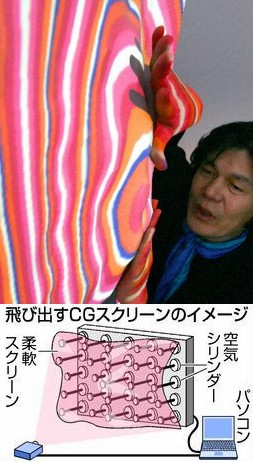
From Pink Tentacle
Gemotion is a soft, ‘living’ display that bulges and collapses in sync with the graphics on the screen, creating visuals that literally pop out at the viewer.
Yoichiro Kawaguchi, a well-known computer graphics artist and University of Tokyo professor, created Gemotion by arranging 72 air cylinders behind a flexible, 100 x 60 cm (39 x 24 inch) screen. As video is projected onto the screen, image data is relayed to the cylinders, which then push and pull on the screen accordingly.
“If used with games, TV or cinema, the screen could give images an element of power never seen before. It could lead to completely new forms of media,” says Kawaguchi.
The Gemotion screen will be on display from January 21 to February 4 as part of a media art exhibit (called Nihon no hyogen-ryoku) at National Art Center, Tokyo, which recently opened in Roppongi.
22:13 Posted in Future interfaces | Permalink | Comments (0) | Tags: future interfaces
OurFloatingPoints 4: Participatory Media

Emerson College and New Radio and Performing Arts, Inc. (NRPA) present OurFloatingPoints 4: Participatory MediaTurbulence.org. (2/28): (FP4) a speaker series that addresses the recent emergence of inexpensive, worldwide, and many-to-many publishing and communication media and focuses on how these media are transforming the relationship between cultural producers and consumers. FP4 is the fourth in an ongoing series of lectures and discussions planned with NRPA and its world-renowned website, Ulises Mejias + Trebor Scholz; (3/28): McKenzie Wark + David Weinberger; (4/25): a panel discussion with Wagner James Au (aka Hamlet Linden), John Lester (aka Pathfinder Linden), and John (Craig) Freeman (aka JC Freemont); moderated by Eric Gordon (aka Boston Borst).
Venue: (2/28 and 3/28) Bill Bordy Theater, Emerson College, 216 Tremont Street, Boston, MA 02116; (4/25) Cahners Theater, Museum of Science, Boston.
22:00 | Permalink | Comments (0) | Tags: participatory media
The mystery of consciousness
Steven Pinker, professor of psychology at Harvard University, has an article in Time magazine about the current state of understanding of consciousness.
From the article:
So neuroscientists are well on the way to identifying the neural correlates of consciousness, a part of the Easy Problem. But what about explaining how these events actually cause consciousness in the sense of inner experience--the Hard Problem?TO APPRECIATE THE HARDNESS OF THE HARD PROBLEM, CONSIDER how you could ever know whether you see colors the same way that I do. Sure, you and I both call grass green, but perhaps you see grass as having the color that I would describe, if I were in your shoes, as purple. Or ponder whether there could be a true zombie--a being who acts just like you or me but in whom there is no self actually feeling anything. This was the crux of a Star Trek plot in which officials wanted to reverse-engineer Lieut. Commander Data, and a furious debate erupted as to whether this was merely dismantling a machine or snuffing out a sentient life.
No one knows what to do with the Hard Problem. Some people may see it as an opening to sneak the soul back in, but this just relabels the mystery of "consciousness" as the mystery of "the soul"--a word game that provides no insight.
Many philosophers, like Daniel Dennett, deny that the Hard Problem exists at all. Speculating about zombies and inverted colors is a waste of time, they say, because nothing could ever settle the issue one way or another. Anything you could do to understand consciousness--like finding out what wavelengths make people see green or how similar they say it is to blue, or what emotions they associate with it--boils down to information processing in the brain and thus gets sucked back into the Easy Problem, leaving nothing else to explain. Most people react to this argument with incredulity because it seems to deny the ultimate undeniable fact: our own experience.
The most popular attitude to the Hard Problem among neuroscientists is that it remains unsolved for now but will eventually succumb to research that chips away at the Easy Problem. Others are skeptical about this cheery optimism because none of the inroads into the Easy Problem brings a solution to the Hard Problem even a bit closer. Identifying awareness with brain physiology, they say, is a kind of "meat chauvinism" that would dogmatically deny consciousness to Lieut. Commander Data just because he doesn't have the soft tissue of a human brain. Identifying it with information processing would go too far in the other direction and grant a simple consciousness to thermostats and calculators--a leap that most people find hard to stomach. Some mavericks, like the mathematician Roger Penrose, suggest the answer might someday be found in quantum mechanics. But to my ear, this amounts to the feeling that quantum mechanics sure is weird, and consciousness sure is weird, so maybe quantum mechanics can explain consciousness.
And then there is the theory put forward by philosopher Colin McGinn that our vertigo when pondering the Hard Problem is itself a quirk of our brains. The brain is a product of evolution, and just as animal brains have their limitations, we have ours. Our brains can't hold a hundred numbers in memory, can't visualize seven-dimensional space and perhaps can't intuitively grasp why neural information processing observed from the outside should give rise to subjective experience on the inside. This is where I place my bet, though I admit that the theory could be demolished when an unborn genius--a Darwin or Einstein of consciousness--comes up with a flabbergasting new idea that suddenly makes it all clear to us.
21:55 Posted in Research tools | Permalink | Comments (0) | Tags: research tools
Motor imagery for pathologic pain
Graded motor imagery for pathologic pain: a randomized controlled trial.
Neurology. 2006 Dec 26;67(12):2129-34
Authors: Moseley GL
BACKGROUND: Phantom limb and complex regional pain syndrome type 1 (CRPS1) are characterized by changes in cortical processing and organization, perceptual disturbances, and poor response to conventional treatments. Graded motor imagery is effective for a small subset of patients with CRPS1. OBJECTIVE: To investigate whether graded motor imagery would reduce pain and disability for a more general CRPS1 population and for people with phantom limb pain. METHODS: Fifty-one patients with phantom limb pain or CRPS1 were randomly allocated to motor imagery, consisting of 2 weeks each of limb laterality recognition, imagined movements, and mirror movements, or to physical therapy and ongoing medical care. RESULTS: There was a main statistical effect of treatment group, but not diagnostic group, on pain and function. The mean (95% CI) decrease in pain between pre- and post-treatment (100 mm visual analogue scale) was 23.4 mm (16.2 to 30.4 mm) for the motor imagery group and 10.5 mm (1.9 to 19.2 mm) for the control group. Improvement in function was similar and gains were maintained at 6-month follow-up. CONCLUSION: Motor imagery reduced pain and disability in these patients with complex regional pain syndrome type I or phantom limb pain, but the mechanism, or mechanisms, of the effect are not clear.
21:48 Posted in Mental practice & mental simulation | Permalink | Comments (0) | Tags: mental practice, mental simulation
Volitional control of neural activity: implications for BCIs
Volitional control of neural activity: implications for brain-computer interfaces.
J Physiol. 2007 Jan 18;
Authors: Fetz EE
Successful operation of brain-computer interfaces [BCI] and brain-machine interfaces [BMI] depends significantly on the degree to which neural activity can be volitionally controlled. This paper reviews evidence for such volitional control in a variety of neural signals, with particular emphasis on the activity of cortical neurons. Some evidence comes from conventional experiments that reveal volitional modulation in neural activity related to behaviors, including real and imagined movements, cognitive imagery and shifts of attention. More direct evidence comes from studies on operant conditioning of neural activity using biofeedback, and from BCI/BMI studies in which neural activity controls cursors or peripheral devices. Limits in the degree of accuracy of control in the latter studies can be attributed to several possible factors. Some of these factors, particularly limited practice time, can be addressed with long-term implanted BCIs. Preliminary observations with implanted circuits implementing recurrent BCIs are summarized.
21:45 Posted in Brain-computer interface | Permalink | Comments (0) | Tags: brain-computer interface
Location-tracker in Second Life
Via 3DPoint
SLStats comes in the form of a wristwatch, available in Hill Valley Square [in SL] in the Huin sim. Once you register with the service in-world, the watch “watches” where you go, tracking your location as you move around the world, as well as which other avatars you come into contact with. The information is used on the SLStats site to rank most popular regions (among SLStats users, of course), and to track how much time you’ve spent in-world, which you can view at a link like this one, which tracks Glitchy: http://slstats.com/users/view/Glitchy+Gumshoe.

00:23 Posted in Locative media, Virtual worlds | Permalink | Comments (0) | Tags: locative media, virtual reality
Information Aesthetics: subway-style trend maps of 2007
Re-blogged from Information Aesthetics

a collection of trends maps documenting 2007, based on the visual style of subway maps. one map illustrates the recent web trends, while another shows the more general social trends (pdf) in Western society, including the rise of social networks & the democratization of the web. (via Information Aesthetics)
00:18 Posted in Information visualization | Permalink | Comments (0) | Tags: information visualization
Critical illness VR rehabilitation device
Critical illness VR rehabilitation device (X-VR-D): Evaluation of the potential use for early clinical rehabilitation.
J Electromyogr Kinesiol. 2007 Jan 11;
Authors: Van de Meent H, Baken BC, Van Opstal S, Hogendoorn P
We present a new critical illness VR rehabilitation device (X-VR-D) that enables diversified self-training and is applicable early in the rehabilitation of severely injured or ill patients. The X-VR-D consists of a VR program delivering a virtual scene on a flat screen and simultaneously processing commands to a moving chair mounted on a motion system. Sitting in the moving chair and exposed to a virtual reality environment the device evokes anticipatory and reactive muscle contractions in trunk and extremities for postural control. In this study we tested the device in 10 healthy subjects to evaluate whether the enforced perturbations indeed evoke sufficient and reproducible EMG muscle activations. We found that particular fast roll and pitch movements evoke adequate trunk and leg muscle activity. Higher angular velocities and higher angles of inclination elicited broader EMG bursts and larger amplitudes. The muscle activation pattern was highly consistent between different subjects and although we found some habituation of EMG responses in consecutive training sessions, the general pattern was maintained and was predictable for specific movements. The habituation was characterized by more efficient muscle contractions and better muscle relaxation during the rest positions of the device. Furthermore we found that the addition of a virtual environment to the training session evoked more preparatory and anticipatory muscle activation than sessions without a virtual environment. We conclude that the X-VR-D is safe and effective to elicit consistent and reproducible muscle activity in trunk and leg muscles in healthy subjects and thus can be used as a training method.
00:11 Posted in Cybertherapy | Permalink | Comments (0) | Tags: virtual reality, cybertherapy
BCI: Communication and Restoration of Movement in Paralysis
Brain-Computer-Interfaces(BCI): Communication and Restoration of Movement in Paralysis.
J Physiol. 2007 Jan 18;
Authors: Birbaumer N, Cohen LG
The review describes the status of brain-computer- or brain-machine-interface research. We focus on non-invasive brain-computer-interfaces (BCIs) and their clinical utility for direct brain communication in paralysis and motor restoration in stroke. A large gap between the promises of invasive animal and invasive human BCI-preparations and the clinical reality characterises the literature: while intact monkeys learn to execute more or less complex upper limb movements with spike patterns from motor brain regions alone without concomitant peripheral motor activity usually after extensive training, clinical applications in human diseases such as Amyotrophic Lateral Sclerosis and Paralysis from stroke or spinal cord lesions shows only limited success with the exception of verbal communication in paralysed and locked-in patients: BCIs based on electroencephalographic potentials or oscillations are ready to undergo large clinical studies and commercial production as an adjunct or a major assisted communication device for paralysed and locked-in patients. However, attempts to train completely locked-in patients with BCI-communication after entering the complete locked-in state with no remaining eye-movement failed. We propose that a lack of contingencies between goal directed thoughts and intentions may be at the heart of this problem. Experiments with chronically curarised rats support our hypothesis, operant conditioning and voluntary control of autonomic physiological functions turned out to be impossible in this preparation. In addition to assisted communication BCIs consisting of operant learning of EEG slow cortical potentials and sensorimotor rhythm was demonstrated to be successful in drug resistant focal epilepsy and attention deficit disorder. First studies of non-invasive BCIs using sensorimotor rhythm of the EEG and MEG in restoration of paralysed hand movements in chronic stroke and single cases of high spinal cord lesions show some promise but need extensive evaluation in well-controlled experiments. Invasive BMIs based on neuronal spike patterns, local field potentials or electrocorticogram may constitute the strategy of choice in severe cases of stroke and spinal cord paralysis. Future directions of BCI research should include the regulation of brain metabolism and blood flow and electrical and magnetic stimulation of the human brain (invasive and non-invasive). A series of studies using BOLD-response regulation with functional magnetic resonance imaging (fMRI) and near infrared spectroscopy demonstrated a tight correlation between voluntary changes in brain metabolism and behaviour.
00:07 Posted in Brain-computer interface | Permalink | Comments (0) | Tags: brain-computer interface