




Dec 15, 2006
Neuroenhancement technology: an ethical analysis
Via IEET
Belgian government funds researcher to study neuroenhancement:
‘Neuroenhancement technology: an ethical analysis and study of the conditions for research and clinical trials.’
A project funded by the Flemish Fund for Scientific Research (G.0048.07) 01/01/2007-31/12/2010.
Aim and objectives:
The emergence of new treatments which have the capacity to profoundly alter or influence mood and cognition is considered by some as one of the most promising as well as most challenging developments of the 21st century within the life sciences (Wolp, 2002). Aside of other socially relevant aspects of current neuroscience (e.g. ‘brain reading’ ) and its technological tools (e.g. fMRI, TMS, PET), it is in particular the discussions regarding ethical and social implications of neuroenhancement technology which are giving rise to the gradual development of ‘neuroethics’. Some of the most pertinent concerns which shape this emerging domain include questions as to how this technology relates to the general goals of medicine and what the conditions for research and clinical trials should be. While the need for a thorough exploraiton of the social and ethical implications of enhancement technology is generally well acknowledged, scarce attention has gone out to the question if and under what conditions such research should be supported.
The aims of the research proposal are the following:
(1) to provide an overview of the current developments and results within neuroenhancement technology;
(2) to obtain thorough insight in the academic, social and policy debates surrounding these developments;
(3) to conduct a conceptual analysis of the conflict between ‘normal’, ‘healthy’ mental functioning and ‘enhanced’ functioning, both in terms of strictly medical as well as medical ethical standards;
(4) to conduct a comparative, medical ethical study of the conditions for acceptance of this and other forms of enhancement technology; and
(5) to apply the results obtained from the analyses to the current context of neuroenhancement technology.
00:28 Posted in Brain training & cognitive enhancement | Permalink | Comments (0) | Tags: cognitive enhancement
The future of research journals and peer-review
via Langreiter
a commentary at the Journal of Neuroscience speculates on the future of research journals and peer-review:
Research studies appear on databases, not in journals
First, I don't think that it makes any sense to continue with paper copies of research articles. Instead of the "quasi-legal" document that is the current scientific article, we should be moving to full data being available on the web together with the software that might have been used to manipulate the data, as well as multimedia presentations to back up the data. Research papers are primarily of interest to other researchers in the same area, and they usually don't need the introduction and certainly not the discussion, which mostly degenerates to hype anyway
...
If an absence of peer review (or post-publication review, as I call it) is a step too far, then we should have an author (or rather funder) pays model. These fees could support a peer review mechanism, which should be open in that both authors and readers would know who was reviewing studies. It's ethically unacceptable that such important judgements should be made an unidentified judge. Like it or not, we live in a world where what is not transparent is deemed to be biased, corrupt, or incompetent until proved otherwise. Plus I believe that peer review should be a scientific discourse rather than an arbitrary judgment. This is far from radical: it's simply science returning to its roots when science was presented and discussed at meetings rather than published in journals.Perhaps we will invent new forms of peer review by learning from innovations like Wikipedia. It is in some ways a form of peer review, only reviewers make changes directly rather than simply commenting.
...
Another worry from the conservative about such a system is to wonder how credit would be allocated. At present credit comes from publishing in prestigious journals. Often the impact factor of the journal (a dubious and manipulated statistic) is allocated to the paper, which is wholly unscientific because there is little correlation between the citations to studies and the impact factor of the journals in which they are published, because the impact factor of a journal is driven by a small number of highly cited studies (Seglen, 1997). In the new world I'm imagining, credit would come from the buzz from researchers and hits on the study. These hits can be disclosed in real time, unlike citations, which come years after studies are published.
00:25 Posted in Research tools | Permalink | Comments (0) | Tags: research tools
Online control of a brain-computer interface using phase synchronization
Online control of a brain-computer interface using phase synchronization.
IEEE Trans Biomed Eng. 2006 Dec;53(12 Pt 1):2501-6
Authors: Brunner C, Scherer R, Graimann B, Supp G, Pfurtscheller G
Currently, almost all brain-computer interfaces (BCIs) ignore the relationship between phases of electroencephalographic signals detected from different recording sites (i.e., electrodes). The vast majority of BCI systems rely on feature vectors derived from e.g., bandpower or univariate adaptive autoregressive (AAR) parameters. However, ample evidence suggests that additional information is obtained by quantifying the relationship between signals of single electrodes, which might provide innovative features for future BCI systems. This paper investigates one method to extract the degree of phase synchronization between two electroencephalogram (EEG) signals by calculating the so-called phase locking value (PLV). In our offline study, several PLV-based features were acquired and the optimal feature set was selected for each subject individually by a feature selection algorithm. The online sessions with three trained subjects revealed that all subjects were able to control three mental states (motor imagery of left hand, right hand, and foot, respectively) with single-trial accuracies between 60% and 66.7% (33% would be expected by chance) throughout the whole session.
00:19 Posted in Brain-computer interface | Permalink | Comments (0) | Tags: brain-computer interface
CREATE 2007: Creative Inventions, Innovations and Everyday Designs - London
Via Usability News
CREATE 2007 is the first joint conference between Human-Computer Interaction Specialist Groups of the Ergonomics Society and British Computing Society HCI Group – on creative invention in HCI.
CREATE 2007 is a 2-day conference about creating innovative interactions, whether digital consumer products, interactive services or interaction paradigms. A conference where the emphasis is not on presenting technology or evaluation, but to share the wealth of creative ideas we have developed to resolve problems, to create new capabilities, or new functions; where the aim is to spawn further creative designs that can make a difference to people. In keeping with this theme, we invite people to bring:
- Their experiences – designs, both successes and failures, that have pushed the boundaries of interaction
- Their approaches – principles and methods that have delivered new, people-centred ideas and products.
CREATE 2007 will present cases of innovative interactions and visualisations, and discussions of how we innovate and the role of user-centred design in the innovation process, in a workshop format allowing us to debate the ways in which new designs come about and how novel but usable interactions can be developed.
Submission:
We invite cases studies of innovative design from the commercial, public, government and research sectors. Cases can come from any paradigm – the web, mobile and hand held, consumer electronics. Outline the problems, the capabilities, or new functions that were being addressed, and then describe the solutions you or your team created to resolve it.
IMPORTANT: Include photos, screen shots, or sketches, and tell us how and why it did or did not work. We also welcome theoretical and research perspectives on how we innovate.
Initial submissions should be no more than 2-pages long. Accepted papers can be either short papers 2-pages long, or be extended to long papers of no more than 6-pages. Submissions may also be invited as posters – please indicate if you specifically want to be considered as a poster.
Send your submissions via email to Sue Hull at s.hull@ergonomics.org.uk. Please include the phrase “CREATE submission” in your subject line.
Important dates:
Initial submission January 12th, 2007
Notification of acceptance Feb 9th, 2007
Full submission March 23rd, 2007
CREATE 2007 June 13-14, 2007
00:14 Posted in Positive Technology events | Permalink | Comments (0) | Tags: positive technology
Intelligent rooms: RoomRender
Via Pink Tentacle
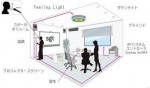
SGI Japan has developed a system that can control the electronics, appliances and hardware in a room based on the spoken commands and emotions of the room’s occupants. RoomRender relies on AmiVoice voice recognition technology (developed by Advanced Media) to recognize and analyze spoken commands, enabling the room to close the blinds, turn on the heater, etc. as instructed.
Read the full story on Pink Tentacle
00:11 Posted in Pervasive computing | Permalink | Comments (0) | Tags: ambient intelligence, emotional computing, pervasive technology, persuasive technology
3D RSS feed reader
Via Infoaesthetic
univeRSS is a 3D RSS feed reader for VISTA that "introduces a full-screen 3D universe where galaxies represent the folders of your RSS feed directory, and the stars are represented by the spinning cubes that hold the feed information. Size and position of the feed cubes indicate how many unread items they contain" (quoted from the Microsoft website)

Currently UniveRSS uses the RSS Feed Store managed through Internet Explorer 7. Later versions will allow you to manage the Feed Store from within the UniveRSS application.
00:03 Posted in Information visualization | Permalink | Comments (0) | Tags: information visualization