




Nov 29, 2006
Analgesic effects of posthypnotic suggestions and virtual reality distraction on thermal pain
Analgesic effects of posthypnotic suggestions and virtual reality distraction on thermal pain.
J Abnorm Psychol. 2006 Nov;115(4):834-41
Authors: Patterson DR, Hoffman HG, Palacios AG, Jensen MJ
The individual and combined effects of posthypnotic suggestion (PHS) and virtual reality distraction (VRD) on experimentally induced thermal pain were examined using a 2 x 2, between-groups design. After receiving baseline thermal pain, each participant received hypnosis or no hypnosis, followed by VRD or no VRD during another pain stimulus. Consistent with the hypothesis that hypnosis and VRD work via different mechanisms, results show that posthypnotic analgesia was moderated by hypnotizability but VRD analgesia was not. The impact of PHSs for analgesia was specific to high hypnotizables, whereas VRD was effective independent of hypnotizability. Results also show a nonsignificant but predicted pattern for high hypnotizables: Audio hypnosis combined with VRD reduced worst pain 22% more and pain unpleasantness 25% more than did VRD alone. Theoretical and clinical implications are discussed. ((c) 2006 APA, all rights reserved).
23:13 Posted in Cybertherapy | Permalink | Comments (0) | Tags: cybertherapy
Rehabilitation after Stroke using Virtual Reality, Haptics (force feedback) and Telemedicine
Rehabilitation after Stroke using Virtual Reality, Haptics (force feedback) and Telemedicine.
Stud Health Technol Inform. 2006;124:51-56
Authors: Broeren J, Dixon M, Stibrant Sunnerhagen K, Rydmark M
We have constructed a haptic immersive workbench to be placed in the patients' home for daily adjusted rehabilitation. We also propose a system for Internet based connection and communication between patients and between patients and a clinical rehabilitation center and clinical assessment/evaluation centers. The benefits of a system for rehabilitation after stroke, based on VR, Haptics and Telemedicine should be: increased quality of life, lesser isolation, feeling more secure, fewer tiring transportations, more frequent exercising, better compliance to training, lower cost for transportation. The long term recovery for a larger group of patients with motor impairments is presently under evaluation.
23:11 Posted in Cybertherapy | Permalink | Comments (0) | Tags: cybertherapy
Virtual reality applications for the remapping of space in neglect patients
Virtual reality applications for the remapping of space in neglect patients.
Restor Neurol Neurosci. 2006;24(4-6):431-41
Authors: Ansuini C, Pierno AC, Lusher D, Castiello U
Purpose: The aims of the present article were the following: (i) to provide some evidence of the potential of virtual reality (VR) for the assessment, training and recovery of hemispatial neglect; (ii) to present data from our laboratory which seem to confirm that the clinical manifestation of neglect can be improved by using VR techniques; and (iii) to ascertain the neural bases of this improvement. Methods: We used a VR device (DataGlove) interfaced with a specially designed computer program which allowed neglect patients to reach and grasp a real object while simultaneously observing the grasping of a virtual object located within a virtual environment by a virtual hand. The virtual hand was commanded in real time by their real hand. Results: After a period of training, hemispatial neglect patients coded the visual stimuli within the neglected space in an identical fashion as those presented within the preserved portions of space. However it was also found that only patients with lesions that spared the inferior parietal/superior temporal regions were able to benefit from the virtual reality training. Conclusions: It was concluded that using VR it is possible to re-create links between the affected and the nonaffected space in neglect patients. Furthermore, that specific regions may play a crucial role in the recovery of space that underlies the improvement of neglect patients when trained with virtual reality. The implications of these results for determining the neural bases of a higher order attentional and/or spatial representation, and for the treatment of patients with unilateral neglect are discussed.
23:10 Posted in Cybertherapy, Virtual worlds | Permalink | Comments (0) | Tags: cybertherapy
Macro-Bushido: A Geoethical Consciousness
From the Journal of Personal Cyberconsciousness, 1(3) 2006 (via IEET)

In this article, Martine Rothblatt, a "geoethical samurai", introduces Macro-Bushido, a set of ethical guidelines for the modern Info-Cultural Age. Macro-Bushido is based on Bushido, the unwritten code of ethics that guided Japan's samurai until about one hundred years ago. The seven principles of Bushido are: Rectitude, Courage, Benevolence, Politeness, Veracity, Honor and Loyalty. Rothblatt dissects each principle and explains how it could be applied to the modern world and in particular, to emerging cyberconsciousness. Rothblatt argues that upholding Macro-Bushido in today's world will result in many benefits, among them that humans may be saved from the consequences of shortsightedness by refocusing their attention on loyalty to a higher goal. In addition, a class of modern samurai may emerge to help keep humanity loyal to the objectives of diversity, unity and immortality. These ideals are invaluable as we arrive at personal cyberconsciousness within humanity's quest for survival.
Link to the article
23:06 | Permalink | Comments (0) | Tags: cyberethics
Relaxation strategies and enhancement of hypnotic susceptibility
Relaxation strategies and enhancement of hypnotic susceptibility: EEG neurofeedback, progressive muscle relaxation and self-hypnosis.
Brain Res Bull. 2006 Dec 11;71(1-3):83-90
Authors: Batty MJ, Bonnington S, Tang BK, Hawken MB, Gruzelier JH
Hypnosis has been shown to be efficacious in a range of clinical conditions, including the management of chronic pain. However, not all individuals are able to enter a hypnotic state, thereby limiting the clinical utility of this technique. We sought to determine whether hypnotic susceptibility could be increased using three methods thought to facilitate relaxation, with particular interest in an EEG neurofeedback protocol which elevated the theta to alpha ratio. This was compared with progressive muscle relaxation and self-hypnosis. Ten subjects with moderate levels of susceptibility (2-7/12) were randomly assigned to each condition and assessed for hypnotic susceptibility prior to and upon completion of 10 sessions of training. Hypnotic susceptibility increased post-training in all groups, providing further evidence that operant control over the theta/alpha ratio is possible, but contrary to our predictions, elevation of the theta/alpha ratio proved no more successful than the other interventions. Nonetheless, all three techniques successfully enhanced hypnotic susceptibility in over half of the participants (17/30), a similar incidence to that reported using other methods. As previously reported, the majority who were not susceptible to modification were at the lower levels of susceptibility, and the greater increases tended to occur in the more susceptible subjects. However, here enhancement was disclosed in some at low levels, and capability was found of reaching high levels, both features not typically reported. Further research is warranted.
22:36 Posted in Biofeedback & neurofeedback | Permalink | Comments (0) | Tags: neurofeedback
Brain-computer interface technology as a tool to augment plasticity
Brain-computer interface technology as a tool to augment plasticity and outcomes for neurological rehabilitation.
J Physiol. 2006 Nov 16;
Authors: Dobkin BH
Brain-computer interfaces are a rehabilitation tool for tetraplegic patients that aim to improve quality of life by augmenting communication, control of the environment, and self-care. The neurobiology of both rehabilitation and BCI control depends upon learning to modify the efficacy of spared neural ensembles that represent movement, sensation, and cognition through progressive practice with feedback and reward. To serve patients, BCI systems must become safe, reliable, cosmetically acceptable, quickly mastered with minimal ongoing technical support, and highly accurate even in the face of mental distractions and the uncontrolled environment beyond a laboratory. BCI technologies may raise ethical concerns if their availability affects the decisions of patients who become locked-in with brain stem stroke or amyotrophic lateral sclerosis to be sustained with ventilator support. If BCI technology becomes flexible and affordable, volitional control of cortical signals could be employed for the rehabilitation of motor and cognitive impairments in hemiplegic or paraplegic patients by offering on-line feedback about cortical activity associated with mental practice, motor intention, and other neural recruitment strategies during progressive task-oriented practice. Clinical trials with measures of quality of life will be necessary to demonstrate the value of near-term and future BCI applications.
22:35 Posted in Brain-computer interface | Permalink | Comments (0) | Tags: brain-computer interface
Model train controlled via brain-machine interface
Re-blogged from Pink Tentacle
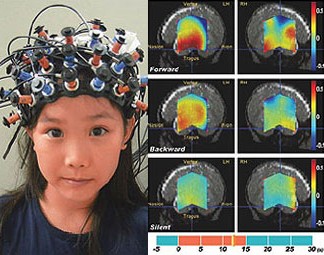
Hitachi has successfully tested a brain-machine interface that allows users to turn power switches on and off with their mind. Relying on optical topography, a neuroimaging technique that uses near-infrared light to map blood concentration in the brain, the system can recognize the changes in brain blood flow associated with mental activity and translate those changes into voltage signals for controlling external devices. In the experiments, test subjects were able to activate the power switch of a model train by performing mental arithmetic and reciting items from memory.
Link to Pink Tentacle post
22:24 Posted in Brain-computer interface | Permalink | Comments (0) | Tags: brain-computer interface
Moodjam mood visualization
Via Infoaesthetic

Moodjam is an online visualization of people's moods visualized as beautiful color strips. Users can keep a record of their moods every hour, day, and weeks and share them with friends, family or co-workers.
22:19 Posted in Emotional computing, Information visualization | Permalink | Comments (0) | Tags: information visualization, emotional computing
3D - Computer Based Pain Visualisation Tool
Via Medgadget

Researchers from Brunel University in the UK have developed a PDA-based pain recording and monitoring system:
Brunel University today unveils the World's first computer based, three-dimensional (3D) solution for pain visualisation. The tool will help patients record their own pain, as well as providing practitioners with a way to collect information on patient experience of pain and allows greater insight into the way pain travels around the body...
The innovative pain visualisation tool is displayed via a web browser as a 3D body. Users can log pain data on an easy-to-use PDA monitor at regular intervals. Pain can be classified as: burning, aching, stabbing, pins and needles and numbness with each pain type allocated a colour, which is represented on the 3D rotating tool.
The data is collected and the pain entries can be stored and replayed over an extended period as a rotating multimedia image, providing physicians with more detailed understanding of surface pain journeys.
Brunel University today unveils the World's first computer based, three-dimensional (3D) solution for pain visualisation. The tool will help patients record their own pain, as well as providing practitioners with a way to collect information on patient experience of pain and allows greater insight into the way pain travels around the body...
The innovative pain visualisation tool is displayed via a web browser as a 3D body. Users can log pain data on an easy-to-use PDA monitor at regular intervals. Pain can be classified as: burning, aching, stabbing, pins and needles and numbness with each pain type allocated a colour, which is represented on the 3D rotating tool.
The data is collected and the pain entries can be stored and replayed over an extended period as a rotating multimedia image, providing physicians with more detailed understanding of surface pain journeys.

22:07 Posted in Research institutions & funding opportunities | Permalink | Comments (0) | Tags: research tools
Driving a Wheelchair with Your Shirt
From Medgadget

Researchers Fishbach and Mussa-Ivaldi at Northwestern University's Department of Physical Medicine and Rehabilitation have developed a high-tech fabric which promises to help wheelchair bound patients.
From the article at MIT Tech Review:
Adaptive, sensor-laden garments could provide a new way for quadriplegics to control their wheelchairs. The system, which is still in an early stage of development, identifies the ideal set of movements that can be employed as control commands for each individual user. "We think this will benefit the most difficult patients, such as those who can move only their head or shoulders," says Alon Fishbach, a scientist at Northwestern who is among those developing the device.
People with high-level spinal-cord injuries often lose control of their hands, but they may still be able to move their shoulders or chests. More and more such patients survive their injuries, thanks to respiratory devices that help them breathe. But these people have limited options when selecting devices to control their wheelchairs or computers. They might use a sip/puff switch, which converts the user's sip or puff of air into a specific command, or a headswitch, which records head movements via a switch on the back of the wheelchair. "But the disadvantage of these devices is that patients must fit the capacities of the machine, rather than the other way around," says Ferdinando Mussa-Ivaldi, another Northwestern scientist working on the device. "If a patient can move their right side more than their left, an intelligent interface could pick up on this."
To overcome this design flaw, the researchers are developing an adaptive device using sensor-laden fabric. The garment is printed with 52 flexible, piezoresistive sensors developed at the University of Pisa. These sensors are made of electroactive polymers that change voltage depending on the angle at which they are stretched. The sensors can detect fine scale movements of the upper body and arms.
The researchers are currently focusing on a system to control wheelchairs, but they say the device could be used to control a wide range of machines.
21:13 Posted in Wearable & mobile | Permalink | Comments (0) | Tags: neurotechnology, wearable