




Nov 07, 2006
SHOJI: Symbiotic Hosting Online Jog Instrument
From Pink Tentacle
Symbiotic Hosting Online Jog Instrument (SHOJI) is a system that monitors the feelings and behavior of the people in the room and relays the mood data to remote terminals where it is displayed as full-colored LED light.
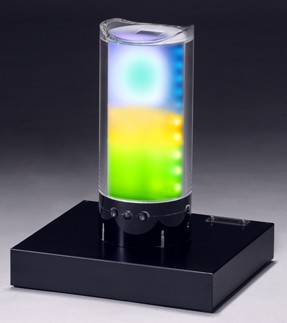
In addition to constantly measuring the room’s environmental conditions, SHOJI terminals can detect the presence and movement of people, body temperature, and the nature of the activity in the room.
Read the full post on Pink Tentacle
23:21 Posted in Emotional computing | Permalink | Comments (0) | Tags: emotional computing
[meme.garden]
re-blogged from Networked Performance

[meme.garden] by Mary Flanagan, Daniel Howe, Chris Egert, Junming Mei, and Kay Chang [meme.garden] is an Internet service that blends software art and search tool to visualize participants' interests in prevalent streams of information, encouraging browsing and interaction between users in real time, through time. Utilizing the WordNet lexical reference system from Princeton University, [meme.garden] introduces concepts of temporality, space, and empathy into a network-oriented search tool. Participants search for words which expand contextually through the use of a lexical database. English nouns, verbs, adjectives and adverbs are organized into floating synonym "seeds," each representing one underlying lexical concept. When participants "plant" their interests, each becomes a tree that "grows" over time. Each organism's leaves are linked to related streaming RSS feeds, and by interacting with their own and other participants' trees, participants create a contextual timescape in which interests can be seen growing and changing within an environment that endures.
The [meme.garden] software was created by an eclectic team of artists and scientists: Mary Flanagan, Daniel Howe, Chris Egert, Junming Mei, and Kay Chang.
23:10 Posted in Cyberart | Permalink | Comments (0) | Tags: cyberart
The future of music experience
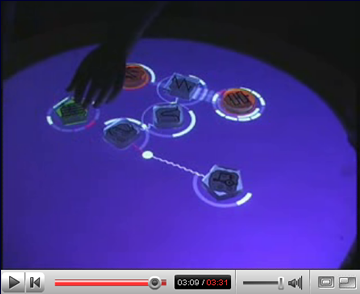
check out this youtube video showing "reactable", an amazing music instrument with a tangible interface
23:00 Posted in Future interfaces | Permalink | Comments (0) | Tags: future interfaces
Efficacy of biofeedback for migraine
Efficacy of biofeedback for migraine: A meta-analysis.
Pain. 2006 Nov 1;
Authors: Nestoriuc Y, Martin A
In this article, we meta-analytically examined the efficacy of biofeedback (BFB) in treating migraine. A computerized literature search of the databases Medline, PsycInfo, Psyndex and the Cochrane library, enhanced by a hand search, identified 86 outcome studies. A total of 55 studies, including randomized controlled trials as well as pre-post trials, met our inclusion criteria and were integrated. A medium effect size (d =0.58, 95% CI=0.52, 0.64) resulted for all BFB interventions and proved stable over an average follow-up phase of 17 months. Also, BFB was more effective than control conditions. Frequency of migraine attacks and perceived self-efficacy demonstrated the strongest improvements. Blood-volume-pulse feedback yielded higher effect sizes than peripheral skin temperature feedback and electromyography feedback. Moderator analyses revealed BFB in combination with home training to be more effective than therapies without home training. The influence of the meta-analytical methods on the effect sizes was systematically explored and the results proved to be robust across different methods of effect size calculation. Furthermore, there was no substantial relation between the validity of the integrated studies and the direct treatment effects. Finally, an intention-to-treat analysis showed that the treatment effects remained stable, even when drop-outs were considered as nonresponders.
22:49 Posted in Biofeedback & neurofeedback | Permalink | Comments (0) | Tags: biofeedback
TagCrowd
From the TagCrowd blog
TagCrowd is a web application for visualizing word frequencies in any user-supplied text by creating what is popularly known as a tag cloud.
Today, tag clouds are primarily used for navigation and visualization on websites that employ user-generated metadata (tags) as a categorization scheme. (Flickr is a good example.)
TagCrowd is trying to do something different.
When we look at a tag cloud, we see not only a richly informative, beautiful image that communicates much in a single glance. We see a whole new approach to text.
Potential uses for tag clouds extend far outside the online realm: as topic summaries for written works, as name tags for conferences, as resumes in a single glance, as analyses for survey data, as visual poetry; the list goes on.
In the future, TagCrowd will develop into a suite of experimental tools and tutorials that empower social and collaborative uses for tag clouds and related visualizations.
00:28 Posted in Information visualization | Permalink | Comments (0) | Tags: information visualization
Talking space
From Textually.org (via Designboom)
Yang Shi Wei and Shawn Wein Shin from Taiwan have designed "Talking Space", a lampshade that creates a space to close off voice during phone conversations

In the designers' own words:
People enjoy the feeling at party. We always hear much sound about laugh, games, music or play... It's good!! Let we relax and excite. Everything is fine. Playing with your friend. But now, your phone is ringing. It maybe tells an important message to you. Can you talk with the other side on noisy place? You need to leave, and try to find another place to close off voice. Going to outside ?! It's just one of way to solve problems. Have another way?
00:17 Posted in Wearable & mobile | Permalink | Comments (0) | Tags: mobile phones
SLAM - Mobile social networking from Microsoft Research
Via LADS
SLAM is a mobile based social networking application deveoped by Microsoft Research’s Community Technologies Group, which enables lightweight, group-centric real-time communication, photo-sharing and location awareness.

From LADS:
From the user perspective, “Slam” means a group of people with whom you can share you exchange messages and share photos easily through your mobile phone. Slam works on group level, which means that any messages sent to a Slam gets delivered to all the members in the group. To use Slam you need to install the Slam application on your Windows Mobile based devices and need a unlimited data plan. So any messages sent from your smart phone will be over HTTP instead of using SMS. If you don’t have Windows based device, you can still communicate with your Slams through SMS, since each Slam has a different phone number to enable SMS delivery.
Slam delivers a pretty impressive feature set on the smart phones. Besides exchanging messages, users can view private and public Slams, create Slam, invite people to an existing Slam, join Slams, view Slam members, view and upload photos, manage their Slams, and view unread messages. While viewing a member profile Slam also indicates if you the user has any an intersecting Slam group with you.
One of the best features Slam team is working on is to provide location information of people in your Slam group. Once group members set their privacy level to allow appropriate Slam groups to view their location information, Slam maps the location information onto a Windows Live map on your mobile. This feature is more of a proof of concept and works only on few phone including Audiovox 5600, I-Mate Sp3 and i-Mate SP5 for some of the Seattle users of Cingular/AT&T and T-Mobile.
Visit also the Microsoft Slam Team Blog
00:00 Posted in Locative media, Social Media | Permalink | Comments (0) | Tags: social networks, locative media