




Jul 29, 2006
Simulated violence experiment

According to this press release, psychologists at Iowa State have done the first study on violence desensitization from video games.
From the press release:
Ames, Iowa -- Research led by a pair of Iowa State University psychologists has proven for the first time that exposure to violent video games can desensitize individuals to real-life violence.
Nicholas Carnagey, an Iowa State psychology instructor and research assistant, and ISU Distinguished Professor of Psychology Craig Anderson collaborated on the study with Brad Bushman, a former Iowa State psychology professor now at the University of Michigan and Vrije Universiteit, Amsterdam.
They authored a paper titled "The Effects of Video Game Violence on Physiological Desensitization to Real-Life Violence," which was published in the current issue of the Journal of Experimental Social Psychology, a professional journal. In this paper, the authors define desensitization to violence as "a reduction in emotion-related physiological reactivity to real violence."
Their paper reports that past research -- including their own studies -- documents that exposure to violent video games increases aggressive thoughts, angry feelings, physiological arousal and aggressive behaviors, and decreases helpful behaviors. Previous studies also found that more than 85 percent of video games contain some violence, and approximately half of video games include serious violent actions.
Their latest study tested 257 college students (124 men and 133 women) individually. After taking baseline physiological measurements on heart rate and galvanic skin response -- and asking questions to control for their preference for violent video games and general aggression -- participants then played one of eight randomly assigned violent or non-violent video games for 20 minutes. The four violent video games were Carmageddon, Duke Nukem, Mortal Kombat or Future Cop; the non-violent games were Glider Pro, 3D Pinball, 3D Munch Man and Tetra Madness.
After playing a video game, a second set of five-minute heart rate and skin response measurements were taken. Participants were then asked to watch a 10-minute videotape of actual violent episodes taken from TV programs and commercially-released films in the following four contexts: courtroom outbursts, police confrontations, shootings and prison fights. Heart rate and skin response were monitored throughout the viewing.
When viewing real violence, participants who had played a violent video game experienced skin response measurements significantly lower than those who had played a non-violent video game. The participants in the violent video game group also had lower heart rates while viewing the real-life violence compared to the nonviolent video game group.
"The results demonstrate that playing violent video games, even for just 20 minutes, can cause people to become less physiologically aroused by real violence," said Carnagey. "Participants randomly assigned to play a violent video game had relatively lower heart rates and galvanic skin responses while watching footage of people being beaten, stabbed and shot than did those randomly assigned to play nonviolent video games.
See also a critique to this article by Ed Castronova, a "synthetic worlds" researcher.
21:05 Posted in Serious games | Permalink | Comments (0) | Tags: serious gaming
Brain-activity interpretation competition won by Italian researchers
Via Mind Hacks

A team of three Italian researchers (Emanuele Olivetti, Diego Sona, and Sriharsha Veeramachaneni) won $10000 in a brain-activity interpretation competition. Entrants were provided with the fMRI data and behavioural reports recorded when four people watched two movies. The competitors' task was to create an algorithm that could use the viewers ongoing brain activity to predict what they were thinking and feeling as the film unfolded.
The Italian team resulted to be the most accurate, with a correlation of .86 for basic features, such as whether an instant of the film contained music. The full results are here.
20:55 Posted in Brain-computer interface, Neurotechnology & neuroinformatics, Persuasive technology | Permalink | Comments (0) | Tags: brain-computer interface
The speed of sight

According to estimates by University of Pennsylvania researchers, information transmission of the human retina is as fast as a regular Ethernet connection:
Using an intact retina from a guinea pig, the researchers recorded spikes of electrical impulses from ganglion cells using a miniature multi-electrode array. The investigators calculate that the human retina can transmit data at roughly 10 million bits per second. By comparison, an Ethernet can transmit information between computers at speeds of 10 to 100 million bits per second...The guinea pig retina was placed in a dish and then presented with movies containing four types of biological motion, for example a salamander swimming in a tank to represent an object-motion stimulus. After recording electrical spikes on an array of electrodes, the researchers classified each cell into one of two broad classes: "brisk" or "sluggish," so named because of their speed.
The researchers found that the electrical spike patterns differed between cell types. For example, the larger, brisk cells fired many spikes per second and their response was highly reproducible. In contrast, the smaller, sluggish cells fired fewer spikes per second and their responses were less reproducible.
But, what's the relationship between these spikes and information being sent? "It's the combinations and patterns of spikes that are sending the information. The patterns have various meanings," says co-author Vijay Balasubramanian, PhD, Professor of Physics at Penn. "We quantify the patterns and work out how much information they convey, measured in bits per second."
Calculating the proportions of each cell type in the retina, the team estimated that about 100,000 guinea pig ganglion cells transmit about 875,000 bits of information per second. Because sluggish cells are more numerous, they account for most of the information. With about 1,000,000 ganglion cells, the human retina would transmit data at roughly the rate of an Ethernet connection, or 10 million bits per second.
Read the press release
20:45 | Permalink | Comments (0) | Tags: artificial intelligence
World Map of Happiness
Via Emerging Technology Trends
Adrian White, Analytic Social Psychologist at the University of Leicester has developed the first ever World Map of Happiness. He analysed data published by several organizations, including UNESCO, the CIA, the New Economics Foundation, and the WHO, to create a global projection of subjective well-being.
Below is a small version of this map (source: Emerging Technology Trends). On this map, red indicates a high level of happiness.

A Flash version of this map is available here.
20:40 Posted in Research tools | Permalink | Comments (0) | Tags: positive psychology
E-finger
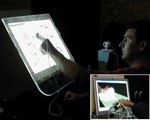
This new fingertip-mounted device uses miniature thin-film force sensors, a tri-axial accelerometer, and a motion tracker. A real-time, network-based, multi-rate data-acquisition system was developed using LabVIEW virtual instrumentation technology. Biomechanical models based on human-subject studies were applied to the sensing algorithm. A new 2D touch-based painting application (Touch Painter) was developed with a new portable, touch-based projection system (Touch Canvas). Also, a new 3D object-digitizing application (Tactile Tracer) was developed to determine object properties by dynamic tactile activities, such as rubbing, palpation, tapping, and nail-scratching.
20:31 Posted in Future interfaces | Permalink | Comments (0)