




Jul 27, 2006
Mouthpiece
Re-blogged from WMMNA
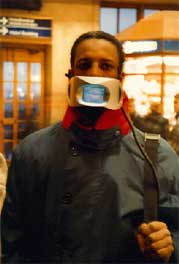
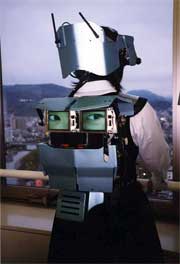
The Mouthpiece has been designed to help strangers who find it difficult to express their feelings or opinions face to face. A small LCD monitor and loudspeakers are covering the mouth of the wearer like a gag. The equipment replaces the real act of speech with pre-recorded, edited and electronically perfected statements, questions, answers, stories, etc.
21:28 Posted in Cyberart, Emotional computing | Permalink | Comments (0)
A mobile network that keeps track of everything you do
Re-blogged from Smart Mobs
AsiaMedia reports "Japan's No. 2 telecom operator KDDI Corp said yesterday that it had developed a server which keeps an electronic record of the smallest events in a person's life and lets others sift through them.
The Lifelog Pod jots down every activity made through a cellphone or computer, including taking photographs, searching for a restaurant, listening to music and managing money. While some may loathe the thought of an omniscient network, the company said it could provide a way to make friends."
Users can learn who else their friends chat with or delve through their companions" data -- minus areas protected by passwords -- to gauge their interests," a KDDI spokesman said.
"Your information is connected to that of your friend, and that of his friend, and so on.
"In this country of cellphone aficionados, cellphone users can also put their blogs on the common server. Only people who have a common connection -- such as a mutual friend -- will be able to access each other's data.
"This isn't a violation of privacy rights," the KDDI official said. "It is simply that everyone is connected."
Japan: A mobile network that keeps track of everything you do
21:22 Posted in Persuasive technology | Permalink | Comments (0)
A P300 event-related potential brain-computer interface
A P300 event-related potential brain-computer interface (BCI): The effects of matrix size and inter stimulus interval on performance.
Biol Psychol. 2006 Jul 21;
Authors: Sellers EW, Krusienski DJ, McFarland DJ, Vaughan TM, Wolpaw JR
We describe a study designed to assess properties of a P300 brain-computer interface (BCI). The BCI presents the user with a matrix containing letters and numbers. The user attends to a character to be communicated and the rows and columns of the matrix briefly intensify. Each time the attended character is intensified it serves as a rare event in an oddball sequence and it elicits a P300 response. The BCI works by detecting which character elicited a P300 response. We manipulated the size of the character matrix (either 3x3 or 6x6) and the duration of the inter stimulus interval (ISI) between intensifications (either 175 or 350ms). Online accuracy was highest for the 3x3 matrix 175-ms ISI condition, while bit rate was highest for the 6x6 matrix 175-ms ISI condition. Average accuracy in the best condition for each subject was 88%. P300 amplitude was significantly greater for the attended stimulus and for the 6x6 matrix. This work demonstrates that matrix size and ISI are important variables to consider when optimizing a BCI system for individual users and that a P300-BCI can be used for effective communication.
21:17 Posted in Brain-computer interface | Permalink | Comments (0)
USA Today: Cisco to introduce telepresence in the Fall
21:15 Posted in Telepresence & virtual presence | Permalink | Comments (0) | Tags: telepresence
Mediamatic Amsterdam

RFID and The Internet of Things
After a succesfull CrashCourse in May, Mediamatic now presents a second workshop on RFID and The Internet of Things: 11, 12, 13 September 2006 :: Confirmed lecturers and trainers: Julian Bleecker (US), Timo Arnall (Norway) and Arie Altena (NL).
RFID allows for the unique identification of objects, and any kind of online data can be linked to these unique ID's. If RFID becomes an open web-based platform, and users can tag, share, and contribute content to the digital existence of their own places and objects, we can truly speak of an Internet of Things. This opens perpectives for new sustainability scenario's, for new relations between people and the stuff they have, and for other locative applications.
The participants of this workshop will develop critical, utopian or nightmarish concepts for an Internet of Things in a hands-on way. Ideas can range from scripts for small new rituals to outlines of societal changes of epic scale. Prototypes can be tested with the workshop tools The Symbolic Table or the Nokia3220 phone with RFID reader.
The workshop has room for 16 designers, artists, thinkers and makers. Participation fee is 350 per person, ex BTW. Lunches, technical equipment and assistance are included. If you want to participate in this workshop, please register at our online registration form.
12:38 Posted in Positive Technology events | Permalink | Comments (0) | Tags: RFID
The Endless Forest

12:34 Posted in Cyberart, Emotional computing | Permalink | Comments (0) | Tags: emotional computing
Virtual Reality therapy for Iraq veterans

A therapist at the Naval Medical Center in San Diego, Calif., Wood monitors patients' heart and breathing rates and even how much they're sweating to see the effect of the virtual environments. The aim is to get patients to draw on their meditation training to regain perspective—and stay calm—when a stimulus causes an emotional response. "The idea being to be in the high-stimulus environment for a long period of time, maintaining low psycho-physiological arousal," Wood says. "The person then can take that learning in the therapeutic environment and transport it out or generalize it to day-to-day life."There may be a great need for PTSD therapy among veterans of the war in Iraq. A 2004 study published in the New England Journal of Medicine estimates that PTSD afflicts about 18% of the troops in Iraq. That study took place early in the war, and the figure now may be higher, says Emory psychiatry professor Barbara Rothbaum. She co-owns Virtually Better, a virtual reality treatment company that has received funding from the ONR to develop and test a version of the therapy. "Things over the past few years have gotten even worse," she says. "I hope we're wrong, but I think everybody's expecting probably a higher rate of PTSD." There are currently 127,000 troops stationed in Iraq, according to the U.S. Defense Dept.
The point is not to retraumatize the patients but to allow the individuals to cope with painful experiences. "The concept here is that by doing this in a very modestly paced manner, the person feels little bits of anxiety as they go through this, but not at a level that overwhelms them," says Albert "Skip" Rizzo, a research scientist at the Institute for Creative Technologies. "Eventually they're actually in the Humvee, driving down the road, and children are by the side of the road, and an IED (improvised explosive device) goes off and there's body parts everywhere."
Read the whole article here...
12:25 Posted in Virtual worlds | Permalink | Comments (0) | Tags: cybertherapy
Designing VR Exposure Therapy Simulations for Post-Traumatic Stress Disorders

"Virtual reality (VR) provides a tool that can allow therapists to gradually intensify a simulation of the traumatic events rather than relying on pure talk and storytelling. (..) At Imprint Interactive, we have been involved with a number of PTSD VR exposure therapy research projects (..)
These include a simulation of the tragic events of 9/11/01, a simulation of a terrorist bus bombing for a research group at the University of Haifa in Israel, and two simulations for treating U.S. soldiers returning from Middle East conflict. (..)
This is a familiar goal in both game design and VR. In game design we call the engagement process “fun” (..) . In VR we call the engagement process presence.
The (..) goal is to make the environment sufficiently reminiscent of the patient’s experience that it evokes memories of the traumatic events.
These applications include functionality that allows therapists to dynamically control the intensity of the experience for the patient, increasing or decreasing the level of stimulation and tension according to the level of anxiety.
Design Guidelines
Our job as virtual environment designers is to seek the sweet spot on the suspension of disbelief curve and avoid wasting resources that would only be dumped into the Uncanny Valley. In the case of VR Exposure Therapy applications I would suggest that the metaphor does double-duty and can also inform our selection of appropriate content to achieve reminiscence: we seek the sweet spot on the curve where we have included sufficient contextual details to evoke responses from a wide variety of patients without adding too much specific information that could distract from some patients’ experiences. (..)
- Favor the suggestive over the specific. (..)
- Use intentional ambiguity to cover a range of possible scenarios. (..)
- Use systemic designs and parallel information to specify and disambiguate. (..)
More than one researcher has reported that VR Exposure therapy patients, when recalling their therapy experiences, have occasionally described significant components of their experience in VR that were not actually present in the simulation!"
11:16 Posted in Virtual worlds | Permalink | Comments (0) | Tags: cybertherapy