




Jul 25, 2006
UK youth addicted to mobile phones
Re-blogged from Smart Mobs
Young people value their mobile phone more than television, a new study has found. The survey, conducted by the LondonSchool of Economics and CarphoneWarehouse, polled over 16,500 young people in the UK to find out how mobile phones have changed the way we live.
Over a quarter of people aged 18-24 highlighted their mobile phone as more important than the internet, TV, MP3 player and games console. Only 11 per cent chose TV, while nearly half voted for the internet.
VNUnet has the complete story
22:32 Posted in Wearable & mobile | Permalink | Comments (0)
How Internet Addiction Is Affecting Lives
22:29 Posted in Persuasive technology | Permalink | Comments (0)
The Most Realistic Virtual Reality Room In The World
Via Science Daily
More than $4 million in equipment upgrades will shine 100 million pixels on Iowa State University's six-sided virtual reality room. That's twice the number of pixels lighting up any virtual reality room in the world and 16 times the pixels now projected on Iowa State's C6, a 10-foot by 10-foot virtual reality room that surrounds users with computer-generated 3-D images. That means the C6 will produce virtual reality at the world's highest resolution.
Read the article
22:27 Posted in Virtual worlds | Permalink | Comments (0)
Motor imagery of walking following training in locomotor attention
Motor imagery of walking following training in locomotor attention. The effect of 'the tango lesson'
Neuroimage. 2006 Jul 20;
Authors: Sacco K, Cauda F, Cerliani L, Mate D, Duca S, Geminiani GC
The hypothesis of this study is that focusing attention on walking motor schemes could modify sensorimotor activation of the brain. Indeed, gait is a learned automated process, mostly regulated by subcortical and spinal structures. We examined the functional changes in the activity of the cerebral areas involved in locomotor imagery tasks, before and after one week of training consisting of physical and mental practice. The aim of the training was to focus the subject's conscious attention on the movements involved in walking. In our training, subjects were asked to perform basic tango steps, which require specific ways of walking; each tango lesson ended with motor imagery training of the performed steps. The results show that training determines an expansion of active bilateral motor areas during locomotor imagery. This finding, together with a reduction of visuospatial activation in the posterior right brain, suggests a decreased role of visual imagery processes in the post-training period in favor of motor-kinesthetic ones.
22:25 Posted in Mental practice & mental simulation | Permalink | Comments (0)
New interaction design institute in Europe: ciid
Copenhagen Institute of Interaction Design:
The Copenhagen Institute of Interaction Design is a new initiative happening in Denmark. The two key promoters of this initiative are Heather Martin and Simona Maschi.
The aim is to create a high profile design institute, which is small but dynamic and which interfaces with academia and industry. The institute will become an international setting for new thinking in design and technology in Copenhagen. The institute will encourage multi-cultural and multi-disciplinary learning, teaching and consulting in Interaction Design. We imagine that people both from the academic and the industrial world will come to Copenhagen to work with us on innovative products, services and technology for the future. The institute aims to become an international centre of excellence in interaction design and innovation by 201
22:23 Posted in Positive Technology events | Permalink | Comments (0)
The Berlin brain-computer interface: EEG-based communication without subject training
22:20 Posted in Brain-computer interface | Permalink | Comments (0)
Interactive Dance Technology
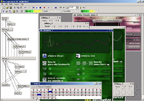
Within the field of interactive dance technology, a number of projects have experimented with dancers producing music in real time from their body movements, as opposed to following the music. In MusicViaMotion (2000) for example, dance movements are captured with a video camera and mapped to sound synthesis in real time. In MIT Medialab's Expressive Footwear project (1998) and Katherine Moriwaki's Music Shoes (2000), the dancers wear sport shoes respectively chinese slippers, equipped with a range of sensors. In Alfred Desio's Zapped Taps, sensors are also used, this time on tap shoes. In all these projects, the sensed movements actuate and modulate artificial sounds.
22:16 Posted in Cyberart | Permalink | Comments (0) | Tags: cyberart
Images that represent complexity
From KurzweilAI.net
Parsons School of Design teacher Manuel Lima has constructed striking images that represent complexity.

Read Original Article
22:13 Posted in Information visualization | Permalink | Comments (0)