




May 13, 2006
Spontaneous mentalizing during an interactive real world task: An fMRI study
Spontaneous mentalizing during an interactive real world task: An fMRI study.
Neuropsychologia. 2006 May 8;
Authors: Spiers HJ, Maguire EA
There are moments in everyday life when we need to consider the thoughts and intentions of other individuals in order to act in a socially appropriate manner. Most of this mentalizing occurs spontaneously as we go about our business in the complexity of the real world. As such, studying the neural basis of spontaneous mentalizing has been virtually impossible. Here we devised a means to achieve this by employing a unique combination of functional magnetic resonance imaging (fMRI), a detailed and interactive virtual reality simulation of a bustling familiar city, and a retrospective verbal report protocol. We were able to provide insights into the content of spontaneous mentalizing events and identify the brain regions that underlie them. We found increased activity in a number of regions, namely the right posterior superior temporal sulcus, the medial prefrontal cortex and the right temporal pole associated with spontaneous mentalizing. Furthermore, we observed the right posterior superior temporal sulcus to be consistently active during several different subtypes of mentalizing events. By contrast, medial prefrontal cortex seemed to be particularly involved in thinking about agents that were visible in the environment. Our findings show that it is possible to investigate the neural basis of mentalizing in a manner closer to its true context, the real world, opening up intriguing possibilities for making comparisons with those who have mentalizing problems.
20:07 Posted in Virtual worlds | Permalink | Comments (0) | Tags: Positive Technology
Virtual Reality in Google Trends
Visualizing the usage of the term "Virtual Reality" with the new Google Trends

(click here for larger image)
20:02 Posted in Virtual worlds | Permalink | Comments (0) | Tags: Positive Technology
MoBeeline
Via WMMNA

Chang Soo LEE and HyeJoo Lee have developed MoBeeline, a system that allows people to send data about a user's emotions to another's clothes via SMS.
From the project's web site:
MoBeeline is a compound word - Mobile + Beeline.
Our mobile service makes a straight line between two or more places.This project is an emotional mobile service based on wearable technology. The basic focus of this project is to stimulate people's emotions with an interaction between mobile and wearable technology, and to develop a social network service between friends.
The main goal is to create a wearable Bluetooth accessory that can receive data from a mobile phone. For example, let us assume that there are two mobile phone users. One user can send operative directions to the other's clothes as the user wants. Without the two users having to meet, they can share their feelings and emotions by sending signals to each other's clothes. Using our service, they will be changed the colors of each others garments, certain patterns or they can send emoticons to LEDs on the garment.
Watch the Video
19:54 Posted in Emotional computing | Permalink | Comments (0) | Tags: Positive Technology
World's Largest 3D-Display
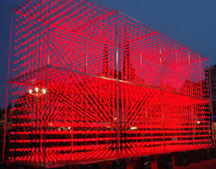
From Networked Performance:
"Electrical engineering students at the Delft University of Technology in the Netherlands have created the world's largest 3D-display. The display consists of 8,000 suspended ping pong balls that each contain a red LED light. It play games of 3D snake, 3D pong, and 3D duckhunt, as wll as displaying SMS messages and simple animations"
19:48 Posted in Virtual worlds | Permalink | Comments (0) | Tags: Positive Technology
Female android developed by japanese team
Japanese scientists have unveiled the most human-looking robot yet - a "female" android named Repliee Q1Expo.

Watch the video of the android woman
19:45 Posted in AI & robotics | Permalink | Comments (0) | Tags: Positive Technology
Nanotubes used for first time to send signals to nerve cells
Via Medgadget
Researchers from the University of Texas Medical Branch and Rice University have succesfully tested the ability of carbon nanotubes to carry electrical signals to nerve cells. From the press release:
The group employed two different types of cells in their experiments, neuroblastoma cells commonly used in test-tube experiments and neurons cultured from experimental rats. Both cell types were placed on ten-layer-thick "mats" of single-walled carbon nanotubes (SWNTs) deposited on transparent plastic. This enabled the researchers to use a microscope to position a tiny electrode next to individual cells and record their responses to electrical pulses transmitted through the SWNTs.In addition to their electrical stimulation experiments, the scientists also studied how different kinds of SWNTs affected the growth and development of neuroblastoma cells. They compared cells placed on mats made of "functionalized" SWNTs, carbon nanotubes with additional molecules attached to their surfaces that may be used to guide cell growth or customize nanotube electrical properties, to cells cultured on unmodified "native" carbon nanotubes and conventional tissue culture plastic.
"Native carbon nanotubes support neuron attachment and growth well - as we expected, better than the two types of functionalized nanotubes we tested," Pappas said. [Todd Pappas, director of sensory and molecular neuroengineering at UTMB's Center for Biomedical Engineering -ed.] "Next we want to find a way to functionalize the nanotubes to make neuron attachment and communication better and make these surfaces more biocompatible."
Read the full press release
19:40 Posted in Neurotechnology & neuroinformatics | Permalink | Comments (0) | Tags: Positive Technology
Emotion's Defibrillator

Tobias Grewenig's new installation Emotion's Defibrillator aims to explore how media affect our physiology:
The user of the installation, wearing an oxygen mask and a pincer on his left forefinger that will measure his/her pulse, puts his head into a big sphere. By placing the hands on two metalic spheres, the equipment is set in motion. First, bio data such as respiration, pulse and skin resistance are measured by the sensors and sent to the software to define the starting parameters. There are various sources of audio and a screen within the sphere. In relation to the data picked up from the body, the audio resonates, tiny electric shocks are delivered via the metallic spheres while the screen shows a flickering image of the user which is being interrupted by "subliminals". When the user takes the hands off the spheres, the installation stops.Grewenig says that it's fascinating to observe how the electronic equipment, although basically off-the-shelf material, starts frightening its user and turns into something profoundly unpredictable. This already happens when the sensoric input is roughly at the level of everyday city-life. (Well, plus electric shocks, that is.)
19:35 Posted in Cyberart | Permalink | Comments (0) | Tags: Positive Technology
Phone shui
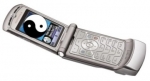
According to Unwired View, Motorola has recently put forth a patent for the Feng Shui Phone, which has the following functionalities:
- Three-dimensional Hall-effect sensor for measuring the strength of electromagnetic fields and to form a compass to determine the geographic direction in which the main wall of the house faces.
- Digital camera to determine color saturation, order and balance of the surroundings.
- GPS receiver to determine geographic location of the phone.
- The coordinates are then sent to the GIS databse through wireless network to to get the information about the surroundings of the location, e.g. the distance from the undesirable sites such as major airports, landfills, and factories.
- Cellphone microphone is used to measure noise level of the location.
- AM/FM radio to measure the AM and FM transmission strength and the distance form nearest AM/FM towers.
- The table with the chi values of each parameter is stored in phones memory and is used for calculation of chi values of different parameters.
19:27 Posted in Wearable & mobile | Permalink | Comments (0) | Tags: Positive Technology