




Apr 21, 2006
The mood of your blog
Via Smart Mobs (New Scientist)
New Scientist has an article about a software called MoodViews that tracks mood swings across the 'blogosphere' and pinpoints the events behind them. Moodviews was created by Gilad Mishne and colleagues at Amsterdam University, The Netherlands. At present, MoodViews consists of three components, each offering a different view of global mood levels, the aggregate across all postings of the various moods:
- Moodgrapher tracks the global mood levels,
- Moodteller predicts them, and
- Moodsignals helps in understanding the underlying reasons for mood changes.
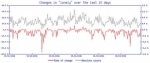
From the MoodViews website:
"Check out the impact of global events on global moods. Find out whether it is true that people drink more during the weekend. Observe states-of-mind with a cyclic nature; e.g., people feel energetic in the mornings and relaxed in the evening"
19:10 Posted in Emotional computing | Permalink | Comments (0) | Tags: Positive Technology
Workshop on the Cognitive Science of Games and Game play
As part of CogSci 2006, 26-29 July 2006, Montreal, Canada
From the website
Craig Lindley: Cognitive Science of Games and Gameplay (full day)
Cognitive science has always had a strong relationship with games and game play. Simple cognition tests frequently having the form of games, and games like chess have provided traditional models of intense cognitive challenges. Ongoing advances in computer game technology have supported the creation of commercial games presenting a wide variety of cognitive challenges embedded within rich, engaging audiovisual worlds. The growth of computer games as an entertainment technology and medium is having a major cultural and social impact, with game players frequently spending large portions of their discretional time deeply immersed in game play.
Despite the emergence of computer games as a major cultural and economic force, the scientific study of complex games is in its very early stages. Methodologies and theoretical paradigms are still being established, and the world waits for substantial results before game systems can be more fully deployed across broad application areas. Games are fundamentally learning systems and this is of particular interest, both from the perspective of the cognitive changes in players arising from entertainment gameplay (and their attendant social implications) and from the perspective of how games might function in more specific pedagogical and therapeutic contexts.
Theories and methods from cognitive science appear to be among the most promising for studying the structure, dynamics, affects and effects of games and game play. Moreover, computer games provide rich, multi-modal, but still controllable environments for conducting cognitive experiments having potentially higher ecological validity than the rarefied experiments of traditional cognitive psychology.
This workshop aims to bring together cognitive scientists interested in game phenomena, cognitive scientists interested in using games as a research tool, game researchers interested in cognitive approaches to the study of games, and game researchers interested in games for the study of cognition. The aim is to consolidate and focus these interests in a new field of the Cognitive Science of Games and Game Play. Topics of interest include but are not limited to:
- cognition-based theoretical frameworks for the study of games and gameplay
- games as a methodological tool for cognition research
- emotion and aesthetics of games and game engagement
- cognitive neurophysiology of games and play
- cognitive foundations of game design principles
- cognitive and perceptual substructure of game interaction
- effects of game play upon player cognitive processes
- schemata involved in game play
- player modelling and motivational factors
- computational modelling of players, play processes, tactics, strategies and learning
- game interaction as a basis of cognitive modelling
- perceptual loading, attention and cognitive capacity management in game play
- empirical study of games, methods, results and interpretations
- social cognition and multiplayer games
- the cognitive substructure of fun
The workshop will be held from 0830 to 1700 on Wednesday July 26 2006.
Submission
Those interested in attending the workshop should submit a 500 – 1000 word abstract by 19 May 2006. Submissions should be sent in electronic form to: craig.lindley@hgo.se Authors of accepted abstracts should submit full papers by Friday 30 June 2006. Full papers may be up to 10 A4 pages in length.
19:00 Posted in Call for papers | Permalink | Comments (0) | Tags: Positive Technology
Electronic media causing ADHD?
From Mind Hacks
Neuroscientist Baroness Greenfield was featured on Radio 4's Today Programme this morning [realaudio] arguing that children are being medicated for ADHD when the problem might be caused by the over-use of 'electronic media' leading to short attention spans...
read the full post
18:05 Posted in Persuasive technology | Permalink | Comments (0) | Tags: Positive Technology
Ageing, Impairment, and Technology
Forthcoming special issues of Pragmatics & Cognition

Editors: Pim Haselager, Maria Eunice Qumlice Gonzales, and Itiel Dror
Deadline for submissions: 30 June 2006
Publication: Summer 2007
2. Ageing, Impairment, and Technology (call for papers)
Editors: Romola Bucks, Jonathan Cole, and Itiel Dror
Deadline for submissions: 30 June 2007
Publication: Summer 2008
Editors: Boris Velichkovsky and Itiel Dror
Deadline for submissions: 30 June 2008
Publication: Summer 2009
6. Cognitive Development and Education in the Mirror of Technology (call for papers)
Editors: TBA and Itiel Dror
Deadline for submissions: 30 June 2009
Publication: Summer 2010
16:25 Posted in Call for papers | Permalink | Comments (0) | Tags: Positive Technology
Intelligent Medical Implants Reports Artificial Vision Breakthrough
"The provoked visual perceptions were pleasant, according to the patients, and this was the first time they had seen something in many years-- in one case, several decades. Understandably, they reacted emotionally to their visual experience."
Hans-Juergen Tiedtke
Chief Executive Officer
IIP-Technologies GmbH
IIP-Technologies GmbH, on behalf of its parent company Intelligent Medical Implants AG ("IMI") (www.intmedimplants.com), announced today that a limited clinical study related to its ongoing Early Human Trial has demonstrated that IMI's patented, first-generation Learning Retinal Implant(TM) enabled patients to see light - as well as simple patterns - via a wireless transmission of data and energy. This is the first time in the history of the development of artificial vision that completely wireless transmission of data and energy into an implant in the eye of long-time blind persons has resulted in pattern recognition.
 The Learning Retinal Implant has been successfully implanted in four patients for a duration of up to 13 weeks to date (the first implantation occurred in late-November 2005). Subsequent clinical testing of the IMI device with these patients commenced on schedule beginning in January 2006 at the University of Hamburg (Germany) Medical School under principal investigator Prof. Gisbert Richard, Professor of Ophthalmology. Each of the implantations has been "extremely well-tolerated" and fixation of the implant has been "stable, with no inflammatory reactions," according to Prof. Richard.
"Each of these blind persons had no visual perception at all, yet upon wireless stimulation of the retina via the Learning Retinal Implant, they were able to 'see' something,"said Hans-Juergen Tiedtke, CEO of IIP-Technologies, a subsidiary of IMI. "One patient, for example, a 65-year-old female from Marienberg, Germany, has not had sight for more than a half century. From early childhood she has suffered from RP, meaning that she has not seen normally for more than 60 years. Nevertheless, in her first pattern recognition test, she described continuous objects such as a half circle. There is no doubt that this result is extremely positive, given that she has had no sight for almost her entire life, yet was still able to immediately receive a visual perception from electrical stimulation.

"While further clinical testing is needed and planned, we are truly delighted by these early results. It is our expectation that, in the not-too-distant future, our Learning Retinal Implant System, along with rehabilitation, may allow patients to recognize objects by identifying their size, as well as their position, movements and shapes. In other words, a blind person, using our Learning Retinal Implant System, is expected to be able to move independently in an unfamiliar environment--thus enabling him or her to lead an autonomous life. Indeed, development of a wireless visual prosthesis that could be implanted permanently with good results is the 'Holy Grail' of artificial vision," added Mr. Tiedtke.
IMI's initial clinical-indication focus is blind persons with Retinitis Pigmentosa ('RP'), one of the two most common causes of vision loss in persons over the age of 50 by hereditary degenerative retinal diseases. RP is considered irreversible, and no treatment or cure is known to date. Several million people are affected worldwide.
13:30 Posted in Brain training & cognitive enhancement | Permalink | Comments (0) | Tags: Positive Technology