




Nov 03, 2005
Using RFID tags to capture human behavior patterns
Via Smart Mobs
At WPC EXPO 2005, Tagged World Project has presented a system that captures human behavior patterns using RFID tags, stores them in an XML format, and uses the data for predicting users' future behavior patterns. The system then provides services proactively.
A scenario: everything in your room is RFID-tagged and you have a mobile RFID reader. If you forget to lock the door, the system alarts you (If you don't touch your room key before leaving the room, the system can detect it).
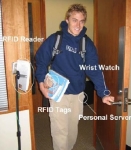
A similar approach has been recently proposed by Gaetano Borriello and co-workers at University of Washington. They have built a prototype of a smartwatch that works using RFID tags to help people keep track of their stuff. Here is a picture of a user walking through a doorway with several tagged objects. An RFID reader is visible on the left (white box on black stand); tags are visible on the notebooks in his hand; his personal server is in his front left pants pocket; and, our wristwatch UI is on his left wrist." Here is the link to the full paper
23:05 Posted in Brain training & cognitive enhancement | Permalink | Comments (0) | Tags: Positive Technology, Cognitive prosthetics
My favourite poet brought back to life
via BBC news
My favourite poet Dylan Thomas is being brought back to life in the form of a computer-generated 3D moving image by art student Bernard Mitchell. The image was created from his death mask. 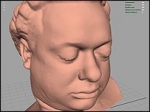 To re-create Thomas face, the death mask of the poet was first skanned at the hospital's maxillofacial department. Next, the scans were used Swansea-based 3D animators iCreate to apply a virtual skin around the structure.
For those who would like to have more info, visit the project's web site
22:30 Posted in Cyberart | Permalink | Comments (0) | Tags: Positive Technology
New asynchronous brain computer interface
Via Smart Mobs
An asynchronous brain computer interface is under development at Oxford University, with the collaboration of Southampton and Essex universities. The system should allow a more effective way of controlling robotic arms and wheelchairs, as opposed to the less natural on/off mode of existing synchronous BCI technology. But the real novelty of this BCI apparatus is that it will use only one electrode.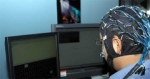
The two-year project has been funded £180,000 by the EPSRC. According to project's leader Prof. Stephen Roberts (Oxford University), the new BCI system could improve the quality of life of severely disabled, but potential applications of this technology range from the gaming and entertainment industries to the automotive sector.
Read full article on the Engineer Online
More to explore
This page offers some introductory links to sources of information on the Web about the BCI
A list of BCI research lab
22:15 Posted in Brain-computer interface | Permalink | Comments (0) | Tags: Positive Technology, brain-computer interface
Benefits of activity and virtual reality based balance exercise programmes for adults with traumatic brain injury: Perceptions of participants and their caregivers
Brain Inj. 2005 Nov;19(12):989-1000
Authors: Thornton M, Marshall S, McComas J, Finestone H, McCormick A, Sveistrup H
21:45 Posted in Cybertherapy | Permalink | Comments (0) | Tags: Positive Technology, virtual reality, cybertherapy
Mirror therapy for alleviating chronic pain
via Medgadget
McCabe and co-workers from the University of Bath and the Royal National Hospital for Rheumatic Diseases (RNHRD)have published in the journal Clinical Medicine the results of a study, which has investigated the use of mirror as a therapeutic mean to alleviate pain. The treatment consists in asking patients patients suffering from complex regional pain syndrome to carry out routine exercises in front of a mirror.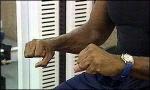
Results showed that more than half experienced pain relief during and after the exercise and further investigations indicated that even greater improvements can be achieved if the tasks are practiced beforehand.
McCabe explain these findings with the ‘cortical’ model of pain. According to this theory, the brain’s image of the body can become faulty, resulting in a mismatch between the brain’s movement control systems and its sensory systems, causing a person to experience pain when they move a particular hand, foot or limb.
Mirror therapy has proven effective also in the treatment of post-stroke hemiplegia as well as in the rehabilitation of "phantom limb" and visual hemineglect.
More to explore
Sathian K, Greenspan AI, Wolf SL. Doing it with mirrors: a case study of a novel approach to neurorehabilitation.
Neurorehabil Neural Repair. 2000;14(1):73-6.
| Ramachandran VS, Altschuler EL, Stone L, Al-Aboudi M, Schwartz E, Siva N. |
Can mirrors alleviate visual hemineglect? Med Hypotheses. 1999 Apr;52(4):303-5.
Altschuler EL, Wisdom SB, Stone L, Foster C, Galasko D, Llewellyn DM, Ramachandran VS.
Rehabilitation of hemiparesis after stroke with a mirror. Lancet. 1999 Jun 12;353(9169):2035-6.
00:45 Posted in Mental practice & mental simulation | Permalink | Comments (0) | Tags: Positive Technology, mental practice, motor imagery
Nov 01, 2005
Nature Insight: Sleep
Until the mid of 20th century, most people thought of sleep as a passive part of our daily lives. Now the body of evidence suggests that the brain is very active during sleep. 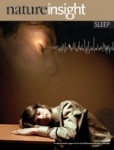 Moreover, neuroscience is beginning to understand the importance of sleep on our daily function and health.
The current issue of Nature Insight, a supplement of the journal Nature, sheds fascinating light on cognitive neuroscience of sleep.
The supplement is freely available online
11:35 Posted in Telepresence & virtual presence | Permalink | Comments (0) | Tags: Positive Technology, Presence
Oct 31, 2005
1st International Conference on Interactice Mobile and Computer aided Learning

Topics include, but are not limited, to:
- M-learning applications;
- Mobile technology support for educator and student;
- Design and development of course content;
- M-learning emerging hardware and software;
- Mobile Web and video Conferencing;
- M-learning objects and development tools;
- Service providers for mobile networks;
- M-learning standards;
- Life-long m-learning;
- Impact of m-learning on social change;
- Future trends in m-learning;
- Web and Computer-based learning;
- Tools for interactive learning and teaching;
- Platforms and authoring tools;
- New learning models and applications;
- Applications of the Semantic Web;
- Adaptive learning environments;
- Methods of content adoption;
- Project-based learning;
- Virtual campus and e-learning;
- Remote and virtual laboratories;
- Remote measurement technologies;
- Concepts for remote engineering;
- Multimedia and virtual environments;
- Cost-effectiveness
- Real world experiences
- Pilot projects / Products / Applications
For more information visit the conference web site
18:32 Posted in Positive Technology events | Permalink | Comments (0) | Tags: Positive Technology
//MUKANA
Mukana is a wearable wireless device to help the visually impaired, which connects technology with textiles. The system consists of a cell phone, a wireless headset, a Global Positioning System (GPS) module and voice recognition software. Users can ask the system to tell them their location, to give information on what route to take to their destination or on the timetables of public transportation. 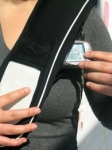 The guide system is operated with a Bluetooth® enabled wireless headset and an integrated 10-key Braille number pad for the visually impaired. Extra batteries are included to guarantee the long-term functioning of the system and the cell phone. There is a pocket where the headset can be charged and stored, as well as a pocket for keys and a wallet. The Braille keypad is located in front of the garment, rotated 90 degrees from the normal position to support ergonomic hand movement.
18:15 Posted in Wearable & mobile | Permalink | Comments (0) | Tags: Positive Technology, wearable
Human responses to augmented virtual scaffolding models
Ergonomics. 2005 Aug;48(10):1223-42
Authors: Hsiao H, Simeonov P, Dotson B, Ammons D, Kau TY, Chiou S
This study investigated the effect of adding real planks, in virtual scaffolding models of elevation, on human performance in a surround-screen virtual reality (SSVR) system. Twenty-four construction workers and 24 inexperienced controls performed walking tasks on real and virtual planks at three virtual heights (0, 6 m, 12 m) and two scaffolding-platform-width conditions (30, 60 cm). Gait patterns, walking instability measurements and cardiovascular reactivity were assessed. The results showed differences in human responses to real vs. virtual planks in walking patterns, instability score and heart-rate inter-beat intervals; it appeared that adding real planks in the SSVR virtual scaffolding model enhanced the quality of SSVR as a human - environment interface research tool. In addition, there were significant differences in performance between construction workers and the control group. The inexperienced participants were more unstable as compared to construction workers. Both groups increased their stride length with repetitions of the task, indicating a possibly confidence- or habit-related learning effect. The practical implications of this study are in the adoption of augmented virtual models of elevated construction environments for injury prevention research, and the development of programme for balance-control training to reduce the risk of falls at elevation before workers enter a construction job.
18:10 Posted in Virtual worlds | Permalink | Comments (0) | Tags: Positive Technology, virtual reality
Alzheimer's Art therapy
via Neurodudes
The New York Times reports about visual-art therapy, an approach which seems to have positive effects on Alzheimer's brain disease. Though it has long been known that music has beneficial effects in the rehabilitation of brain-injured patients, the potential role of visual arts has not been systematically explored so far.  According to neurologist and scientis Oliver Sacks, an aesthetic encounter is not just a visual experience, but involves the activation of emotions; further, he observes that demented patients can recognize and respond vividly to paintings, while they are scarcely responsive to words and disoriented and out of it
read NYT full article
18:05 Posted in Cyberart | Permalink | Comments (0) | Tags: Positive Technology, cyberart
EMagin Z800 3DVisor Stereoscopic Headset for under $1000
via Extremetech
Good news for virtual reality therapy. eMagin offers stereoscopic headset for under $1,000.
The Z800 has 800x600 active matrix OLED displays including a pair of sharp OLED displays which supports 8 bits per pixel (16.67 million colors) and 200:1 contrast ratio. 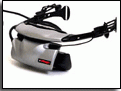
The price includes the head-tracker (six-degrees-of-freedom MEMS sensor, with independent gyroscopes and accelerometers for the X-Y-Z axes), a pair of stereo audio earbuds, and an integrated microphone. But the most interesting feature of the Z800 is that it is USB powered. This reduces the number of wires and gives the user more freedom of movement.
17:20 Posted in Cybertherapy | Permalink | Comments (0) | Tags: Positive Technology, virtual reality
Lost in translation? Get CMU translation goggles
via Engadget
Researchers from the International Center for Advanced Communication Technologies (interACT), a joint venture of Carnegie Mellon and the University of Karlsruhe, have developed a wearable system, which allows real-time speech translation. 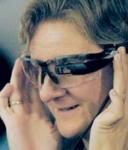 The system consists of consists of 11 electrodes that detect mouth muscle movements, translates that to a spoken language, and then re-translates that into other languages. According to comp-sci professor Alex Weibel, director of inteACT, the system still makes mistakes, he is confident that researchers will improve it significantly in the next five years. "It will make communication and cultural learning more likely" since people using this technology will be empowered to come together when they wouldn't otherwise interact, Waibel said.
17:05 Posted in Wearable & mobile | Permalink | Comments (0) | Tags: Positive Technology, wearable
15th International Conference on Artificial Reality and Telexistence
(thanks Régine)
December 5th-8th, 2005, University of Canterbury, Christchurch, New Zealand
ICAT is the oldest international conference on Virtual Reality and Telexistence. ICAT 2005 will not only look for innovations in the technology itself, but also explore novel ways to transfer and express information and creative ideas to the society and people.
The 15th International Conference on Artificial Reality and Telexistence (ICAT 2005), will be held at the University of Canterbury, Christchurch, New Zealand from December 5th to 8th, 2005. Christchurch is the second largest city in New Zealand, only minutes from the sea and an hour's drive from the mountains and provides a wide range of activities in the beautiful New Zealand countryside
For further information visit the conference web site
16:23 Posted in Positive Technology events | Permalink | Comments (0) | Tags: Positive Technology
Call for Papers: Narrative AI and Games
Via the Presence Listserve
A symposium part of the AISB 2006 conference, April 5th-6th 2006, University of Bristol, Bristol, England
Submissions
Papers sought in the following areas, but are not limited to:
· Interactive narrative and virtual storytelling
· Applied AI in games
· Believable synthetic agents for games or narrative
· Agent strategy planning in a games or interactive narrative context
· The application of narrative based games in education
· The use of games as test-beds for research
Submissions should be no longer than 8 pages.
Formatting instructions will be available from the symposium website shortly
Organisers
Mr Sandy Louchart – Salford University
Dr Judy Robertson – Glasgow Caledonian University
Further information
http://www.nicve.salford.ac.uk/AISB06
15:42 Posted in Positive Technology events | Permalink | Comments (0) | Tags: Positive Technology