




Sep 30, 2005
Immersion and Virtual Reality @ Interfaces Montréal
TUESDAY, 4th October 2005 Interface [s] Montréal 5:30pm
From aerospace to surgery, and in all things game related, the simulators and immersion environments developed to serve humankind are indispensable tools that significantly improve human knowledge and enhance our reality experience.
Speakers: Yves Gonthier - Canadian Space Agency; Jean-Claude Artonne - Immervision; Jocelyn Faubert - Université de Montréal, École d'optométrie; Carl-Éric Aubin - École Polytechnique de Montréal, Dép. génie mécanique & CHU Sainte-Justine; Luc Courchesne - Université de Montréal et Ideaction.
[Yves Gonthier]: A Real-Time Simulator for 3D Mental Image Reconstruction On-Board the International Space Station
[Jean-Claude Artonne] Immervision: Panoramic technologies in everyday applications[Jocelyn Faubert] : Understanding human behavior with immersive virtual environments
[Carl-Éric Aubin] Surgical Simulator for the Virtual Prototyping of the Surgical Instrumentation of the Scoliotic Spine
[Luc Courchesne] Panoscope 360°
 Tags: virtual reality
11:50 Posted in Positive Technology events | Permalink | Comments (0) | Tags: Positive Technology
Sep 29, 2005
Virtual reality helps stroke patients learn to drive again
Sept. 27 issue of Neurology reports results of a study, which has investigated the effect of simulator-based training on driving after stroke. The research has involved 83 subacute stroke patients randomly assigned to either simulator-based training or control group. Then, all patients were evaluated in off-road and on-road performance tests to assess their driving ability after training. 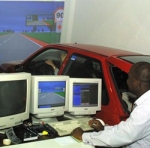 Results showed that virtual reality training improved driving ability, especially for well educated and less disabled stroke patients. However, authors warn that findings of the study may have been modified as a result of the large number of dropouts and the possibility of some neurologic recovery unrelated to training.
More to explore
A. E. Akinwuntan, W. De Weerdt, H. Feys, J. Pauwels, G. Baten, P. Arno, and C. Kiekens Effect of simulator training on driving after stroke: A randomized controlled trial, Neurology 2005 65: 843-850
Sung H. You, et al., Virtual Reality–Induced Cortical Reorganization and Associated Locomotor Recovery in Chronic Stroke: An Experimenter-Blind Randomized Study, Stroke, Jun 2005; 36: 1166 - 1171.Sveistrup, H. Motor rehabilitation using virtual reality, Journal of NeuroEngineering and Rehabilitation 2004, 1:10 (download full text)
16:25 Posted in Cybertherapy | Permalink | Comments (0) | Tags: Positive Technology, virtual reality
Sep 28, 2005
The singularity is near
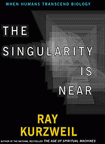 Here is a quote from a New Scientist article that sums up Kurzweil's projections:
"Ultimately, we will merge with our technology. This will begin with nanobots in our bodies and brains. The nanobots will keep us healthy, provide full-immersion virtual reality from within the nervous system, provide direct brain-to-brain communication over the internet and greatly expand human intelligence. But keep in mind that non-biological intelligence is doubling in capability each year, whereas our biological intelligence is essentially fixed. As we get to the 2030s, the non-biological portion of our intelligence will predominate. By the mid 2040s, the non-biological portion of our intelligence will be billions of times more capable than the biological portion. Non-biological intelligence will have access to its own design and will be able to improve itself in an increasingly rapid redesign cycle."
Via smart mobs10:50 Posted in Brain training & cognitive enhancement | Permalink | Comments (0) | Tags: Positive Technology, Cognitive prosthetics