




Sep 05, 2005
Meditation alters perceptual rivalry in Tibetan Buddhist monks
reported in the June 7 issue of Current Biology their results from a series of experiments with 76 monks in Ladakh. The goal of their research was to investigate how certain type of meditation can Researchers found that the skills developed by Tibetan Buddhist monks in their meditation practice strongly influence their experience of binocular rivalry, a perceptual phenomenon that occurs when the brain alternates between viewing different images presented to each eye. The neural processes underlying perceptual rivalry are still unclear but they are thought to be linked with brain mechanisms that regulate attention and conscious awareness.
76 Tibetan Buddhist monks participated in the study. The researchers tested the experience using binocular goggles that prompt visual rivalry. The researchers found that the use of a specific meditation technique, called “one-point meditation” determined a high rate of perceptual dominance. In other words, when they used that technique the normal switching processes of binocular rivalry slowed considerably. This observation suggests that individuals who have trained themselves in meditation techniques can alter the normal fluctuations in the states of their consciousness.
More to explore
Carter, O.L., Presti, D.E., Callistemon, C., Ungerer, Y., Liu, G.B., and Pettigrew, J.D. (2005). Meditation alters perceptual rivalry in Tibetan Buddhist monks. Current Biology, Vol. 15, June 7, 2005, pp. 412-413.
16:20 Posted in Meditation & brain | Permalink | Comments (0) | Tags: Positive Technology, meditation
Laser-based tracking for HCI
Via FutureFeeder
Smart Laser Scanner is a high resolution human interfaces that tracks one’s bare fingers as it moves through space in 3Ds. Developed by Alvaro Cassinelli, Stephane Perrin & Masatoshi Ishikawa, the system uses a laser, an array of moveable micro-mirrors, a photodector (an instrument that detects light), and special software written by the team to collect finger-motion data. 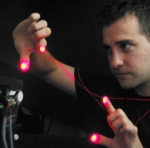 The laser sends a beam of light to the array of micro-mirrors, which redirect the laser beam to shine on the finger tip. A photodector senses light reflected off the finger and works with the software to minutely and quickly adjust the micro-mirrors so that they constantly beam the laser light onto the fingertip. According to Cassinelli and his co-workers, the system's components could be eventually integrated into portable devices.
More to explore
The Smart Laser Scanner website (demo videos available for download)
15:25 Posted in Future interfaces | Permalink | Comments (0) | Tags: Positive Technology, Future interfaces