




Jan 04, 2005
Experience Colors!
Art | Color becomes all in Arcadia installation
By Edward J. Sozanski
Inquirer Columnist
Olafur Eliasson's installation at Arcadia University, Your colour
memory, might be the most intense and disorienting sensory
experience you'll ever have.
Being inside this oval space suffused with the most vivid color
imaginable, shifting at random through every hue of the spectrum
and then some, is like standing inside a sunrise.
The installation that transforms the Arcadia gallery into a color-
immersion chamber is complex technically, but easily described.
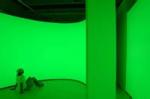
Inside the rectangular, high-ceilinged room, Eliasson has
constructed an oval, open-topped chamber with a small chamber
at one side that's curtained off.
One enters at the side, at a point where the encircling wall
separates like the first coil of a spiral. The inside surface of the
oval is made of translucent plastic stretched as taut as a
drumhead.
Inside the wall, whose outside surface is opaque, Eliasson has
installed a series of computer-controlled lights and filters. These
lights generate random sequences of primary and secondary
colors that change unpredictably.
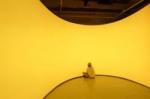
To say that the light in this chromatic bombardment is intense
understates the effect, which admittedly varies for each visitor.
We all see and react to colors differently, but I doubt anyone with
normal color vision would deny that Eliasson's installation
transforms color into a physical presence.
19:10 Posted in Cyberart | Permalink | Comments (0)
Transpersonal Psychology
From Wikipedia, the free encyclopedia.
A major motivating factor behind the initiative to establish this school of psychology was the already published work of Abraham Maslow regarding human peak experiences. Maslow was also one of the initiators behind the publication of the first issue of the Journal of Transpersonal Psychology in 1969, the leading academic journal in the field. This was soon to be followed by the founding of the Association for Transpersonal Psychology in 1972. Today Transpersonal Psychology also includes approaches to health, social sciences and practical arts. According to the Association for Transpersonal psychology the Transpersonal perspective includes such research interests as: Psychology and psychotherapy, Meditation, spiritual paths and practices, Change and personal transformation, Consciousness research, Addiction and recovery, Psychedelic and altered states of consciousness research, Death, dying and near death experience (NDE), Self-realization and higher values, The mind-body connection, Mythology and Shamanism and Exceptional Human Experience (EHE).
However, most psychologists do not hold strictly to traditional schools of psychology; most psychologists take an eclectic approach. Furthermore, the phenomena listed are considered by standard subdisciplines of psychology, religious conversion falling within the ambit of social psychology, altered states of consciousness within physiological psychology, and spiritual life within the psychology of religion. Transpersonal psychologists, however, disagree with the approach to such phenomena taken by traditional psychology, and claim that they have typically been dismissed either as signs of various kinds of mental illnesses or regression to infantile stages of psychosomatic development. One must not confuse transpersonal psychology with parapsychology- a mistake frequently made due to the unenviable academic reputation of both branches, and the eerie atmosphere surrounding the subjects investigated.
Although there are many disagreements with regard to transpersonal psychology, one could succinctly lay out a few basic traits of the field:
* transpersonal psychology is rooted in religious psychological doctrines expounded in: Zen Buddhism, Kabbalah, Gnosticism, Sufism, Vedanta, Taoism and Neoplatonism
* by common consent, the following branches are considered to be transpersonal psychological schools: Jungian Depth Psychology or, more recently rephrased by James Hillman, a follower of Carl Jung as Archetypal Psychology; Psychosynthesis founded by Roberto Assagioli and schools of Abraham Maslow and Robert Tart.
* Some transpersonal psychologists claim other authors, for example William James, as supporting their approach. This is controversial; it is unlikely that James ever used the expression "transpersonal" to describe his approach to psychology.
* Doctrines or ideas of many colorful personalities who were or are "spiritual teachers" in the Western world are often assimilated in the transpersonal psychology mainstream scene: Gurdjieff, Alice Bailey or Ken Wilber. This development is, generally, seen as detrimental to the aspiration of transpersonal psychologists to gain firm and respectable academic status.
All transpersonal psychologies, whichever their differences, share one basic contention: they claim that human beings possess the supraegoic centre of consciousness that is irreducible to all known states of empirical, or, better, "ordinary" consciousness (sleep, waking state, ...). This root of consciousness (and human existence, for some schools) is frequently called "Self" (or "Higher Self"), in order to distinguish it from "self" or "ego", which is equated to the seat of ordinary everyday waking consciousness. However, they differ in the crucial traits they ascribe to the Self:
* the supraegoic root of consciousness (the Self) survives bodily death in some transpersonal schools; for others, it dies with the body
* for ones, the Self is dormant and latent; for others, it is ever watchful and precedes empirical human consciousness
* some think that Self is mutable and potentially expandable; others aver that it is perfect and completely outside of time-space, and that only "ego" is subject to temporal change
Currently, transpersonal psychology (especially Archetypal Psychology of Carl Jung and his followers) is integrated, at least to some extent, to numerous psychology departments in US and European Universities; also, transpersonal therapies are included in many therapeutic practices.
14:40 Posted in Meditation & brain | Permalink | Comments (0) | Tags: Positive Technology, meditation
Upcoming VR-conferences
The 3rd Annual Virtual Reality, Associated Technologies and Rehabilitation Conference, University of Haifa, Israel, March 7-9, 2005, http://hw.haifa.ac.il/occupa/LIRT/
IEEE VR2005, Bonn, Germany, March 12-16, 2005, http://www.vr2005.org/view.php?nid=0
The 7th Annual Laval Virtual Reality International Conference and Exhibition, Laval, France, April 20-24, 2005, http://www.laval-virtual.org/en/index.php
CyberTherapy2005: A Decade of VR, Ramada Plaza, Basel, Switzerland, June 6-10, 2005, http://www.interactivemediainstitute.com/conference2005/
The 11th International Conference on Human-Computer Interaction, Las Vegas, Nevada, USA, July 22-27, 2005, http://www.hcii2003.gr/general/hcii2005.asp
The 4th International Workshop on Virtual Rehabilitation, Catalina Island, Los Angeles, California, September 19-21, 2005, http://www.iwvr.org/2005
14:29 Posted in Positive Technology events | Permalink | Comments (0)
MMVR13: Medicine Meets Virtual Reality
Medicine Meets Virtual Reality 2005
Long Beach, California, January 26 - 29, 2005
MMVR is the premier forum for computer scientists and physicians who develop, refine, and promote advanced, data-centered tools for clinical care and medical education. MMVR stimulates interdisciplinary networking and collaboration for improved research, validation, and commercialization.
Primary MMVR foci are medical and surgical simulation and information-guided diagnosis and therapy, along with supporting technologies: imaging, modeling, haptics, visualization, robotics, and informatics. Lectures, posters, workshops, and panels educate creators and advocates of emerging technologies.
MMVR encourages a vigorous discussion of current progress – from engineering groundwork, through assessment and validation studies, to experience with clinical and academic utilization and commercialization.
MMVR engineers, clinicians, and educators are a vanguard community of thinkers envisioning and making real the future of healthcare and medical education.
10:32 Posted in Positive Technology events | Permalink | Comments (0)