




Dec 10, 2004
Virtual Reality in rehabilitation: the IREX system
IREX Exercise Applications
Virtual reality rehabilitation therapy applications enhance a patient’s rehab experience by immersing them in a virtual reality world. While in the virtual reality environment, the patient is motivated by seeing herself/himself engaging in various sports and games. This dramatically improves a patient’s focus and compliance to the activity in therapy.
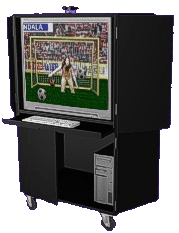
Virtual reality sport and game environments aid clinicians in the development of exercise programs geared towards the creation of therapeutic treatment protocols.
13:30 Posted in Cybertherapy | Permalink | Comments (0) | Tags: Positive Technology, virtual reality
Dec 09, 2004
Positive Psychology

Martin Seligman and Mihaly Csikszentmihalyi describe this new field of research in the article: Positive Psychology: An Introduction
20:45 Posted in Meditation & brain | Permalink | Comments (0) | Tags: Positive Technology, meditation
Optimal Experience & Ambient Intelligence

In the chapter that I have recently published in the book "Ambient Intelligence", I present a framework to evaluate user’s experience in AmI systems that stresses the role of attention in actively selecting information from the digital environment. Being a limited resource, attention forces the individual to focus on a restricted number of environmental or internal stimuli per time unit. Therefore, each individual effectively perceives only a small part of the available information. This form of psychological selection is driven a positive, complex and rewarding state of consciousness, called flow, or optimal experience. Starting from these premises, in the second part of the chapter I explain how optimal user experience in AmI systems may be assessed. In particular, I describe the Experience Sampling Method, a procedure that has been effectively used in various applied research domains.
20:10 Posted in Pervasive computing | Permalink | Comments (0) | Tags: Positive Technology, Ambient intelligence
The Experience of Flow
Flow is an optimal experience characterized by:
* a sense of playfulness
* a feeling of being in control
* concentration and highly focused attention
* mental enjoyment of the activity for its own sake
* a distorted sense of time
* a match between the challenge at hand and one's skills
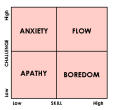
Info and Quotes from Flow: The Psychology of Optimal Experience By Mihaly Csikszentmihalyi:
"Contrary to expectation, "flow" usually happens not during relaxing moments of leisure and entertainment, but rather when we are actively involved in a difficult enterprise, in a task that stretches our mental and physical abilities." - Mihaly Csikszentmihalyi
"People seem to get more flow from what they do on their jobs than from leisure activities in free time." - Mihaly Csikszentmihalyi
It turns out that watching TV is not at all a flowful activity. People generally report higher levels of stress, depression, and tension after watching TV. It seems that TV's main virtue is that it occupies the mind undemandingly. Flow is hard to achieve without effort. Flow is not "wasting time".
"It is by being fully involved with every detail of our lives, whether good or bad, that we find happiness, not by trying to look for it directly. - Mihaly Csikszentmihalyi

"People who learn to control inner experience will be able to determine the quality of their lives, which is as close as any of us can come to being happy." - Mihaly Csikszentmihalyi
"Getting control of life is never easy, and sometimes it can be definitely painful." - Mihaly Csikszentmihalyi
"Since what we experience is reality, as far as we are concerned, we can transform reality to the extent that we influence what happens in consciousness and thus free ourselves from the threats and blandishments of the outside world." - Mihaly Csikszentmihalyi
20:00 Posted in Emotional computing | Permalink | Comments (0) | Tags: Positive Technology, experience computing
Neurotiv project
- Pervasive diffusion of intelligence in the space around us, through the development of network technologies towards the objective of the so-called “Ambient Intelligence” (AmI);
- Increasingly relevant role of mobility, through the develpoment of mobile communications, from the UMTS towards the so-called “Fourth Generation” (4G);
- Increase of reachness and completeness of communications, through the development of multimedia technologies, towards the “Immersive Virtual Telepresence” (TIV), including an increased attention to the aspects of human perception and of person-machine interaction.
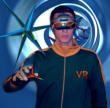
The TIV perspective is reached through the complete development of multimedia technologies, generating far away the sense of presence through the integrated availability of sound, vision, smell, touch-and-feel (haptics) signals. Typically, the sense of presence is accomplished through multisensor stimuli by means of which actual reality is either hidden and substituted with a virtual reality, i.e. fully synthetic, or is virtualized, i.e. made virtual through audio and 3-D video analysis and modeling procedures.
The convergence of AmI, 4G and TIV technologies manifests itself as the next frontier of ICT. This convergence will determine the advent of ubiquitous 3-D telecommunications and the built-up of intelligent environments for health care in which complex multimedia contents integrate and enrich the real space. The most ambitious objective is to integrate the computer interfaces in the real environment (Mixed Reality) so that the user can take advantage of the clinical care in the most natural and intuitive way.
The Neurotiv Project aims at improving the know-how level, at generating new development and application opportunities, at organizing and finalizing multidisciplinary skills, and at developing system and component prototypes for the use of TIV technologies in a managed care system for neuropsychology and clinical psychology.
More in detail, the project aims at:
- proving the technical and clinical viability of integrating TIV systems in a managed care platform for neuro-psychology assessment and rehabilitation
- designing/tuning and developing managed care tools to be used in the prevention, planning provision and follow-up of the required treatment. The developed modules will be optimised to meet the demands of the emerging 2,5G/GPRS and 3G/UMTS wireless networks and terminals.
- Defining new treatment protocols for the use of the clinical tools in assessment, therapy and follow up.
- Verify the clinical economic/organizative efficacy of the managed care system by using controlled clinical trials.
- Disseminating the obtained results through scientific papers and conference presentations.
More to explore
The NEUROTIV project web site
19:50 Posted in Cybertherapy | Permalink | Comments (0) | Tags: Positive Technology, virtual reality, cybertherapy
EMMA project

This research will help to understand better the development of some psychopathological phenomena and the development of "new correcting experiences and learnings" to cope those psychopathological experiences.
Furthermore, EMMA project will pretend the development of innovative tools to be used with three different real users:
* users of (real world) mental health services, such as treatment for anxiety disorders, depression, and so on
* users with acute restricted mobility (e.g. designed experiences for hospital inpatients), and
* mood enhancement for general population (relaxation environments through TV or VR).
19:30 Posted in Cybertherapy | Permalink | Comments (0) | Tags: Positive Technology, virtual reality, cybertherapy
The VEPSY project
VEPSY is a European-Union funded research project for Telemedicine and Portable Virtual Environments for Clinical Psychology.
The project ended in July 2003. VEPSY-updated has involved partners from an international network of academic institutions and industrial companies.
The main goal of the project was to prove the technical and clinical viability of using portable and shared Virtual Reality systems in clinical psychology. 
The project has provided both innovative VR based tools for the treatment of patients, clinical trials to verify their viability and dissemination of its results.
In 2004 the VEPSY project won the Honourable Mention Award at the Europan e-Health Award 2004
18:45 Posted in Cybertherapy | Permalink | Comments (0) | Tags: Positive Technology, virtual reality, cybertherapy
New eDimensional VirtualFX Brings Mind-Blowing 3D to Your XBOX, PS2 and More
FROM THE PRESENCE-L LISTSERV:
New eDimensional VirtualFX Brings Mind-Blowing 3D to Your
XBOX, PS2 and More
Games Press 02/12/2004
(West Palm Beach, FL – December 2, 2004) eDimensional, the
leading manufacturer and worldwide distributor of cutting
edge gaming and virtual reality accessories, announces the
release of the new VirtualFX 2D to 3D TV Converter – bringing
a true virtual reality experience to your standard home
television.
At just $129.95 including 2 pairs of wireless 3D glasses,
eDimensional's new VirtualFX instantly converts any existing
video game into a mind-blowing 3D experience, giving players
the most lifelike gaming environment ever created – literally
putting them inside the game. Fighter planes seemingly buzz
by just inches away, racecars zoom at awesome velocity, and
First Person Shooters are suddenly a battlefield reality.
In addition to enhancing the gaming experience, the
proprietary E-D technology can also be used to watch DVDs and
even live TV in real 3D on a standard television (plasma, LCD
and projection screens are not supported).
"Our E-D 3D Glasses for the PC have been extremely popular
for years, but our recent breakthrough allows us to finally
bring that same amazing 3D effect eDimensional is known for
to the TV." explains Michael Epstein, president of
eDimensional. "With our new VirtualFX we are revolutionizing
the home entertainment experience – more interactivity, more
immersion, more realistic graphics and more exciting effects
– giving gamers and movie-watchers alike a truly mind-blowing
3D experience."
The VirtualFX package comes complete with two pair of
wireless 3D glasses, one converter box and a remote control.
Installation of the VirtualFX is a snap and is hooks up just
as easily as a regular DVD player. A dual-emitter transmitter
is utilized to give the widest viewing angle and range
possible and to beam a signal to perfectly synchronize the
refresh rate of the screen with the glasses. This
transmission also allows for additional users who have their
own pair of wireless glasses which can be purchased
individually for just $25.
The VirtualFX is available now through www.eDimensional.com.
As a bonus offer for the holidays, eDimensional is including
three 3D IMAX DVDs (A $60 value), originally shown in IMAX
theaters and specially made for exceptional 3D effects.
About eDimensional
eDimensional was founded in 2000 by a group of gamers at
heart, dedicated to creating the most realistic gaming and
entertainment experience ever. Thanks to fantastic customer
feedback and swift success, eDimensional has grown rapidly
and emerged as the leading manufacturer and worldwide
distributor of cutting-edge gaming accessories.
eDimensional's flagship product, the E-D 3D Gaming System,
was released to critical acclaim, and has since received an
unprecedented number of awards and accolades for providing
the most realistic PC viewing experience. For more
information on eDimensional and its wide array of gaming
accessories, go to eDimensional.com.
18:40 Posted in Cybertherapy | Permalink | Comments (0) | Tags: Positive Technology, virtual reality
Using VR to help children with motor impairments
Local children reach into virtual world
Students’ study hopes to help kids with motor impairments
By Shayna Garlick / Staff Writer
December 02, 2004
Seven-year-old Jewell Payne was in a virtual castle. Five blocks of different colors floated in front of her, and when she extended her hand and touched one, it disappeared. After a few minutes she had completed the exercise, and she removed her goggles to come back to reality.
Payne is one of 20 to 25 children who organizers hope will participate in this virtual reality game this semester, as part of research being conducted by Carole Dennis, chair of the occupational therapy department, and Sharon Stansfield, assistant professor of mathematics and computer science. Next semester, Dennis and Stansfield hope to have up to five children with cerebral palsy play the game, so they can evaluate its success as a treatment method for children with motor impairment.
The study allows technology that was first designed by Stansfield and computer science students in the summer of 2003 to finally be put to use.
Dennis said the study will help them compare movement in the real world and in the virtual world. Children participating in the research complete three sets of tasks, one in the real world and two in the virtual world.
In the “real world” game, a white board with five foam blocks of different colors attached to it is placed in front of the child. A computer mouse is placed on the child’s knee. When instructed to touch a block, he or she clicks the mouse, touches the block and then clicks the mouse again. The child does this for the other four blocks and repeats the exercise about five times. Sensors taped to the child collect data on the distance, speed and time it took him or her to go through each motion.
The child then puts on the virtual reality goggles and completes these sets of movements in two different virtual worlds. In both of these, the child will be inside a castle with blocks floating on the wall. However, the difference lies in what happens to the blocks once the child touches them. In one set of tasks, the blocks will turn in to something fun for the child, such as an alien or Mr. Potato Head. In the second virtual world, the blocks will simply disappear.
Studies have shown that when a task is more meaningful for a person, their motor control tends to better, Dennis said. She said they will be looking to see if movements are smoother and faster in the more exciting virtual world than the one in which the blocks just disappear. She is particularly interested in helping children with hemiplegia, a type of cerebral palsy in which one side of the body is stronger than the other. She hopes to set up games with which these children can use their stronger side and won’t have to work too hard to make interesting things happen.
She also hopes this motivation factor can be reverted back to the real world. For example, once researchers can analyze how a child with cerebral palsy reaches for the blocks in the real world, the child can practice that in game format and then go back to the real world again. Observers can look to see if the child’s performance has improved, Dennis said. Dennis and Stansfield said they are unsure of the outcome of the research because this is the first time this kind of virtual reality research has been conducted. Although they predict that the children will work harder in and enjoy the virtual world more, they are less certain it will actually improve their motor abilities.
The study is a multidisciplinary project, combining computer science and occupational therapy. Evan Suma, a senior computer science major, started work on this project a year ago. He said aside from the technical skills, he has also learned how difficult completing multidisciplinary research can be. “You’re talking different languages, and you have to sort of translate and figure out how to create something that will meet the goals of someone who speaks a totally different language than you,” he said.
Eight occupational therapy graduate students are also working on the study as part of a group research course. Senior Jessica Danow said she learned how much really goes in to a research project.
“I think its always great working with real people and doing something that’s the beginning steps of something that’s really going to make a difference,” she said.
18:35 Posted in Cybertherapy | Permalink | Comments (0) | Tags: serious gaming