




Jul 17, 2006
Computers learn common sense
Via The Engineer, July 11, 2006
BBN Technologies has been awarded $5.5 million in funding from the Defense Advanced Research Projects Agency (DARPA) for the first phase of "Integrated Learner," which will learn plans or processes after being shown a single example.
The goal is to combine specialised domain knowledge with common sense knowledge to create a reasoning system that learns as well as a person and can be applied to a variety of complex tasks. Such a system will significantly expand the kinds of tasks that a computer can learn.
Read the full article
23:49 Posted in AI & robotics | Permalink | Comments (0) | Tags: artificial intelligence
Video games can improve performance in vision tasks
Three years ago, C. Shawn Green and Daphne Bavelier of the University of Rochester conducted a study in which they found that avid video game players were better at several different visual tasks compared to non-gamers ("Action Video Game Modifies Visual Attention," Nature, 2003). In particular, the study showed that video game players had increased visual attention capacity on a flanker distractor task, as well as improved ability to subitize (subitizing is the ability to enumerate a small array of objects without overtly counting each item).
The same authors have now completed a follow-up study that has been released in the current issue of Cognition. The new experiment's findings suggests that the data previously interpreted as supporting an increase in subitizing may actually reflect the deployment of a serial counting strategy on behalf of the video-game players.
23:35 Posted in Brain training & cognitive enhancement | Permalink | Comments (0)
BrainGate
In a study published in the journal Nature this week, researchers from Boston-based Cyberkinetics Neurotechnology Systems describe how two paralyzed patients with a surgically implanted neural device successfully controlled a computer and, in one case, a robotic arm, using only their thoughts.
These findings include the ability to voluntarily generate signals in the dorsal pre-motor cortex, the area of the brain responsible for the planning, selection and execution of movement. While accuracy levels have been previously published, the current study reveals unprecedented speed in retrieving and interpreting the neural signals that can be applied to the operation of external devices that require fast, accurate selections, such as typing.
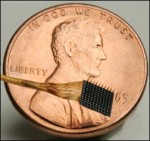
The brain-computer interface used in the study consists of an internal sensor to detect brain cell activity and external processors that convert these brain signals into a computer-mediated output under the person's own control.
According to John Donoghue, Chief Scientific Officer of Cyberkinetics, and a co-inventor of the BrainGate technology, "The results achieved from this study demonstrate the utility and versatility of Cyberkinetics' neural sensing technology to achieve very rapid, accurate decoding - about as fast as humans ordinarily make decisions to move when asked. The contributions of complementary research with our electrode and data acquisition technology should enhance our development of the BrainGate System in its ability to, one day, enable those with severe paralysis or other neurological conditions to lead more independent lives."
See video here
23:04 Posted in Brain-computer interface | Permalink | Comments (0)