




Apr 18, 2006
United States Patent: Nervous system manipulation by electromagnetic field from monitors
I found this US technology patent, which claims a method for manipulating the nervous system of a subject via broadcast television signals, DVD, and computer terminal (if the link does not work, go to this page and type the number 6,506,148 in the "Query" bar):
| Inventors: | Loos; Hendricus G. (3019 Cresta Way, Laguna Beach, CA 92651) |
| Appl. No.: | 872528 |
| Filed: | June 1, 2001 |
11:35 Posted in Persuasive technology | Permalink | Comments (0) | Tags: Positive Technology
WMMNA: Children 'bond with robots'
Researchers from Sony Intelligence Dynamics Laboratories and a nursery school in San Diego are conducting an experiment that focuses on how children can develop emotions toward robots. Results of this research could be used to develop smarter and friendlier humanoid robots, with a huge commercial potential.

11:17 Posted in AI & robotics | Permalink | Comments (0) | Tags: Positive Technology
High Speed, Light-based Brain Activity Detector
From Neuromarketing
Neuroscientists Gabriele Gratton and Monica Fabiani at the University of Illinois Beckman Institute’s Cognitive Neuroimaging Laboratory are using very intense near-infrared illumination to measure neuronal activity in the cortex:
The EROS is a new non-invasive brain imaging method that we are developing at the CNL. Our research has determined that this technique possesses a unique combination of spatial and temporal resolution. This makes it possible to use EROS to measure the activity in localized cortical areas. For this reason, EROS can be used to analyze the relative timing of activity in different areas, to study the order of recruitment of different cortical areas, and to examine the connections between areas. These are all questions that are difficult to study with other brain imaging methods.
According to these researchers, the EROS system can measure very short intervals of activity, down to the millisecond level. Its biggest shortcoming is the inability to detect activity more than a few centimeters deep, but it is a relative unexpensive technique (as compared to fMRI and PET) that is not invasive to the test subject.
More information about EROS can be found in this paper entitled: "Fast and Localized Event-Related Optical Signals (EROS) in the Human Occipital Cortex: Comparisons with the Visual Evoked Potential and fMRI" (Neuroimage 6, 168–180 (1997)
11:05 Posted in Research tools | Permalink | Comments (0) | Tags: Positive Technology
Moving while being seated
Via Emerging Technology Trends
Researchers from Max Plank Institute (Germany) and Chalmers University of Technology (Sweden) have developed a new virtual reality prototype, which gives users the illusion of movement while being seated. According to developers, this approach could lead to commercial low-cost VR simulators in the near future.
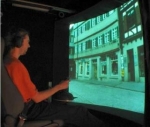 The simulator "exploits a vection illusion of the brain, which makes us believe we are moving when actually we are stationary. The same can be experienced, for instance, when you are stopped at a traffic light in your car and the car next to you edges forward. Your brain interprets this peripheral visual information as though you are moving backwards".
More information about the scientific background of this approach can be found in the paper entitled "Influence of Auditory Cues on the Visually Induced Self-Motion Illusion (Circular Vection) in Virtual Reality" (PDF format, 9 pages, 1.22 MB).
The VR system is the main outcome of the EU-funded project POEMS "Perceptually Oriented Ego — Motion Simulation".
10:41 Posted in Virtual worlds | Permalink | Comments (0) | Tags: Positive Technology
Apr 17, 2006
PhD in Computing/Virtual Reality & Neuroscience - Bournemouth, UK
Applicants must have (or expect to receive) a good honours degree or equivalent in computer science or related discipline and demonstrate:
* An excellent understanding of Human-Computer Interaction
* Strong object oriented design and programming skills
* Strong computer graphics knowledge and experience
Studentships will be funded at £12,500 per year, starting 01/10/2006. Please send applications (including covering letter, CV and two academic referees) to the address below.
Dr Fiona Knight
Graduate School Manager
The Graduate School
Bournemouth University
PG63 Talbot Campus
Fern Barrow, Poole
Dorset BH12 5BB
United Kingdom
Tel: +44 (0)1202 965902
Fax: +44 (0)1202 965069
Email: graduateschool@bournemouth.ac.uk
14:28 Posted in Research institutions & funding opportunities | Permalink | Comments (0) | Tags: Positive Technology