




Mar 19, 2006
Brains are gorgeous at the right magnification
Via Neurofuture
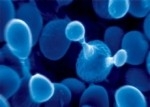
Mark Miller's photographs of the brain show that even neurons can become spectacular pieces of art at the right scale. In particular, this photo (depicting red retrobeads from the pyramidal tract merged with a blue fluoroNisal counterstain)

reminds me of an artpiece of Italian artists Bianco-Valente, whose work focuses on the invisible co-evolution between natural and artificial, between biological and technological networks:
14:05 Posted in Cyberart | Permalink | Comments (0) | Tags: Positive Technology
Mar 18, 2006
Virtual clay
Via Transmaterial

Researchers at Buffalo's Virtual Reality Lab have developed a virtual sculpting system that replicates in real time the physical act of sculpting a block of clay. A special glove records the force exerted by the hand in manipulating and shaping a block of clay. Force-feedback, hand position, and speed of fingertip motion are communicated to a computer, where the virtual clay is shaped precisely to the contouring of the actual clay.
13:16 Posted in Virtual worlds | Permalink | Comments (0) | Tags: Positive Technology
Acclair
[the author of this articke is Régine Debatty, we-make-money-not-art]
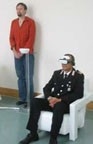 Acclair, by Luther Thie and Eyal Fried, is a security and neuromarketing service that points to Acclairism, a new form of discrimination based on the individual's bio-data and membership in an "acclaired" elite.
The project creates a "social fiction" to explore a situation wherein people willingly accept a highly invasive, highly authoritative manipulation in return for tangible rewards and social status. Acclair is a fictional company providing brain-testing services as part of an accelerated security clearance for air-travelers with its use of Brain Fingerprinting technology (BFP).
Before departure, the Acclair member goes through a one-minute brain test in a relaxing environment. His/her brain output is used for security clearance, and then sold to marketing entities interested in his consumerist personality. According to his brain's market value, the Acclair member is rewarded with Capitality credit points that enable meaningful capital benefits and "Amnesty" credit points that provide legal pardons for applicable past offenses.
Acclairism is an attempt to bring to light some of the conflicts and questions brought about by biometric technologies: What defines us as unique individuals? What defines us as trusted members of society? How much personal information will we willingly give away and under which circumstances?
Part of ISEA 2006, San José, this summer
12:50 Posted in Persuasive technology | Permalink | Comments (0) | Tags: Positive Technology
Mar 17, 2006
Are game designers discarding heads-up displays?
Via Wired
Some game designers are discarding "heads-up displays," trying to create a more immersive environment by providing game data such as a player's health and ammo levels using subtler hints that are truer to life. Big mistake, according to Clive Thompson:
 I let fly with a flurry of jabs, then lean in and deliver a sneaky uppercut. It connects perfectly -- I can hear the moist thwack of my boxing glove on my opponent's cheek. When he staggers back to his corner of the boxing ring, I admire my handiwork: Swollen eyes, drooling crimson -- it's like something Picasso might have painted if he worked with blood. I can tell that one more barrage is gonna win me the round.
And the thing is, I don't need to look at a "health bar" floating over my opponent to see he's nearly vanquished. Indeed, in this Xbox 360 version of Fight Night Round 3 there is no "heads-up display," or HUD, at all. Most action games rely on such an omnipresent overlay, floating on screen and showing how much ammo or health you've got left. But with Fight Night, you just have to pay close attention to the acoustic and visual cues -- the increasingly sluggish attacks of your fighter, the fatigue written on his face...
Continue to read the full article
16:05 Posted in Telepresence & virtual presence | Permalink | Comments (0) | Tags: Positive Technology
20th International Symposium on Human Factors in Telecommunication
13:15 Posted in Positive Technology events | Permalink | Comments (0) | Tags: Positive Technology
Kino 3D

Kino 3D is a forum (in Italian) about open-source computer graphics. It includes several sections:
- Discussion on 2D and 3D computer graphics and open source for any platform;
- OpenLab: Experiments, work in progress, prototypes;
- Tutorial about Blender (the open source, cross platform suite of tools for 3D creation);
- Discussion about video, animations, and 2D/3D videogames;
- Off topics;
- A link to the international Blender forum;
The forum is an useul resource for professionals and people interested in knowing more about the world of open-source computer graphics.
12:25 Posted in Virtual worlds | Permalink | Comments (0) | Tags: Positive Technology
USA Today: computer games and neurofeedback as a treatment
Via Mind Hacks
USA Today has an article about the use of computer games and neurofeedback as a treatment:
A generation raised on video games is inspiring researchers' efforts to unlock the mysteries of a puzzling learning disorder that afflicts millions of school-age children and even some adults.Whether speeding down a virtual street in Sony's Gran Turismo or slaying Spyro the Dragon, researchers hope games such as these will improve the lives of those with attention-deficit hyperactivity disorder, commonly known as ADHD, or cognitive-processing difficulties.
People with these disorders experience "constant frustration," says Henry Owens, a Melbourne, Fla., clinical psychologist who recently began offering a patented video game system, which evolved from NASA technology, to some of his patients.
"If they just play video games on their own, they will zone out," he says. "When they play on this system, if they zone out, the video game doesn't respond any more," acting as an incentive to improve focus and concentration.
10:32 Posted in Biofeedback & neurofeedback | Permalink | Comments (0) | Tags: Positive Technology
Mar 16, 2006
4th Congress on Applications of Virtual Reality (CARVI 2006)

The 4th Congress on Applications of Virtual Reality (CARVI 2006) will be held on 15-16 June in Vitoria-Gasteiz (Spain) and organized by EUVE Technological Center specialised in Virtual Reality, Television, Virtual Engineering and Meteorology. The Conference is aimed at architecture, urban planning, reconstruction of cultural heritage, civil works, engineering, television, advertising, institutions.
Visit the conference web site for more information
23:08 Posted in Virtual worlds | Permalink | Comments (0) | Tags: Positive Technology
Meditation States and Traits
Psychol Bull. 2006 Mar;132(2):180-211
Authors: Cahn BR, Polich J
18:36 Posted in Meditation & brain | Permalink | Comments (0) | Tags: Positive Technology
KOTOHANA
Via Pink Tentacle
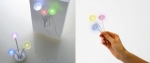
KOTOHANA is a flower-shaped terminal which allows to remotely communicate human emotions using LED light. LEDs change color according to the emotions felt by the remote person. Emotional state of the remote person is inferred by analysing affective correlates of voice; results of the analysis are sent via wireless LAN to the other terminal, where it is expressed as LED light. KOTOHANA is a joint project of NEC, NEC Design and SGI Japan
18:33 Posted in Emotional computing | Permalink | Comments (0) | Tags: Positive Technology
A visual exploration on mapping complex networks
Posted by Luis on Networked Perfomance
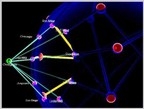
VisualComplexity.com intends to be a unified resource space for anyone interested in the visualization of complex networks. The project's main goal is to leverage a critical understanding of different visualization methods, across a series of disciplines, as diverse as Biology, Social Networks or the World Wide Web.
18:18 Posted in Information visualization | Permalink | Comments (0) | Tags: Positive Technology
1st International Conference on Interactive Mobile and Computer aided Learning
19-21 April 2006, Princess Sumaya University of Technology Amman, Jordan
The conference will provide participants with the newest state of the art on portable devices and their role in university education and potential benefits for learning purposes. Examples of the implementation by laptops, palmtops, mobile phones, PDA, smartphones, WAPs, GPS and a navigational system, WWW-access via Bluetooth, WLAN or GPRS will be presented, accompanied by experimentations to demonstrate their coherence and feasibility.
Early Bird Fee until 31 May 2006. To register and for up-to-date information go here
13:02 | Permalink | Comments (0) | Tags: Positive Technology
Toward a Science of Consciousness 2006
From Charles T. Tart
The program for Toward a Science of Consciousness 2006, April 4-8, 2006, Tucson, Arizona has gone to press.
As usual, The Journal of Consciousness Studies will publish the indexed conference Program/Abstract book which will be available at the conference.
However the 310 accepted abstracts are now available online
Full conference program information is available at the conference website
10:20 Posted in Telepresence & virtual presence | Permalink | Comments (0) | Tags: Positive Technology
Mar 15, 2006
Robot for the Edlerly
Via Gear Factor
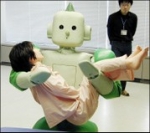
Japanese researchers are developing a robot, RI-MAN, which will provide assistance to the elderly. RI-MAN is 5-foot-tall, and weights 220-pound. A layer of soft silicone allows it to lift patients into its arms. Moreover, built-in sensors detect a person's body position and weight, so the robot can figure out how best to lift them. At the moment, RI-MAN can only carry a 26-pound doll, but could be capable of lifting a 150-pound person within five years.
21:27 Posted in AI & robotics | Permalink | Comments (0) | Tags: Positive Technology
Wrist-mounted PC
 "A European embedded computing specialist has announced a wrist-worn wearable computer that runs embedded Linux or Windows CE. Eurotech's WWPC ("wrist-worn PC") offers a wealth of standard PC interfaces, along with several innovative wearable-specific features, the company claims. It targets emergency rescue, security, healthcare, maintenance, logistics, and "many other" applications."
20:03 Posted in Wearable & mobile | Permalink | Comments (0) | Tags: Positive Technology
Mar 14, 2006
NADA - Networked Performance

NADA affords both the technical novice and expert an unified platform for prototyping physical interfaces and digital content - from handheld product concepts to reactive environments that can be connected across the Internet.
Working models that require less work... NADA is designed for maximum versatility and efficiency. It is a true cross-platform application, and it connects to a variety of commercially available hardware for bringing digital information into and out of standard PC's and Macs. Supported hardware is automatically detected and auto-configured, minimizing complexity for the user. Project authoring with NADA can be done in either Macromedia Flash MX2004 (or later) or Java. Even beginners without programming experience can design and prototype with sensors, actuators, lights, switches and animation using an intuitive graphical environment. Graduate to finer levels of control by developing projects using the NADA API for ActionScript and Java. Below is the look of the NADA interface
20:35 Posted in Research tools | Permalink | Comments (0) | Tags: Positive Technology
Commedia Virtuale: from theatre to avatars
Commedia Virtuale: from theatre to avatars
Digital Creativity Journal, Volume 16, Number 3 / 2005
Ben Salem
We are investigating face, hand and body expressions to be applied to avatars of a virtual environment to improve their communication capabilities and enrich and facilitate their perception by users of the environment. We report on our work based on obtaining inspiration from the world of theatre. In this perspective Commedia dell'Arte and Noh theatre have been the focus of our attention. We explore key features of Commedia dell'Arte, namely improvisation, exaggerated gestures and expressive postures, and investigate how their adoption in the design of avatars can be useful for collaborative virtual environments. With the same objectives we look at another theatre style, the Noh theatre. We investigate the variety of masks and the choreography. The outcome is a visual language for avatars made up of postures, gestures and appearances. We have concluded this investigation with the production of an experimental theatre play involving real and virtual actors.
09:33 Posted in Telepresence & virtual presence | Permalink | Comments (0) | Tags: Positive Technology
Remote-Control Humans
Via the Presence L-Listserv
(From Top Tech News)
By Sixto Ortiz Jr.
March 10, 2006 7:02AM
The possibilities are endless, from fully immersive virtual- reality environments that faithfully reproduce real motion to, perhaps, a way to control unruly crowds without tear gas, rubber bullets, and riot police.
The idea of controlling people by manipulating brain activity long has been a staple of science fiction and dystopian fantasy. Hypnotism, implanted devices, brainwashing, even the Jedi mind trick -- all are methods that have appeared in fictional works as effective ways to subvert the will of human beings.
Today, however, the possibility of being controlled by an outside force is more science than fiction, thanks to researchers at Nippon Telegraph and Telephone in Japan.
A team at NTT's Communication Science Laboratories has invented a headset that can, when linked to a remote control equipped with a pair of joysticks, force the wearer to move against his or her will.
The device originally was designed to add realism to video games and other virtual environments. But while technically impressive, the invention is viewed by some as ethically troubling -- viewed, quite literally, as a new form of mind control. The apparatus has raised questions about the possibilities and perils of a world in which humans can be moved around like chess pieces.
Shock Value
NTT is using a technology called galvanic vestibular stimulation (GVS) to influence the delicate machinery in the inner ear that controls balance and movement in humans.
Subjects slip on the headset, which looks like a pair of bulky headphones, and researchers zap electrical impulses into their ears to control their movements remotely.
"At low currents, GVS selectively activates nerve cells in the peripheral vestibular system (the balance receptors in the inner ear) and such activation results in sensations and movements of the eyes and limbs, just as natural stimulation of balance receptors results in such movements," said Dr. Ian Curthoys, professor of vestibular function at the University of Sydney's Vestibular Research Laboratory.
In other words, GVS artificially induces the same natural sensations caused whenever the inner ear's balancing mechanism is stimulated with real movement. For example, Curthoys said, a subject undergoing this type of stimulation could feel like she is turning even though she is sitting still. The technology could be used both to trick a person into "feeling" motion and to move in a predetermined direction.
The possibilities are endless, from fully immersive virtual- reality environments that faithfully reproduce real motion to, perhaps, a way to control unruly crowds without tear gas, rubber bullets, and riot police.
Read the full article
09:24 Posted in Persuasive technology | Permalink | Comments (0) | Tags: Positive Technology
Two vacancies for Neural Scientists at University of Twente
PhD student (4 years)
What we expect:
What we offer:
We offer a full-time position with a maximum duration of 4 years. The gross salary for the PhD student will range from € 1877 in the first year to € 2407 per month in the fourth year, according to the Collective Labour Agreement for Dutch Universities. Salary will be supplemented by EU-mobility allowances. Candidates can not be Dutch citizens.
Postdoc (1 year, with possibility for extension to 2 or 4 years)
What we expect:
PhD diploma (not older than 6 years) in biophysics/neuroscience/neural networks/statistics or BME. Strong expertise in neuro-informatic modeling.
What we offer:
Information and application
For information about this position you may contact : Prof. dr. Wim L.C. Rutten, professor of Neurotechnology.
Tel: +31 53 4892761 or 4892760
e-mail: w.l.c.rutten@utwente.nl
09:20 Posted in Research institutions & funding opportunities | Permalink | Comments (0) | Tags: Positive Technology
Mar 13, 2006
Computational Models of Creativity in the Arts
Call for Participation: This workshop will bring together practitioners and researchers who are involved in the use of computational systems in the fine and performing arts, lite* the application of computational and generative methodologies in the arts and related creative disciplines. However a very broad list of (non-exclusive) descriptors might include:
* the application of computational and generative methodologies
in the arts and related creative disciplines
* computational approaches to creativity, cognition and
aesthetics
* the application of artificial intelligence and artificial life
* the application of evolutionary and adaptive systems
* cultural applications of computing and digital electronics in
general
Funded by the London Centre for Arts and Cultural Enterprise - LCACE - and the University of Sussex.
21:35 Posted in Creativity and computers | Permalink | Comments (0) | Tags: Positive Technology