




Feb 09, 2014
Nick Bostrom: The intelligence explosion hypothesis
Via IEET
Philosopher Nick Bostrom is a Swedish at the University of Oxford known for his work on existential risk and the anthropic principle covered in books such as Global Catastrophic Risks, Anthropic Bias and Human Enhancement. He holds a PhD from the London School of Economics . He is currently the director of both The Future of Humanity Institute and the Programme on the Impacts of Future Technology as part of the Oxford Martin School at Oxford University.
22:31 Posted in Blue sky, Ethics of technology | Permalink | Comments (0)
A high-fidelity virtual environment for the study of paranoia
A high-fidelity virtual environment for the study of paranoia.
Schizophr Res Treatment. 2013;2013:538185
Authors: Broome MR, Zányi E, Hamborg T, Selmanovic E, Czanner S, Birchwood M, Chalmers A, Singh SP
Abstract. Psychotic disorders carry social and economic costs for sufferers and society. Recent evidence highlights the risk posed by urban upbringing and social deprivation in the genesis of paranoia and psychosis. Evidence based psychological interventions are often not offered because of a lack of therapists. Virtual reality (VR) environments have been used to treat mental health problems. VR may be a way of understanding the aetiological processes in psychosis and increasing psychotherapeutic resources for its treatment. We developed a high-fidelity virtual reality scenario of an urban street scene to test the hypothesis that virtual urban exposure is able to generate paranoia to a comparable or greater extent than scenarios using indoor scenes. Participants (n = 32) entered the VR scenario for four minutes, after which time their degree of paranoid ideation was assessed. We demonstrated that the virtual reality scenario was able to elicit paranoia in a nonclinical, healthy group and that an urban scene was more likely to lead to higher levels of paranoia than a virtual indoor environment. We suggest that this study offers evidence to support the role of exposure to factors in the urban environment in the genesis and maintenance of psychotic experiences and symptoms. The realistic high-fidelity street scene scenario may offer a useful tool for therapists.
22:25 Posted in Cybertherapy, Research tools, Virtual worlds | Permalink | Comments (0)
Effects of the addition of transcranial direct current stimulation to virtual reality therapy after stroke: A pilot randomized controlled trial
Effects of the addition of transcranial direct current stimulation to virtual reality therapy after stroke: A pilot randomized controlled trial.
NeuroRehabilitation. 2014 Jan 28;
Authors: Viana RT, Laurentino GE, Souza RJ, Fonseca JB, Silva Filho EM, Dias SN, Teixeira-Salmela LF, Monte-Silva KK
Abstract. BACKGROUND: Upper limb (UL) impairment is the most common disabling deficit following a stroke. Previous studies have suggested that transcranial direct current stimulation (tDCS) enhances the effect of conventional therapies.
OBJECTIVE: This pilot double-blind randomized control trial aimed to determine whether or not tDCS, combined with Wii virtual reality therapy (VRT), would be superior to Wii therapy alone in improving upper limb function and quality of life in chronic stroke individuals.
METHODS: Twenty participants were randomly assigned either to an experimental group that received VRT and tDCS, or a control group that received VRT and sham tDCS. The therapy was delivered over 15 sessions with 13 minutes of active or sham anodal tDCS, and one hour of virtual reality therapy. The outcomes included were determined using the Fugl-Meyer scale, the Wolf motor function test, the modified Ashworth scale (MAS), grip strength, and the stroke specific quality of life scale (SSQOL). Minimal clinically important differences (MCID) were observed when assessing outcome data.
RESULTS: Both groups demonstrated gains in all evaluated areas, except for the SSQOL-UL domain. Differences between groups were only observed in wrist spasticity levels in the experimental group, where more than 50% of the participants achieved the MCID.
CONCLUSIONS: These findings support that tDCS, combined with VRT therapy, should be investigated and clarified further.
22:21 Posted in Brain stimulation, Cybertherapy, Virtual worlds | Permalink | Comments (0)
The importance of synchrony and temporal order of visual and tactile input for illusory limb ownership experiences - an FMRI study applying virtual reality
The importance of synchrony and temporal order of visual and tactile input for illusory limb ownership experiences - an FMRI study applying virtual reality.
PLoS One. 2014;9(1):e87013
Authors: Bekrater-Bodmann R, Foell J, Diers M, Kamping S, Rance M, Kirsch P, Trojan J, Fuchs X, Bach F, Cakmak HK, Maaß H, Flor H
Abstract. In the so-called rubber hand illusion, synchronous visuotactile stimulation of a visible rubber hand together with one's own hidden hand elicits ownership experiences for the artificial limb. Recently, advanced virtual reality setups were developed to induce a virtual hand illusion (VHI). Here, we present functional imaging data from a sample of 25 healthy participants using a new device to induce the VHI in the environment of a magnetic resonance imaging (MRI) system. In order to evaluate the neuronal robustness of the illusion, we varied the degree of synchrony between visual and tactile events in five steps: in two conditions, the tactile stimulation was applied prior to visual stimulation (asynchrony of -300 ms or -600 ms), whereas in another two conditions, the tactile stimulation was applied after visual stimulation (asynchrony of +300 ms or +600 ms). In the fifth condition, tactile and visual stimulation was applied synchronously. On a subjective level, the VHI was successfully induced by synchronous visuotactile stimulation. Asynchronies between visual and tactile input of ±300 ms did not significantly diminish the vividness of illusion, whereas asynchronies of ±600 ms did. The temporal order of visual and tactile stimulation had no effect on VHI vividness. Conjunction analyses of functional MRI data across all conditions revealed significant activation in bilateral ventral premotor cortex (PMv). Further characteristic activation patterns included bilateral activity in the motion-sensitive medial superior temporal area as well as in the bilateral Rolandic operculum, suggesting their involvement in the processing of bodily awareness through the integration of visual and tactile events. A comparison of the VHI-inducing conditions with asynchronous control conditions of ±600 ms yielded significant PMv activity only contralateral to the stimulation site. These results underline the temporal limits of the induction of limb ownership related to multisensory body-related input.
22:16 Posted in Telepresence & virtual presence, Virtual worlds | Permalink | Comments (0)
Bodily maps of emotions
Via KurzweilAI.net
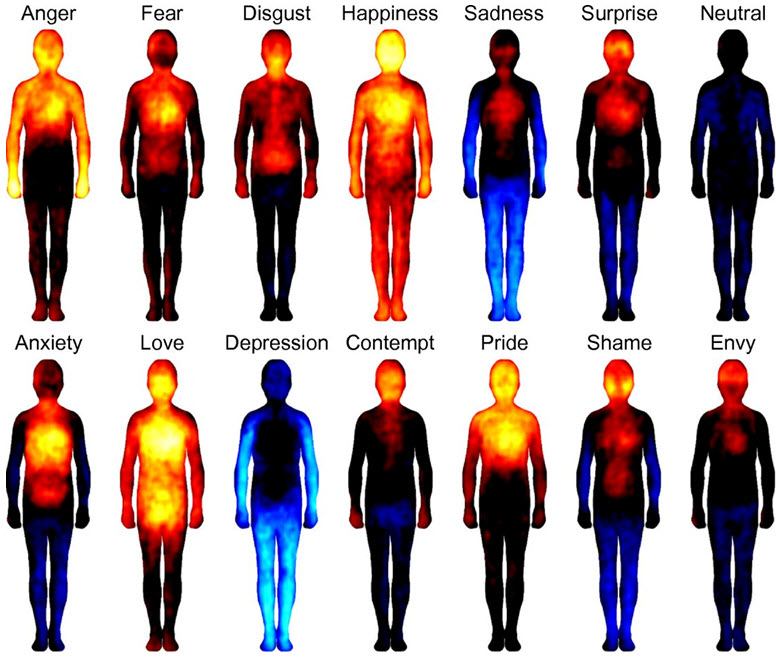
Bodily topography of basic (Upper) and nonbasic (Lower) emotions associated with words. The body maps show regions whose activation increased (warm colors) or decreased (cool colors) when feeling each emotion. (Credit: Lauri Nummenmaa et al./PNAS)
Researchers at Aalto University in Finland have compiled maps of emotional feelings associated with culturally universal bodily sensations, which could be at the core of emotional experience.
The researchers found that the most common emotions trigger strong bodily sensations, and the bodily maps of these sensations were topographically different for different emotions. The sensation patterns were, however, consistent across different West European and East Asian cultures, highlighting that emotions and their corresponding bodily sensation patterns have a biological basis.
The research was carried out on line, and over 700 individuals from Finland, Sweden and Taiwan took part in the study. The researchers induced different emotional states in their Finnish and Taiwanese participants. Subsequently the participants were shown pictures of human bodies on a computer, and asked to color the bodily regions whose activity they felt increasing or decreasing.
“Unraveling the subjective bodily sensations associated with human emotions may help us to better understand mood disorders such as depression and anxiety, which are accompanied by altered emotional processing, autonomic nervous system activity, and somatosensation (body sensations),” the researchers said in an open-access paper in Proceedings of the National Academy of Sciences. “These topographical changes in emotion-triggered sensations in the body could provide a novel biomarker for emotional disorders.”
Abstract of PNAS paper
Emotions are often felt in the body, and somatosensory feedback has been proposed to trigger conscious emotional experiences. Here we reveal maps of bodily sensations associated with different emotions using a unique topographical self-report method. In five experiments, participants (n = 701) were shown two silhouettes of bodies alongside emotional words, stories, movies, or facial expressions. They were asked to color the bodily regions whose activity they felt increasing or decreasing while viewing each stimulus. Different emotions were consistently associated with statistically separable bodily sensation maps across experiments. These maps were concordant across West European and East Asian samples. Statistical classifiers distinguished emotion-specific activation maps accurately, confirming independence of topographies across emotions. We propose that emotions are represented in the somatosensory system as culturally universal categorical somatotopic maps. Perception of these emotion-triggered bodily changes may play a key role in generating consciously felt emotions.
21:57 Posted in Emotional computing, Research tools | Permalink | Comments (0)
Feb 08, 2014
An Inuit/Eskimo family in the Arctic 1959
The barren life of an Inuit family and their children in Iqaluit, Nunavut, Arctic Canada more than fifty years ago.
Why do I blog this? Just because I liked it.
21:33 Posted in Cyberart | Permalink | Comments (0)