




Feb 02, 2014
Activation of the human mirror neuron system during the observation of the manipulation of virtual tools in the absence of a visible effector limb
Activation of the human mirror neuron system during the observation of the manipulation of virtual tools in the absence of a visible effector limb.
Neurosci Lett. 2013 Oct 25;555:220-4
Authors: Modroño C, Navarrete G, Rodríguez-Hernández AF, González-Mora JL
Abstract. This work explores the mirror neuron system activity produced by the observation of virtual tool manipulations in the absence of a visible effector limb. Functional MRI data was obtained from healthy right-handed participants who manipulated a virtual paddle in the context of a digital game and watched replays of their actions. The results show how action observation produced extended bilateral activations in the parietofrontal mirror neuron system. At the same time, three regions in the left hemisphere (in the primary motor and the primary somatosensory cortex, the supplementary motor area and the dorsolateral prefrontal cortex) showed a reduced BOLD, possibly related with the prevention of inappropriate motor execution. These results can be of interest for researchers and developers working in the field of action observation neurorehabilitation.
20:07 Posted in Telepresence & virtual presence, Virtual worlds | Permalink | Comments (0)
Effect of Meditation on Cognitive Functions in Context of Aging and Neurodegenerative Diseases
Effect of Meditation on Cognitive Functions in Context of Aging and Neurodegenerative Diseases.
Front Behav Neurosci. 2014;8:17
Authors: Marciniak R, Sheardova K, Cermáková P, Hudeček D, Sumec R, Hort J
Abstract. Effect of different meditation practices on various aspects of mental and physical health is receiving growing attention. The present paper reviews evidence on the effects of several mediation practices on cognitive functions in the context of aging and neurodegenerative diseases. The effect of meditation in this area is still poorly explored. Seven studies were detected through the databases search, which explores the effect of meditation on attention, memory, executive functions, and other miscellaneous measures of cognition in a sample of older people and people suffering from neurodegenerative diseases. Overall, reviewed studies suggested a positive effect of meditation techniques, particularly in the area of attention, as well as memory, verbal fluency, and cognitive flexibility. These findings are discussed in the context of MRI studies suggesting structural correlates of the effects. Meditation can be a potentially suitable non-pharmacological intervention aimed at the prevention of cognitive decline in the elderly. However, the conclusions of these studies are limited by their methodological flaws and differences of various types of meditation techniques. Further research in this direction could help to verify the validity of the findings and clarify the problematic aspects.
19:53 Posted in Meditation & brain, Research tools | Permalink | Comments (0)
A low-cost sonification system to assist the blind
Via KurzweilAI.net
An improved assistive technology system for the blind that uses sonification (visualization using sounds) has been developed by Universidad Carlos III de Madrid (UC3M) researchers, with the goal of replacing costly, bulky current systems.
Called Assistive Technology for Autonomous Displacement (ATAD), the system includes a stereo vision processor measures the difference of images captured by two cameras that are placed slightly apart (for image depth data) and calculates the distance to each point in the scene.
Then it transmits the information to the user by means of a sound code that gives information regarding the position and distance to the different obstacles, using a small audio stereo amplifier and bone-conduction headphones.
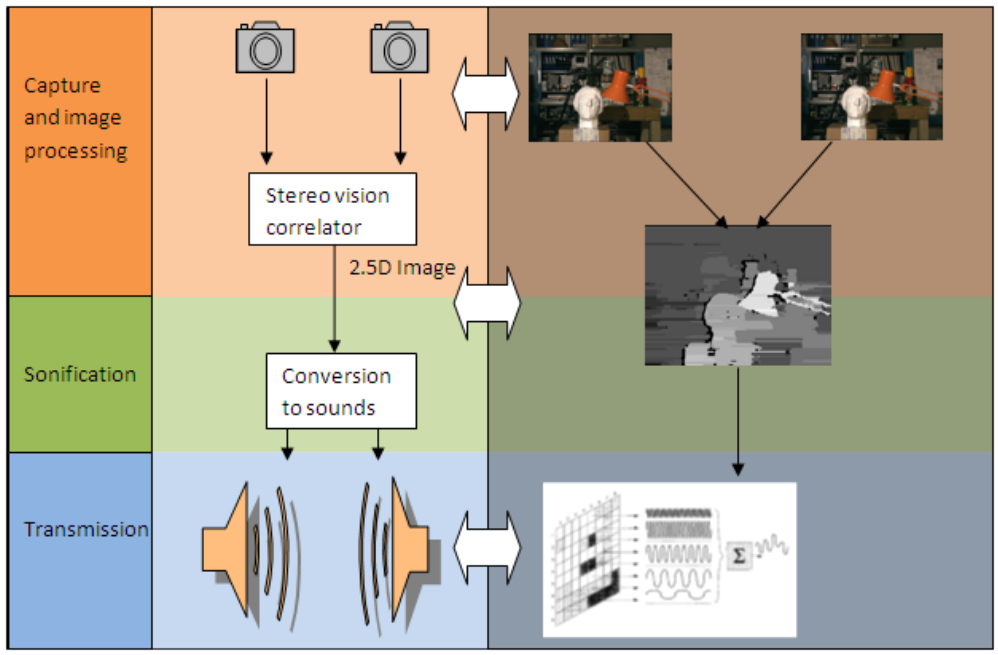
Assistive Technology for Autonomous Displacement (ATAD) block diagram (credit: P. Revuelta Sanz et al.)
19:48 Posted in Neurotechnology & neuroinformatics, Wearable & mobile | Permalink | Comments (0)