




Dec 08, 2013
Real-Time fMRI Pattern Decoding and Neurofeedback Using FRIEND: An FSL-Integrated BCI Toolbox
Real-Time fMRI Pattern Decoding and Neurofeedback Using FRIEND: An FSL-Integrated BCI Toolbox.
PLoS One. 2013;8(12):e81658
Authors: Sato JR, Basilio R, Paiva FF, Garrido GJ, Bramati IE, Bado P, Tovar-Moll F, Zahn R, Moll J
Abstract. The demonstration that humans can learn to modulate their own brain activity based on feedback of neurophysiological signals opened up exciting opportunities for fundamental and applied neuroscience. Although EEG-based neurofeedback has been long employed both in experimental and clinical investigation, functional MRI (fMRI)-based neurofeedback emerged as a promising method, given its superior spatial resolution and ability to gauge deep cortical and subcortical brain regions. In combination with improved computational approaches, such as pattern recognition analysis (e.g., Support Vector Machines, SVM), fMRI neurofeedback and brain decoding represent key innovations in the field of neuromodulation and functional plasticity. Expansion in this field and its applications critically depend on the existence of freely available, integrated and user-friendly tools for the neuroimaging research community. Here, we introduce FRIEND, a graphic-oriented user-friendly interface package for fMRI neurofeedback and real-time multivoxel pattern decoding. The package integrates routines for image preprocessing in real-time, ROI-based feedback (single-ROI BOLD level and functional connectivity) and brain decoding-based feedback using SVM. FRIEND delivers an intuitive graphic interface with flexible processing pipelines involving optimized procedures embedding widely validated packages, such as FSL and libSVM. In addition, a user-defined visual neurofeedback module allows users to easily design and run fMRI neurofeedback experiments using ROI-based or multivariate classification approaches. FRIEND is open-source and free for non-commercial use. Processing tutorials and extensive documentation are available.
23:39 Posted in Biofeedback & neurofeedback, Neurotechnology & neuroinformatics | Permalink | Comments (0)
iMirror
Take back your mornings with the iMirror – the interactive mirror for your home. Watch the video for a live demo!
23:26 Posted in Augmented/mixed reality, Future interfaces | Permalink | Comments (0)
How to use mind-controlled robots in manufacturing, medicine
via KurzweilAI
University at Buffalo researchers are developing brain-computer interface (BCI) devices to mentally control robots.
“The technology has practical applications that we’re only beginning to explore,” said Thenkurussi “Kesh” Kesavadas, PhD, UB professor of mechanical and aerospace engineering and director of UB’s Virtual Reality Laboratory. “For example, it could help paraplegic patients to control assistive devices, or it could help factory workers perform advanced manufacturing tasks.”
Most BCI research has involved expensive, invasive BCI devices that are inserted into the brain, and used mostly to help disabled people.
UB research relies on a relatively inexpensive ($750), non-invasive external device (Emotiv EPOC). It reads EEG brain activity with 14 sensors and transmits the signal wirelessly to a computer, which then sends signals to the robot to control its movements.
Kesavadas recently demonstrated the technology with Pramod Chembrammel, a doctoral student in his lab. Chembrammel trained with the instrument for a few days, then used the device to control a robotic arm.
He used the arm to insert a wood peg into a hole and rotate the peg. “It was incredible to see the robot respond to my thoughts,” Chembrammel said. “It wasn’t even that difficult to learn how to use the device.”
The video (below) shows that a simple set of instructions can be combined to execute more complex robotic actions, Kesavadas said. Such robots could be used by factory workers to perform hands-free assembly of products, or carry out tasks like drilling or welding.
The potential advantage, Kesavadas said, is that BCI-controlled devices could reduce the tedium of performing repetitious tasks and improve worker safety and productivity. The devices can also leverage the worker’s decision-making skills, such as identifying a faulty part in an automated assembly line.
23:10 Posted in AI & robotics, Brain-computer interface | Permalink | Comments (0)
Dec 02, 2013
Meaning in life: An important factor for the psychological well-being of chronically ill patients?
Rehabilitation Psychology - Vol 55, Iss 3
Dezutter, Jessie; Casalin, Sara; Wachholtz, Amy; Luyckx, Koen; Hekking, Jessica; Vandewiele, Wim
Purpose: This study aimed to investigate 2 dimensions of meaning in life—Presence of Meaning (i.e., the perception of your life as significant, purposeful, and valuable) and Search for Meaning (i.e., the strength, intensity, and activity of people’s efforts to establish or increase their understanding of the meaning in their lives)—and their role for the well-being of chronically ill patients. Research design: A sample of 481 chronically ill patients (M = 50 years, SD = 7.26) completed measures on meaning in life, life satisfaction, optimism, and acceptance. We hypothesized that Presence of Meaning and Search for Meaning will have specific relations with all 3 aspects of well-being. Results: Cluster analysis was used to examine meaning in life profiles. Results supported 4 distinguishable profiles (High Presence High Search, Low Presence High Search, High Presence Low Search, and Low Presence Low Search) with specific patterns in relation to well-being and acceptance. Specifically, the 2 profiles in which meaning is present showed higher levels of well-being and acceptance, whereas the profiles in which meaning is absent are characterized by lower levels. Furthermore, the results provided some clarification on the nature of the Search for Meaning process by distinguishing between adaptive (the High Presence High Search cluster) and maladaptive (the Low Presence High Search cluster) searching for meaning in life. Conclusions: The present study provides an initial glimpse in how meaning in life may be related to the well-being of chronically ill patients and the acceptance of their condition. Clinical implications are discussed. (PsycINFO Database Record (c) 2013 APA, all rights reserved)
23:37 Posted in Technology & spirituality | Permalink | Comments (0)
A genetically engineered weight-loss implant
Via KurzweilAI
ETH-Zurich biotechnologists have constructed an implantable genetic regulatory circuit that monitors blood-fat levels. In response to excessive levels, it produces a messenger substance that signals satiety (fullness) to the body. Tests on obese mice revealed that this helps them lose weight.
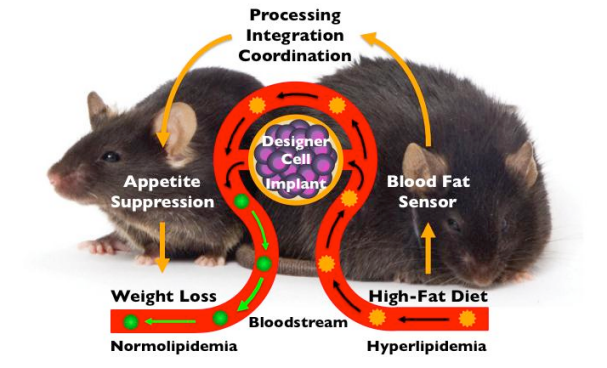
Genetically modified cells implanted in the body monitor the blood-fat level. If it is too high, they produce a satiety hormone. The animal stops eating and loses weight. (Credit: Martin Fussenegger / ETH Zurich / Jackson Lab)
23:25 Posted in Neurotechnology & neuroinformatics, Physiological Computing | Permalink | Comments (0)