




Aug 27, 2010
The Experiment-Driven Life
A great presentation by Mattew Cornell about the concept of self-tracking and the implications of this emerging research field for people's wellbeing.
18:21 Posted in Self-Tracking | Permalink | Comments (0) | Tags: self tracking, life logging, quantified self
Augmented City
Keiichi Matsuda did it again. After the success of Domestic Robocop, the architecture graduate and filmaker got the nomination for the Royal Institute of British Architects (RIBA) Silver Medal award, for his new video "Augmented City". As in his previous work, in this new video Matsuda describes a future world overlaid with digital information, whose built environment can be manipulated by the individual. In this way, the objective physical world is transformed in a subjective virtual space.
In Matsuda's own words:
Augmented City explores the social and spatial implications of an AR-supported future. 'Users' of the city can browse through channels of the augmented city, creating aggregated customised environments. Identity is constructed and broadcast, while local records and coupons litter the streets. The augmented city is an architectural construct modulated by the user, a liquid city of stratified layers that perceptually exists in the space between the self and the built environment. This subjective space allows us to re-evaluate current trends, and examine our future occupation of the augmented city.
TO CHANGE FROM SPLIT SCREEN TO 3D/2D, CLICK THE '3D' TAB AT THE BOTTOM OF YOUR VIEWER
18:04 Posted in Augmented/mixed reality | Permalink | Comments (0) | Tags: augmented reality, kelichi matsuda
Aug 26, 2010
Heart Chamber Orchestra
The Heart Chamber Orchestra consists of classical musicians who use their heartbeats to control a computer composition and visualization environment. To my best knowledge, this is the first example of "group biofeedback".
The musicians are equipped with ECG (electrocardiogram) sensors. A computer monitors and analyzes the state of these 12 hearts in real time. The acquired information is used to compose a musical score with the aid of computer software. It is a living score dependent on the state of the hearts.
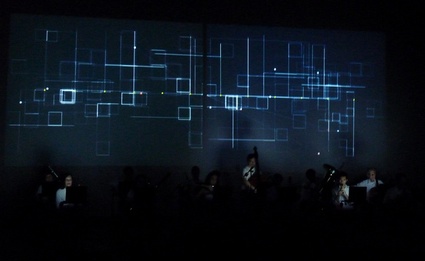
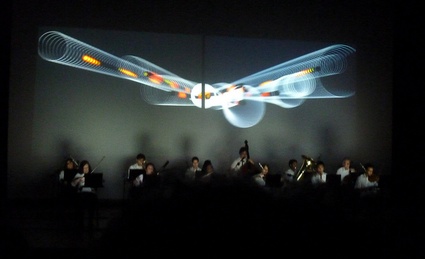
While the musicians are playing, their heartbeats influence and change the composition and vice versa. The musicians and the electronic composition are linked via the hearts in a circular motion, a feedback structure. The emerging music evolves entirely during the performance.
The resulting music is the expression of this process and of an organism forming itself from the circular interplay of the individual musicians and the machine.
The sensor network consists of 12 individual sensors; each one is fitted onto the body of a musician. A computer receives the heartbeat data. Software analyzes the data and generates via different algorithms the real-time musical score for the musicians, the electronic sounds and the computer graphic visualization
Below is a video documentation from the Heart Chamber Orchestra performance on the 28th of March 2010 at Kiasma Theatre at Pixelache Festival in Helsinki, Finland.
20:02 Posted in Biofeedback & neurofeedback, Creativity and computers, Cyberart | Permalink | Comments (0) | Tags: biofeedback, heart chamber orchestra, creativity
Aug 24, 2010
Vicon Revue makes lifelogging a reality
Vicon Revue is a wearable digital camera that allows to take photographs automatically, while it is being worn. In this way, the user can keep a photo log of his/her day to day life. The camera is the commercial evolution of SenseCam, a project developed by Microsoft Research in Cambridge, UK. Vicon Revue is sold to researchers for about $700, but the consumer version (expected for next year) could be significantly cheaper.

The camera is equipped with a wide-angle lens that provides a fish-eye view and contains several sensors, such as a temperature sensor, a light color and intensity sensor, an infra-red motion detector, a multi-axis accelerometer, and a 3-axis magnetometer (compass). The size of the camera is reasonably small (6.5cm w x 7cm h x 1.7cm d; 94g weight) and it includes 2GB memory.
To get an idea of the quality of the output you can take a look at this time lapse video showing images taken over the course of 24 hours with Vicon Revue.
19:04 | Permalink | Comments (0) | Tags: lifelogging, self tracking, vicon revue, lifebits
Short-term meditation induces white matter changes in the anterior cingulate
Short-term meditation induces white matter changes in the anterior cingulate.
Proc Natl Acad Sci U S A. 2010 Aug 16;
Authors: Tang YY, Lu Q, Geng X, Stein EA, Yang Y, Posner MI
The anterior cingulate cortex (ACC) is part of a network implicated in the development of self-regulation and whose connectivity changes dramatically in development. In previous studies we showed that 3 h of mental training, based on traditional Chinese medicine (integrative body-mind training, IBMT), increases ACC activity and improves self-regulation. However, it is not known whether changes in white matter connectivity can result from small amounts of mental training. We here report that 11 h of IBMT increases fractional anisotropy (FA), an index indicating the integrity and efficiency of white matter in the corona radiata, an important white-matter tract connecting the ACC to other structures. Thus IBMT could provide a means for improving self-regulation and perhaps reducing or preventing various mental disorders.
18:10 Posted in Meditation & brain | Permalink | Comments (0) | Tags: meditation, mindfulness, brain
LHC rap
The Large Hadron Collider, the world's largest and highest-energy particle accelerator, promises to revolutionize our knowledge of the universe and advance our understanding of the most fundamental laws of nature.
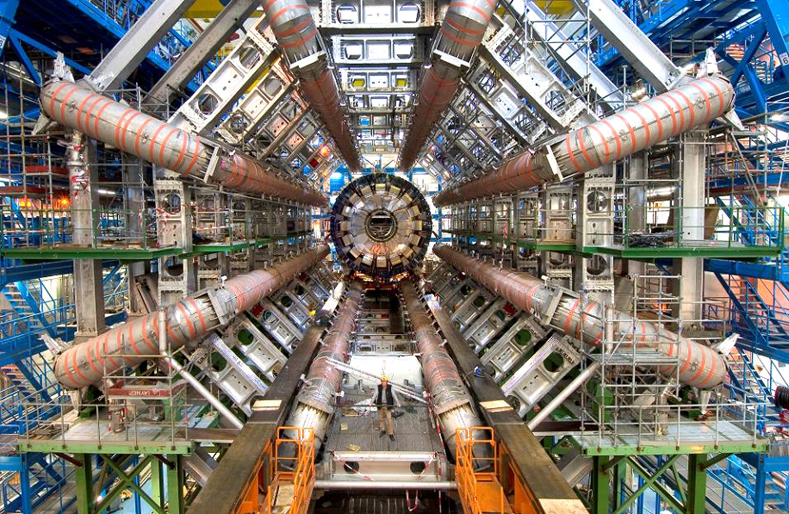
But if you are not very good at quantum physics, do not worry: you can still get an explanation in RAP format of what the LHC is all about.
A 'sound' explanation, indeed!
17:47 Posted in Research tools | Permalink | Comments (0) | Tags: large hadron collider, rap, research tool