




Mar 26, 2008
Towards Partecipative Ecology: the OpenSpime project
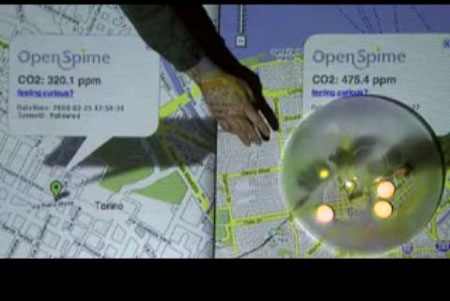
OpenSpime is a project of a pervasive technology infrastructure that allows individuals and corporations to better understand their environment, through the use of a series of GPS-enabled sensors.
A brainchild of Leandro Agrò, Roberto Ostinelli and David Orban, OpenSpime was inspired by Bruce Sterling's vision of "Internet of Things". Sterling describes a new type of technological device called "spime", a physical object that is part of the internet as it becomes trackable in space and time, through pervasive RFID communications and GPS navigation.
In this sense, OpenSpime platform represents one of the first concrete attempt to turn Internet of Things into reality.The first spime they've designed is a sensor that can measure the CO2 level in parts-per-million in the surrounding air, and through a wireless connection can send that information back to the OpenSpime servers. There they can be mashed up and aggregated on Google Maps.
check it out the concept video:
15:45 Posted in Information visualization | Permalink | Comments (0)
Cognitive processing and motor skill learning in motor-handicapped teenagers
Cognitive processing and motor skill learning in motor-handicapped teenagers: effects of learning method.
Somatosens Mot Res. 2007 Dec;24(4):163-9
Authors: Deviterne D, Gauchard GC, Lavisse D, Perrin PP
15:14 Posted in Mental practice & mental simulation | Permalink | Comments (0) | Tags: mental simulation
Assessing human reorientation ability inside virtual reality environments
Assessing human reorientation ability inside virtual reality environments: the effects of retention interval and landmark characteristics.
Cogn Process. 2008 Mar 20;
Authors: Bosco A, Picucci L, Caffò AO, Lancioni GE, Gyselinck V
The purpose of the present study was to assess the navigational behaviour of adult humans following a disorientation procedure that perturbed their egocentric frame of reference. The assessment was carried out in a virtual reality (VR) environment by manipulating the disorientation procedure, the retention interval, the relative positions of target and landmark. The results of experiment I demonstrated that adding a physical rotation to a virtual disorientation procedure did not yield an additional decrease in searching performance. The results of experiment II showed that shortening the delay between study and test phase decreased the errors more markedly for geometric than landmark ones. An orientation specificity effect due to the manipulation of the relative position between target and landmark was discussed across the experiments. In conclusion, VR seemed to be a valuable method for studying human reorientation. Moreover, the virtual experimental setting involved here promoted knowledge of the relationship between working memory and spatial reorientation paradigm.
12:16 Posted in Virtual worlds | Permalink | Comments (0) | Tags: virtual reality